With Columbia's green-lighting of Behold a Pale Horse (1964), director Fred Zinnemann got to indulge a long-harbored fascination with the Spanish Civil War and a belief that the need for a film on the subject seemed important. The end result was a stark and effectively moody drama that didn't garner the box-office results that the studio hoped, but stands as a compelling look at the deep-rooted obsessions and hatreds that societal conflicts can stoke on a grand scale.
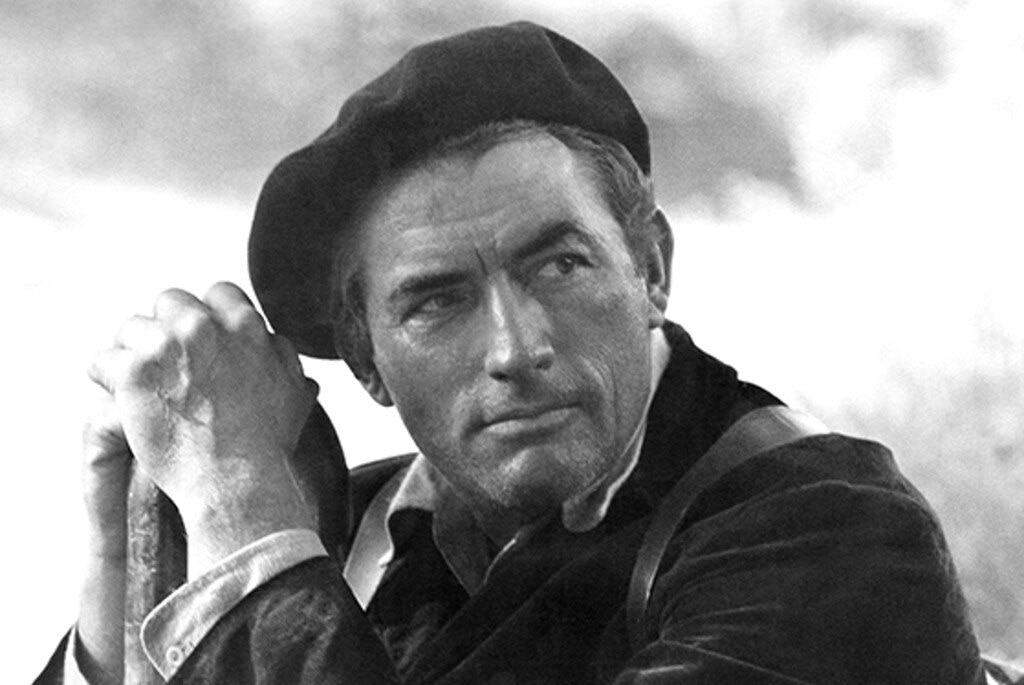
Zinnemann's source material, adapted for the screen by J.P. Miller, was a novella by British filmmaker Emeric Pressburger entitled Killing a Mouse on Sunday. The book was based on a real-life Loyalist guerrilla who kept making sorties over the French border for years after Franco's triumph in 1939, and the film opens twenty years afterward, with the protagonist, Manuel Artiguez (Gregory Peck), seemingly resigned to bitter exile in the Gallic village of Pau. The once-daring fighter has remained a subject of Ahab-like fixation for Capt. Vinolas (Anthony Quinn), the police chief of Artiguez' hometown. The prideful policeman is himself looking at the end of a career that he'll regard as a failure without bringing Artiguez to heel.
Vinolas' obsession has in turn fed the vengeful desires of ten-year-old Paco Degas (Marietto Angeletti), whose father, a onetime resistance fighter, was beaten to death by the police in the false hope that he'd give up Artiguez' whereabouts. The youngster actually completes a treacherous journey into Pau to beg Artiguez to deliver vengeance, and gets callously rebuffed.
However, with Artiguez's mother Pilar (Mildred Dunnock) dying in the local hospital, Vinolas has irresistible bait for a trap, and dispatches the informant Carlos (Raymond Pellegrin) to ply Artiguez with the news. Pilar, knowing she's got mere hours remaining, begs Father Francisco (Omar Sharif), the young priest administering her last rites, to warn her son against visiting. After much agonizing between duty to country and duty to God, Francisco determines to make a covert side trip to Pau while on a pilgrimage to Lourdes. The priest, as a confidant of Vinolas, knows of Carlos' mission, and their hairsbreadth crossing of paths, as well as Artiguez' fateful response when the truth comes out, take the tale to its conclusion.
In his 1992 autobiography A Life in the Movies, Zinnemann recalled how Quinn had initially lobbied for the role of Artiguez, but the director felt that his casting as the protagonist "could make the film seem literal and predictable. It seemed that we needed someone who could be deceptively gentle, yet capable of ice-cold ferocity. No wonder I was thrilled to hear of Gregory Peck's interest in playing that sort of desperate character. Turning in a riveting performance, he succeeded in hiding the warmth and gentleness that are so much a part of his nature."
Zinnemann was aware that mounting the project with the Franco regime still in power was a dicey prospect, and all the location filming took place, not surprisingly, in the French Basque region. As the director recounted in notes taken during the filming, "[t]he silence was soon disturbed by the far whining of a plane coming from the direction of Spain. As it got closer, we saw that it was a military plane, hovering over us for a while, circling several times, while our crew stood nervously peering into the sky. Then it disappeared as suddenly as it came and our crew heaved a sigh of relief..."
The director noted that governmental ire at the production ultimately spurred Columbia's divestiture of its Spanish distribution business. "Unofficially, they were quite relieved, as they could make more money selling each picture outright from then on," Zinnemann asserted. "They even made a profit from the sale of its facilities."
As recounted in John Griggs' The Films of Gregory Peck (1984), the actor spoke of his discomfiture from the mild enthusiasm displayed by the crowd at Behold a Pale Horse's New York premiere. "Let's say I sweated through every frame... Zinnemann and I did realize that the background and the Spanish character would be a bit obscure for Americans. And since the film is so understated, I was always a little bit doubtful about how it would go over here."
In his autobiography, Zinnemann would later comment that when Behold a Pale Horse "was finished the film seemed quite exciting with its haunting music and stylish photography. [Mike] Frankovich and other Columbia executives had great hopes for it and launched it well. Unfortunately it fell below our expectations...Still, the movie does not seem to have aged, perhaps because the issues continue to be very much alive."
Producer: Fred Zinnemann (uncredited)
Director: Fred Zinnemann
Screenplay: J.P. Miller; Emeric Pressburger (novel)
Cinematography: Jean Badal
Art Direction: Auguste Capelier
Music: Maurice Jarre
Film Editing: Walter Thompson
Cast: Gregory Peck (Manuel Artiguez), Anthony Quinn (Vinolas), Omar Sharif (Francisco), Raymond Pellegrin (Carlos), Paolo Stoppa (Pedro), Mildred Dunnock (Pilar), Daniela Rocca (Rosana, Mistress of Vinolas), Christian Marquand (Zaganar), Marietto Angeletti (Paco Dages), Perette Pradier (Maria, Hussy), Zia Mohyeddin (Luis, Guide of Paco), Rosalie Crutchley (Teresa, Wife of Vinolas), Molly Urquhart (Hospital Nurse), Jean-Paul Moulinot (Father Estiban), Laurence Badie (Celestina).
BW-122m. Letterboxed.
by Jay S. Steinberg
Behold a Pale Horse
by Jay S. Steinberg | March 18, 2009
SIGN UP FOR OUR NEWSLETTERS

CONNECT WITH TCM