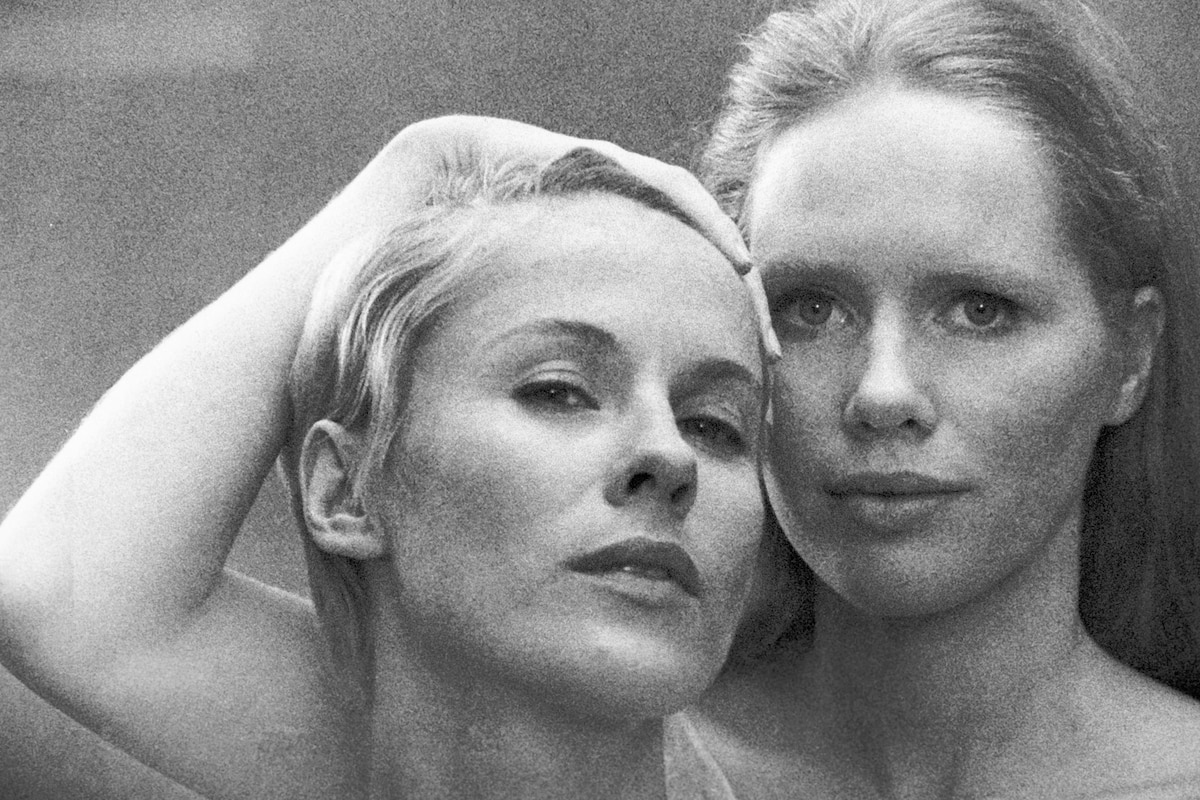
One of Ingmar Bergman's most complex films, Persona (1966) on the surface appears simple and accessible. Bergman called it "a sonata for two instruments." It begins with film leader being projected, then comic bits from silent film, followed by more disturbing images: a spider, a nail driven through a hand, corpses in a morgue. The final images leading into the film's story are of one woman's face turning into another's. Liv Ullmann plays Elisabeth, an actress who has stopped speaking in the middle of a performance. Her doctor sends her to a remote seaside cottage, where she's cared for by a loquacious nurse, Alma (Bibi Andersson). Gradually, the two women, who resemble each other physically, begin to assume each other's identities. The title, a Latin word, refers both to the masks worn by actors in classical drama, and to a term used by psychologist Carl Jung to describe an artificial personality used to hide the real self. Persona has been much discussed and interpreted since its release, but Bergman himself refused to elucidate, writing in the preface to the published screenplay, "On many points I am unsure, and in one instance, at least, I know nothing."
In 1965, Bergman was an internationally acclaimed director of such films as The Seventh Seal (1957) And Wild Strawberries (1957). He was preparing to shoot a new film, The Cannibals, when he became ill. What had started as a cold turned into pneumonia complicated by an ear infection, and antibiotic poisoning. Bergman spent months in the hospital and The Cannibals was cancelled. Lying in a hospital bed for weeks, unable to work, Bergman got the idea for Persona. In interviews, he's given conflicting accounts of which image came to him first. "I was lying there, half dead, and suddenly I started to think of two faces, two intermingled faces, and that was the beginning, the place where it started." In an alternate interview he gave this version: "One day I suddenly saw in front of me two women sitting next to each other and comparing hands with one another. I thought to myself that one of them is mute and the other speaks."
Persona was the first Bergman film for the Norwegian actress Liv Ullmann, and the start of a long personal and professional relationship. Ullmann had met Bibi Andersson in 1962, when they appeared together in a Norwegian-Swedish co-production, Pan, and the two women had become friends. Andersson, a Bergman regular since she appeared in Smiles of a Summer Night (1955), recommended Ullmann to Bergman, and introduced the two when Ullmann went to Sweden with a theatrical company. Bergman had seen a photograph of the two women together, and was struck by their resemblance. He cast them in the leading roles in Persona.
Still feeling the effects of his illness, Bergman began shooting Persona in a Stockholm studio. It did not go well at first. Ullmann was nervous, and Bergman wasn't getting what he wanted. Then they went on location to the island of Fårö, which Bergman had discovered and fallen in love with while making Through a Glass Darkly (1961) in 1960. Suddenly, everything clicked, and Bergman decided to reshoot most of the unsatisfactory footage they'd shot in the studio. Bergman and Ullmann fell in love, beginning a relationship that resulted in the birth of a daughter. Although their romantic relationship ended after four years, they remained close for the rest of Bergman's life. Ullmann appeared in ten of Bergman's films, and she directed a 2000 film, Faithless, from his original screenplay. Bergman would build a home on Fårö to which he retreated between projects for the rest of his life. He died there in 2007.
American critics were respectful, but perplexed by Persona. Variety, always with an eye toward the box office, noted, "Bergman has come up with probably one of his most masterful films technically and in conception, but also one of his most difficult ones....It appears mainly for special usage and arty spots abroad." Bosley Crowther of the New York Times called it a "lovely, moody film which, for all its intense emotionalism, makes some tough intellectual demands....At the end, which is inconclusive, the film goes back into the projection machine, and we are left with the haunting wonder: Was this something that happened, or a dream?" Roger Ebert, then a novice reviewer, later admitted he didn't understand it. Revisiting the film more than 30 years later, he still didn't, but it didn't matter. "Persona is a film we return to over the years, for the beauty of its images and because we hope to understand its mysteries. It is apparently not a difficult film: Everything that happens is perfectly clear, and even the dream sequences are clear--as dreams. But it suggests buried truths, and we despair of finding them." A 1972 poll in the British film journal Sight and Sound chose Persona as one of the top ten films ever made.
Director: Ingmar Bergman
Producer: Ingmar Bergman
Screenplay: Ingmar Bergman
Cinematography: Sven Nykvist
Editor: Ulla Ryghe
Costume Design: Mago
Art Direction: Bibi Lindstrom
Music: Lars Johan Werle
Principal Cast: Bibi Andersson (Nurse Alma), Liv Ullmann (Actress Elisabeth Vogler), Gunnar Bjornstrand (Mr. Vogler), Margaretha Krook (Dr. Lakaren), Jorgen Lindstrom (The Boy).
BW-83m.
by Margarita Landazuri
Persona
by Margarita Landazuri | March 18, 2009
SIGN UP FOR OUR NEWSLETTERS

CONNECT WITH TCM