Ripped from the headlines! True stories of crime and sleaze!
Have I got your attention? Filmmakers have been pulling that gimmick for decades. If the makers of Law and Order: Classic, Diet Law and Order, and Law and Order: Short Attention Span Unit had lived in the 1950s, they'd have been cranking out pulp thrillers alongside Sam Katzman.
Katzman epitomized the "make it fast, make it cheap, and make it again" philosophy of mid-century exploitation film. His contemporaries and peers like Roger Corman and William Castle ended up as pop culture heroes, lauded as pioneers of American indie film-Katzman failed to turn his own name into a brand identity and so missed out on such accolades. But don't be fooled-you may not know his name, but he was a profit-making machine for Columbia Pictures. He worked in all genres, with the savvy to stay on top of cultural moods and trends. Horror, action, comedy-it didn't matter. If there was an easily-identifiable audience to target, he was there. And real life in the 1950s happily handed him just such a market.
Tennessee Senator Estes Kefauver-a name only a democracy could love-led the good fight against corporate corruption, monopolies, and organized crime. His televised Congressional hearings were pop cultural events that introduced the very idea of the Mafia to most Americans. Suddenly, low-budget moviemakers rushed to turn Kefauver's dry courtroom drama into delirious pulp fiction.
The titles were made like Mad Libs: [name of big city] Confidential, or [name of big city] Expose! The film that followed such a name was just as much the work of a standardized template. Gone were the rich chiaroscuro lighting effects and Gothic design that characterized the films noir of the decade past. These things were meant to look like documentaries, so some slapdash production technique only added to the grit. Add some narration at the open, to make it sound educational and authoritative - and for garnish add a prologue with some real-life official introducing the self-important melodrama to come.
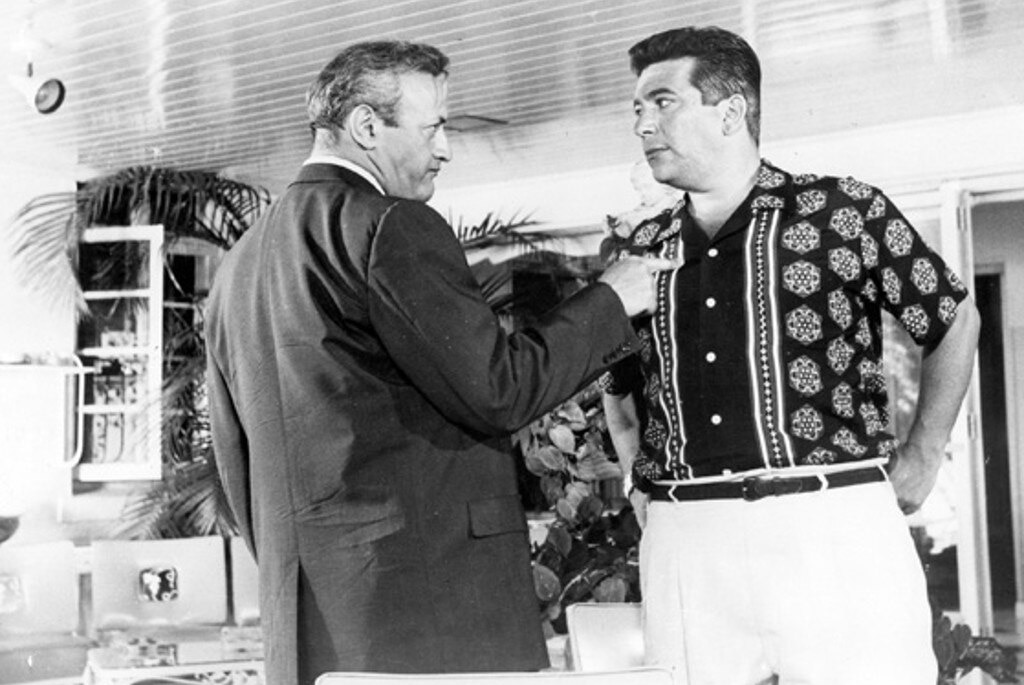
Thus, Miami Expose (1956): the story of how organized crime sought to bring legalized gambling to Florida, which suave gangster Ray Sheridan (Alan Napier) expected to control from behind the scenes using his extensive network of corrupt officials. Miami's then-Mayor Randy Christmas introduces the film from his desk (or a reasonable film set facsimile) before an unidentified narrator takes over. The film begins with a plane crash (which is only sort of pictured) that sets events into motion: in late 1955 and throughout 1956, Florida was the site of a startling number of plane wrecks. Passenger airliners, Army troop transports, small crop dusters-if it flies, it went down in Florida in the mid-1950s. Whether any of these genuine tragedies was intended as the reference point of the film, and if so which one, is unclear.
The shadow of Fritz Lang's 1953 thriller The Big Heat hangs heavy across this B-level production. Despite the sun-soaked Florida settings, screenwriter Robert E. Kent (working under his usual pseudonym James B. Gordon) and director Fred Sears clearly have Lang's picture firmly in mind. A criminal mastermind sits at the center of a secret web laced throughout the corrupted underbelly of an unsuspecting society, a hard-boiled cop dares stand up to him, and the key to the mystery lies in a gangster's moll who knows too much. As Lt. Barton Scott, star Lee J. Cobb makes for a more believable if less marquee-friendly cop hero than The Big Heat's Glenn Ford. He even gets a few scenes of humanizing family life reminiscent of similar material in Lang's film-but with a nice extra touch, in that Barton is not married, he is courting a single mother who lost her first husband to the violence of police life, a constant reminder to all concerned of what is at stake.
Cynical viewers jaded by contemporary crime thrillers may find the story addled by cliché, but it was films like these that first set such familiar tropes into place: Lt. Scott is on the verge of retirement, but when his partner is killed by the gangsters it gets personal. Once the mystery gets rolling, though, there are some unsuspected details. The film is awfully cavalier about putting children into danger, which leads to one especially nice moment as Patricia Medina's character (a former gangster moll) starts to spin into unhinged hysteria only to be shamed by the realization that she's next to a five-year-old kid, and he isn't afraid.
Alan Napier makes for a suave villain-and in one scene shows off a remarkably buff physique (he was 53 years old at the time). He was a busy and well-regarded character actor still ten years away from entering pop cultural immortality as the butler to TV's Batman. His stooge, lobbyist Oliver Tubbs, featured the final screen appearance of the once popular star and former president of the Screen Actor's Guild, Edward Arnold.
Sears was one of Katzman's most reliable workhorse directors (and in turn Gordon/Kent was one of his most dependable scribblers). The start of 1956 found producer Katzman obliged by the changing exhibition landscape to abandon one of his bread-and-butter production lines, the weekly cliffhanger serial. The money that had been earmarked for such stuff was simply folded into his slate of features, making it possible to slightly increase the budgets for things such as Miami Expose, the first film Katzman oversaw under the new budgeting arrangement. It had been announced as Miami Shakedown, but underwent a title change as Sears and his team shot on location in the Everglades and pre-Castro Cuba in March of 1956. The result spotlights some of the more interesting cinematography by Benjamin Kline, whose CV otherwise includes handling cinematography for most of the Three Stooges shorts
At 74 minutes, Miami Expose is a lean and gangly thing, an unpretentious programmer that delivers its promised thrills and moves on. For Katzman that was enough. "Lord knows I'll never make an Academy Award movie, but then I am just as happy to get my achievement plaques from the bank every year," he said in a 1953 interview.
Producer: Sam Katzman
Director: Fred F. Sears
Screenplay: James B. Gordon
Cinematography: Benjamin H. Kline
Art Direction: Paul Palmentola
Music: Mischa Bakaleinikoff
Film Editing: Al Clark
Cast: Lee J. Cobb (Lt. Barton 'Bob' Scott), Patricia Medina (Lila Hodges), Edward Arnold (Oliver Tubbs), Michael Granger (Louis Ascot), Eleanore Tanin (Ann Easton), Alan Napier (Ray Sheridan), Harry Lauter (Det. Tim Grogan), Chris Alcaide (Morrie Pell, Gunman), Hugh Sanders (Chief Charles Landon), Barry L. Connors (Stevie Easton).
BW-73m.
by David Kalat
sources:
LeRoy Ashby, With Amusement For All
Wheeler Winston Dixon, Lost in the Fifties: Recovering Phantom Hollywood
Miami Expose
by David Kalat | March 09, 2009
SIGN UP FOR OUR NEWSLETTERS

CONNECT WITH TCM