The more things change, the more they stay the same. Joseph Losey's second feature film, The Lawless (1950), was manufactured as an explicitly didactic morality play intended to dramatize a pressing social ill of the late 1940s, but which was heavily colored by social problems (and issue films) of a decade earlier. With few changes the same film could be released as new today and be seen as current and relevant. On top of that, without entirely realizing it, its makers had crafted a film that presciently anticipated the very troubles that would plague them personally in the years immediately following. The Lawless manages to encapsulate nearly a century of American strife in a trim 83 minutes. Given that its principal concern is racism, this fact is something of a downer.
For those of us living today in the post-Civil Rights era, when the biracial son of an African father can ascend to the highest office in the free world, it can be all too easy to forget how recent were the struggles that created this world. Somewhere between the ugly prejudices of the past and the world of today there must have been a period of transition, as people challenged traditional modes of thinking and accepted social conditions. This period culminated in the famous marches and speeches of the mid-century - but before those heroic days came years of struggle and hard work. Filmmakers like Joseph Losey saw their role in the media as one of grave responsibility, and sought to use their films as platforms to ennoble and uplift their fellow man, to stir the consciences of their viewers.
The message films of the 1930s and 40s can be embarrassingly earnest to the jaded viewers of today-designed to make a point, they tend to occupy a melodramatic space not far from the After School Specials of later generations. Samuel Goldwyn famously said, "Pictures are for entertainment. Messages should be delivered by Western Union." Reviewing Losey's first film, the earnest anti-racism fable The Boy with Green Hair (1948), the New Yorker wrote that "It's good he doesn't approve of people going around killing each other. Maybe, however, [Losey] could have summed up his views more interestingly in a commercial." Looking back on these early films, Losey himself even said, "I was still trying to get out of my system, I suppose, some of the things which were very much a part of me in the thirties and early forties."
"They were what is called 'message pictures.' And they were made by a man-me--and other men and women who thought we knew the answers or thought we could find answers. I stopped somewhere along the line," Losey later explained, "and have been much more interested in making pictures of provocation: that is, opening up the mind so people have to examine situations and attitudes and come to their own conclusions."
Shot on location in Marysville and Grass Valley in late 1949 for a mere $407,000 (Losey once claimed he had but $150,000 to spend, but this is not borne out by studio documentation), The Lawless takes place in a fictional California small town riven, like so many real ones, into two classes: the middle class whites congregate in Santa Maria, a self-proclaimed "Friendly Town." The local fruit industry depends on low-cost labor, provided in large measure by Mexican immigrants, derisively known as "fruit tramps," living in a shantytown called Sleepy Hollow. They work long hours for meager pay, are reflexively considered unreliable layabouts and eyed with suspicion by the police. In any ghetto, the hardships of life can wear down people's civility, and so Sleepy Hollow has its share of problems and violence-which community organizers like intrepid journalist Sunny Garcia (Gail Russell) work to resolve. But when angry young men from across the tracks come to Sleepy Hollow full of anti-Mexican resentment, looking to start a fight, even the noblest of intentions fall short.
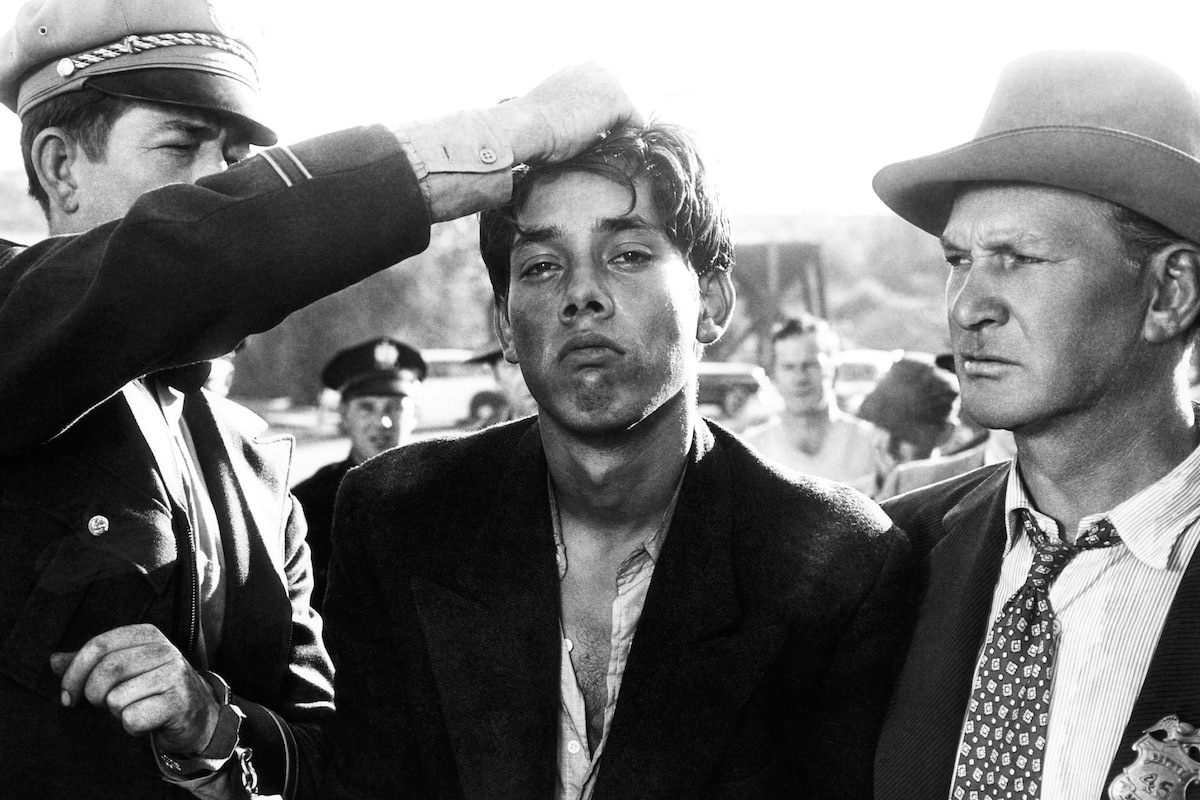
Like West Side Story (1961), we find it all coming to a head at a dance, where rival gangs fail to keep their roiling passions at a controlled simmer. Some white kids throw the first punches, and a melee ensues. And, again like West Side Story, the spiraling consequences put the most level-headed young man into the worst of it, hunted like a criminal because the world assumes that's what he must inevitably be. One day Paul Rodriguez is defending Santa Maria as a great place to live-his wary father advises him to stay away from Americans, to which the boy replies, "I'm an American." But the next, he's an animal on the run for his life, a scapegoat for a community determined to be at war with itself.
Losey found a photogenic non-actor named Lalo Rios to play Paul, and given how many films of the era figured it was OK to smudge some dark makeup on white actors rather than hire any real Latino actors (did I mention West Side Story yet?), it is a refreshing change-although Losey took some hits from critics who accused him of paternalism. (What was the guy thinking-hiring a Latino kid to play a Latino kid? Just like a bleeding heart liberal!).
Under pressure from the producers to make the film less cerebral and more pulpy, screenwriter Daniel Mainwaring and director Losey were obliged to include some loony escalations to Paul's predicament, which starts to accrue too many absurd coincidences and misfortunes to remain believable. The Lawless already takes place in the time before court-appointed lawyers, which means the poor kid will be obliged to plead guilty to whatever cockamamie charges the arresting officers choose to slap on him, since he cannot afford a lawyer to contest the case. Such a situation is already nightmarish, without the Wiley Coyote antics the film forces Paul through along the way.
However, while the guts of The Lawless are intense sequences involving Paul's desperate flight, the heart of the film belongs to top-lined Macdonald Carey as newspaper publisher Larry Wilder. Carey was a talented actor who brightened many a B-level production like this but whose oddly featureless face denied him A-list stardom. As Wilder he plays a once-crusading reporter worn down by fighting the good fight for too long. Now he has opted for a less demanding career in smalltown America in search of a quieter life. Challenged by Sunny to use his paper to help ease the racial tension, he declines-he's new to town and not looking to start fights or choose up sides, he says.
Trouble is, the injustice is all too plain for him to ignore for long. His own colleagues and friends are making matters worse, in pursuit of sensational journalism that sidelines reason for outrage and whips up the worst emotions in already moblike crowd. His growing attraction to Sunny complicates his position further so he takes his first tentative steps towards social action, and is roundly punished for it. Merely by refusing to take part in the anti-Mexican hysteria, Larry makes himself a target of the mob's anger-and the riot mentality descends on him.
Here is where The Lawless touched the lives of its makers most closely, intentionally or not. Mainwaring and Losey may have thought they were commenting on racism, but they were also anticipating the coming dread of the Hollywood Blacklist. Congressional investigation into Communist sympathizers in the film industry had already begun, and Losey had already found himself in the middle of the brawl. Before long he would flee to England, while many of his friends would serve time behind bars. Mainwaring's use of the pseudonym Geoffrey Homes was a preexisting condition unrelated to the Blacklist - but for his political beliefs he would soon be forced to remain completely anonymous, uncredited on his scripts because he had become a non-person in Hollywood. Like Larry Wilder, those who spoke out against the witch-hunts would only invite scrutiny on themselves, and the hysteria became accepted as the natural order of things. Of course there are enemy Communists in Hollywood corrupting our minds through pop culture, of course they must be removed - the only question is who is who. The ensuing madness drove away many of our most promising filmmakers, out of intolerant America and into the welcoming arms of Europe, much as the rise of Nazism had driven Germany's finest filmmakers out of Europe a generation before.
In The Lawless, a character looks around the wreckage left by his neighbors and friends, driven to mindless violence to enforce a meaningless standard of conformity, and clucks, "I never thought it could happen here." Losey and Mainwaring were saying the same to themselves, behind the scenes.
Losey had been twiddling his thumbs at RKO, under contract to a studio that had decided to let him idle rather than let a rancorous malcontent use their precious filmstock. He was rescued by the forward-thinking producer Dore Schary at MGM who bought off the director's contract and took him on as a writer. Losey soon befriended fellow writer and fellow traveler Daniel Mainwaring, and the two repaid Schary by offering their services instead to Paramount's notorious B-producer team William Pine and William Thomas, the so-called "Dollar Bills." Schary was irked at the way Losey treated him, but was almost immediately called out for his own associations with Hollywood left-wingers.
Relations with the Dollar Bills were never happy. Thomas was known for holding conferences with his staff while he was seated on the toilet, door open. They interfered constantly-amending the story as mentioned earlier to include more sensational excitement, at the cost of realism, and slathering an inappropriate romantic musical score over the entire film. Hot-headed Losey rose to the bait, and at one point threw his script at Thomas in disgust and sneered, "Go direct your own f*cking picture!" Careers had ended over less. Thomas coolly noted that his upstart director had done this in private, with only Mainwaring as a witness; if the two agreed to keep mum he would permit Losey to retain his job. This they did, only for Losey to then get into a fistfight with production manager Doc Merman.
Losey's relations with the cast were also tense. Although Carey was a pro and would work with Losey again on future projects, Gail Russell was a pretty young ingénue hired for her looks and forced into acting against her wishes. She was terrified, and unable to perform without a steadying drink-the one thing her managers had forbade Losey from giving the poor girl. One scene with Carey dragged on for hours. Carey was by now so rattled he could barely focus on his own performance, and Losey realized the entire production was on the brink of total collapse. He offered the shaken actress a drink - and saved the scene, at a cost. She spiraled into dependency - exactly as her handlers feared, and Losey struggled to keep her, Carey, and the untrained Rios together as some semblance of a professional unit.
If it sounds like this was a ramshackle production, the result betrays no such thing. If it were a bottle of wine, one would say The Lawless offered high quality and flavor for a low cost. Losey collaborated with production designer John Hubley to carefully pre-visualize the film in detail. The two studied the socialist realist photography of Paul Strand and Walker Evans, along with Life Magazine coverage of lynch mobs and race riots. From this research they drew up storyboards, an uncommon luxury for a film of this budget level, that greatly simplified the tasks of the on-set crew.
Director of photography Roy Hunt assembled a package of lightweight cameras, and he sped through each set up at a breakneck pace. With just twenty-one days on the schedule, the man literally ran-grabbing a handheld camera with which to chase Lalo Rios across Grass Valley landscapes. Having come from a background in radio, Losey played with the soundtrack, emphasizing and suppressing sound effects for dramatic rather than realistic effect. Although the unfortunate musical score by Mahlon Merrick undercuts the effect, Losey's attempt at such cinematic texture enriches a film that could too easily have seemed stagebound and theatrical.
The Boy with Green Hair had recreated its small town vibe on Hollywood soundstages and back lots, much to Losey's disappointment. Determined to rectify the error, he took Hunt and the cast out to actual Californian hamlets for The Lawless. For the riot scene, he asked the people of Marysville to gather in the town square and throw stones-they were not told what the film was about, and obliged, to their later chagrin.
Paramount's executive Y. Frank Freeman found the finished picture uncomfortably pink, and sent it out quietly in the summer of 1950. Two months before its American premiere, it opened in the United Kingdom under the alternate title The Dividing Line. English critics raved, and before long the island nation would claim the homeless Losey as their own.
Message films existed because their makers believed strong ideas had the power to change society-and the Blacklist bought the same logic, fearful that strong ideas had the power to change society. The Lawless depicts a weary shopworn hero, running low on courage, discovering the limits of such idealism-ideas are powerful, but not all-powerful. The days of the Blacklist may seem old news, and certain details of the film are now anachronistic, but in an age where self-appointed "Minute Men" feel entitled to wield criminal violence in a paradoxical campaign against the supposed violent criminals immigrating from Mexico, The Lawless has lost little of its relevance and punch. It remains a surprisingly grown-up film for its era, made with cinematic flair by artisans whose beliefs cost them their jobs.
Producers: William H. Pine, William C. Thomas
Director: Joseph Losey
Screenplay: Daniel Mainwaring (screenplay, as Geoffrey Homes; novel "The Voice of Stephen Wilder" uncredited)
Cinematography: J. Roy Hunt
Art Direction: Lewis H. Creber
Music: Mahlon Merrick
Film Editing: Howard Smith
Cast: Macdonald Carey (Larry Wilder), Gail Russell (Sunny Garcia), John Sands (Joe Ferguson), Lee Patrick (Jan Dawson), John Hoyt (Ed Ferguson), Lalo Rios (Paul Rodriguez), Maurice Jara (Lopo Chavez), Walter Reed (Jim Wilson), Guy Anderson (Jonas Creel), Argentina Brunetti (Mrs. Rodriguez), William Edmunds (Angie Jensen), Gloria Winters (Mildred Jensen), John Davis (Harry Pawling), Martha Hyer (Caroline Tyler).
BW-83m.
By David Kalat
Sources:
James Palmer and Michael Riley, The Films of Joseph Losey
Edith De Rhaw and Andre Deutsch, Joseph Losey
Tom Milne, editor, Losey on Losey
Michael Ciment, Conversations with Losey
James Leahy, The Cinema of Joseph Losey
Foster Hirsch, Joseph Losey
David Caute, Joseph Losey: A Revenge on Life
The Lawless
by David Kalat | March 09, 2009
SIGN UP FOR OUR NEWSLETTERS

CONNECT WITH TCM