Gentlemen Prefer Blondes begins on an ocean liner that's bringing Lorelei
Lee and Dorothy Shaw to Paris, where Lorelei plans to marry her wealthy fiancé.
Both heroines are showgirls, and both have specialized tastes: Lorelei loves money,
jewelry, and men rich enough to provide them, while Dorothy is in love with love
itself, including the sexual side, which she's as candid about as 1950s censorship
would allow. Romantic complications start on the ship and continue in Paris, but
they're cleared up in time for a double wedding in the final scene.
Marilyn Monroe has become such a legendary icon, and Gentlemen Prefer
Blondes is such a celebrated part of her filmography, that it's surprising to
discover she wasn't the first choice to play Lorelei, the voluptuous gold-digger
who never met a diamond she didn't like. Production chief Darryl F. Zanuck had
Betty Grable in mind when Twentieth Century-Fox bought movie rights to the
eponymous Broadway show, and a large factor in Zanuck's change of heart was
Monroe's salary, considerably lower than Grable's when the picture was made in
1953. Then too, Monroe's star was rising and Grable's was on the wane.
Monroe received only $18,000 for her services, and the modest fee may have been
justified. Although she was an experienced actress by this time this was her
seventeenth credited role and her sixth movie of the year she often arrived late
and was frightened of starting work on intimate scenes and musical numbers alike.
At rehearsals she usually looked "like she'd just crawled out of bed no makeup,
tangled hair, and blue jeans," costar Jane Russell wrote years later. Yet in other
ways Monroe gave her all to the project, staying after hours to learn dance numbers
and singing all her own songs except the intro to "Diamonds Are a Girl's Best
Friend." She was a creative contributor, too. When a character tells Lorelei that
he'd heard she was dumb, she answers, "I can be smart when it's important, but most
men don't like it." This line, added at Monroe's direct suggestion, was "her own
sly riposte to the prevailing sexism of the 1950s," Monroe biographer Donald Spoto
declares.
Zanuck hired Russell to play Dorothy, the brunette of the picture, as insurance in
case Monroe underperformed. This was only Russell's eleventh role since her debut
in Howard Hughes's notorious 1943 western The Outlaw, but she was a more
even-tempered professional than Monroe; by all accounts she helped director Howard
Hawks keep her insecure costar under control, calming her down and repeating
Hawks's instructions when Monroe chronically failed to understand or remember them.
The hardest work for both Russell and Monroe was the dance numbers, which were
directed by choreographer Jack Cole, since Hawks had no interest in them. Cole was
an indefatigable artist who "worked dancers to death," Russell wrote in her
autobiography, "but...was patience itself" with her and Monroe, even though "we
didn't know our left foot from our right."
In all, Russell recalled, "I had a ball on that picture, but I don't think Marilyn
did altogether." One reason why Russell had such a ball is that the studio had to
borrow her from Hughes's company, where she was still under contract, and the
loan-out deal stipulated that her wardrobe, hair, and makeup crew would come along
with her, plus cinematographer Harry J. Wild, who earned Monroe's gratitude by not
favoring Russell in his shots. Russell was certainly a good sport about the
production, as the climax of a big production number shows. A line of men were
diving over her head into a swimming pool, and one diver came in too low, knocking
her head first into the water, where she surfaced looking like the proverbial
drowned rat. The shot was redone a few days later, but the first take was used in
the final cut, and Russell applauded the decision.
The tale of Lorelei and Dorothy first appeared in a novella by Anita Loos called
The Diary of a Hasty Traveler, which was serialized in Harper's
Bazaar in 1925. Later that year Loos published it as a book called Gentlemen
Prefer Blondes: The Illuminating Diary of a Professional Lady, and then she
turned it into a play, which ran on Broadway in the 1926-27 season before becoming
a Paramount picture in 1928. Loos used the characters again in the novellas Why
Not Brunette and But Gentlemen Marry Brunettes not every gent prefers
blondes, it appears and teamed with Joseph Fields to adapt the play version as a
Broadway musical, which opened in 1949 with Carol Channing and Yvonne Adair in the
leads. (A revival in 1995 tanked after two dozen performances.)
Of all the story's versions, the 1953 movie is easily the most popular, thanks in
part to Hawks, who enjoyed directing it despite some compromises he had to make.
One concerned the film's gaudy Technicolor look, which went completely against his
preference for low-key hues, but was unavoidable for this splashy $2 million
production. A more serious problem concerned Monroe, whom Hawks found vulgar,
dim-witted, and unsexy. He had worked with her in Monkey Business the
previous year, so he had some idea of what to expect, but he said later that "there
were a lot of times when I was ready to give up the ghost." Still, he appreciated
her charisma on the screen, and as Todd McCarthy writes in his Hawks biography, "he
played with it and helped make her into a great star in the process." In the end,
Hawks considered himself lucky to have directed Monroe before her anxieties grew
even more disabling in subsequent years, and his final verdict on her is as
accurate as it is unsparing. "There wasn't a real thing about her," he said in the
interview book Hawks on Hawks. "Everything was completely
unreal....Gentleman Prefer Blondes was the first [picture] where she really
went good, and then [Hollywood] had no sense to stick with that."
Gentlemen Prefer Blondes has a lot going for it besides its glamorous female
stars. Charles Coburn is excellent as Sir Francis Beekman, an infatuated diamond
mogul better known as Piggy, and while Elliott Reid is just adequate as the guy who
woos Dorothy, awkward Tommy Noonan is just right as Lorelei's filthy rich fiancé.
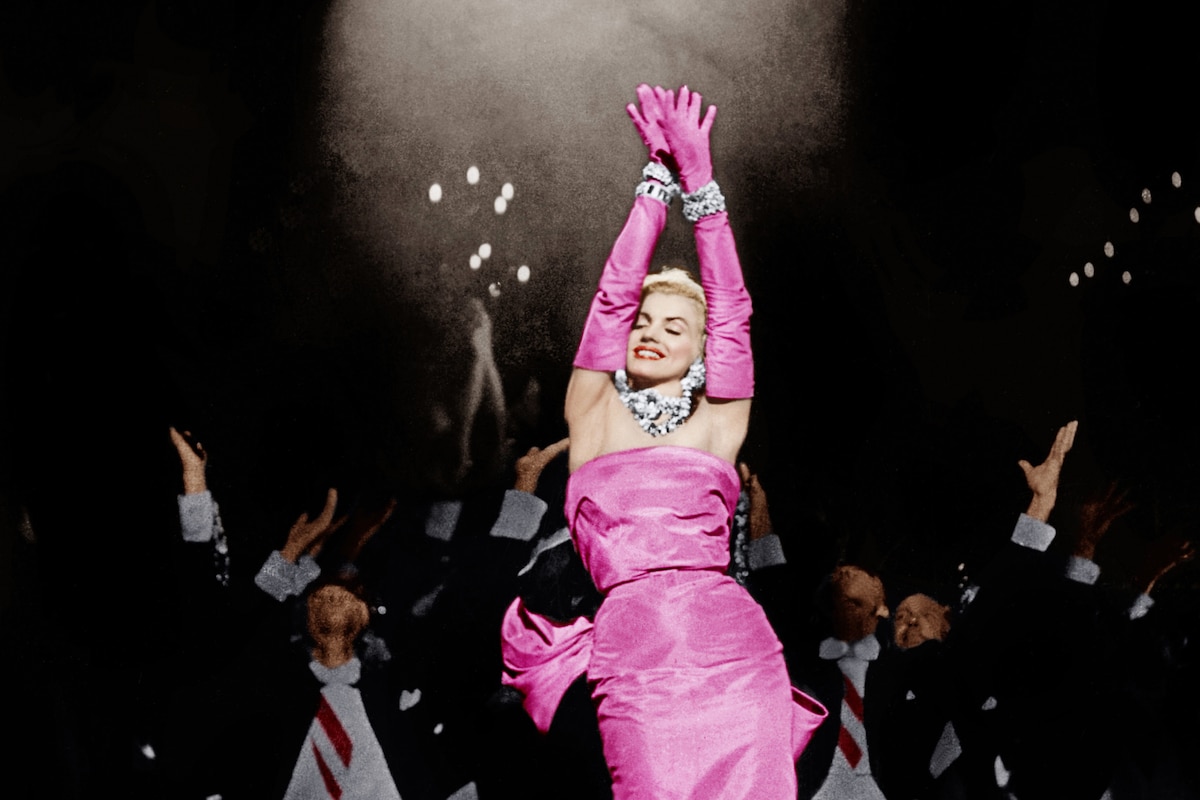
The bouncy score includes tuneful songs like "Two Little Girls from Little Rock"
and "Anyone Here for Love?" as well as the memorable ditty about diamonds and best
friends, and the production numbers are as brassy and bold as the Technicolor
colors that jazz them up. Reviewers were generally pleased with Gentlemen Prefer
Blondes and the public loved it, buying more than $5 million worth of tickets
by the end of 1953, which made it the second-biggest hit of Hawks's career to date.
As for the dialogue, I could quote it endlessly, but I'll settle for the
screenplay's last line, a marvel of innuendo in a heavily censored era. Dorothy to
Lorelei as they walk down the aisle to marry their respective men: "Remember,
honey, on your wedding day it's all right to say Yes."
Director: Howard Hawks
Producer: Sol C. Siegel
Screenplay: Charles Lederer, based on the musical comedy by Joseph Fields and Anita
Loos
Cinematographer: Harry J. Wild
Film Editing: Hugh S. Fowler
Art Direction: Lyle Wheeler, Joseph C. Wright
Music: Jule Styne and Leo Robin, with songs by Hoagy Carmichael and Harold
Adamson
Choreography: Jack Cole
With: Jane Russell (Dorothy Shaw), Marilyn Monroe (Lorelei Lee), Charles Coburn
(Sir Francis "Piggy" Beekman), Elliott Reid (Ernie Malone), Tommy Noonan (Gus
Esmond), George Winslow (Henry Spofford III), Marcel Dalio (Magistrate), Taylor
Holmes (Mr. Esmond Sr.), Norma Varden (Lady Beekman), Howard Wendell (Watson),
Steven Geray (hotel manager).
C-91m.
by David Sterritt
Gentlemen Prefer Blondes
by David Sterritt | February 11, 2009
SIGN UP FOR OUR NEWSLETTERS

CONNECT WITH TCM