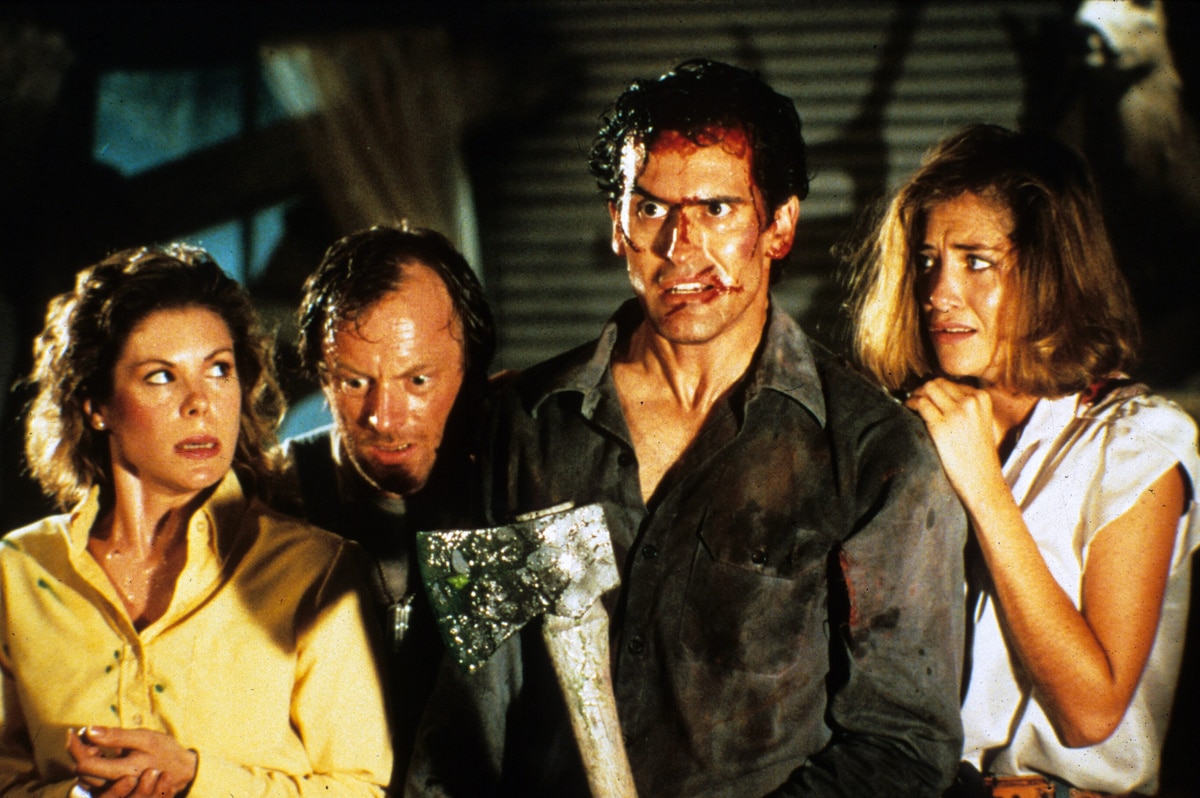
With Evil Dead II: Dead by Dawn (1987), writer-director Sam Raimi pulled off a typically impossible feat he made a sequel to a cult movie milestone ("the ultimate experience in grueling terror") that was widely considered to be better than the original. Initially, Raimi had wanted to press on from the exposure afforded him by The Evil Dead (1981) to a sequel that would catapult its benighted protagonist Ash (Bruce Campbell) into the Middle Ages. When moneyman Dino De Laurentiis came aboard (at the behest of Stephen King, then making his own directorial debut with the De Laurentiis-produced Maximum Overdrive[1986]), the power behind the newly minted De Laurentiis Entertainment Group demanded a scenario more in line with that of Raimi's original cult hit. With a budget ten times that of The Evil Dead, Raimi's follow-up has a more aesthetically pleasing look and a host of special effects that pays homage to a score of horror and suspense classics: the canted angles of The Cabinet of Dr. Caligari (1920), the anthropomorphic trees of The Wizard of Oz (1939), the fruit cellar of Psycho (1960), stop motion animation reminiscent of Ray Harryhausen, the boarded-up windows of Night of the Living Dead (1968), the "blood flood" from The Shining (1980), the rays of light streaming in through a sundered wall from Raising Arizona (1985) and it's anyone's guess whether Ash's perambulating hand was a nod to The Beast with Five Fingers (1946), The Crawling Hand (1963) or Dr. Terror's House of Horrors (1965).
With Evil Dead II, Sam Raimi took the opportunity to experiment with time cuts, which advance the action one significant piece at a time in the manner of comic book panels. This technique is most pronounced in the now celebrated setpiece in which Ash amputates his stump with the help of nominal heroine Annie Knowby (Sarah Berry), whose father has unwisely unleashed ancient evil upon the world. In addition to the forward momentum gained by telescoping these events, this editing tack brackets the dumb fun (which so often metastasize into full blown surreal slapstick) with an authorial intelligence that was not lost on moviegoers whose enthusiasm turned Evil Dead II into an instant cult classic rated slightly higher than Raimi's gnarly original. Raimi had grown up on the punishing physical comedy of The Three Stooges and the hyperkinetic cartoons of Tex Avery, which bent the physical world to the demands of animated high comedy. In Evil Dead II, Raimi and crew freshen the shopworn formula of inanimate objects coming to an horrific semblance of life (a gimmick driven into the ground with the trifecta successes of The Exorcist [1973], The Omen and Carrie [both 1976]) by making these items (a rocking chair, a gooseneck lamp, a stuffed deer head) not just so much telekinetic flotsam and jetsam but characters in their own right, who taunt Ash in witchy high octaves, pushing him to hysterical, transcendental laughter even while promising he'll be "dead by dawn."
In a 1988 interview with British journalist Jonathan Ross, Sam Raimi projected for himself an inevitable loss of creativity that would come with the assignment of bigger budgeted studio projects. Indeed, as Raimi became the A-list director-for-hire of such popular successes as A Simple Plan (1998), For Love of the Game (1999) and the Billy Bob Thornton-scripted The Gift (2000), the stately, tasteful manner of his craft seemed a betrayal of his salad days as a DIY splatterpunk using Milk Duds to thicken his bathtub ichor. If Raimi had been suspected by his early fan base of having sold out prior to the New Millennium, his helming of Columbia's mega budget Spider-Man franchise from 2002 on was likely the final coffin nail for the faithful. Yet while these summer blockbusters (the final budget of Spider-Man 3 is calculated to have hit $350 million) seem, at least superficially, to be anathema to the hands-on Raimi aesthetic, there is an obvious and reassuring kinship shared by Ash of The Evil Dead canon and Spider-Man's Peter Parker. We meet both characters on the cusp of adulthood and witness their maturation being interrupted by occult forces, supernatural events that change them physically, complicate their love lives and compel both to rise above their fears and physical limitations to become unlikely and initially unwilling heroes. Although Raimi rarely works in full-on horror these days, Ghost House Pictures, the production company he founded with Evil Dead producer Robert G. Tapert, remains a strong brand in the genre with such box office hits as Boogeyman (2005) and The Grudge (2004) and 30 Days of Night (2007).
Producer: Robert G. Tapert
Executive Producers: Alex De Benedetti, Irvin Shapiro
Co-Producer: Bruce Campbell
Director: Sam Raimi
Writers: Sam Raimi, Scott Spiegel
Music: Joseph LoDuca
Cinematographer: Peter Deming, Eugene Shlugleit
Editor: Kaye Davis
Art Direction: Randy Bennett, Philip Duffin
Special Effects: Mark Shostrum, Howard Berger, Gregory Nicotero, Robert Kurtzman, Steve Wang
Visual Effects: Doug Beswick, Tom Hitchcock, Bob Kayganich
Cast: Bruce Campbell (Ash), Sarah Berry (Annie Knowby), Denise Bixler (Linda), Richard Domeier (Ed), Dan Hicks (Jake), Kassie Wesley (Bobbie Joe), John Peakes (Professor Raymond Knowby), Lou Hancock (Henrietta Knowby), Ted Raimi (Possessed Henrietta), Sam Raimi (Medieval Soldier).
C-85m.
by Richard Harland Smith
The Gist (Evil Dead 2: Dead By Dawn) - THE GIST
by Richard Harland Smith | January 27, 2009
SIGN UP FOR OUR NEWSLETTERS

CONNECT WITH TCM