You wouldn't know it from the silly story of a socialite with
limited talent who embarks on a singing career while her
opera-hating husband turns out to be a gifted baritone
secretly launching his own debut, but this soufflé of a
romantic comedy is based on a story by James M. Cain, the
author best known for his dark melodramas of adultery,
betrayal and murder. There's little of that Cain darkness in
Wife, Husband and Friend, a light romantic comedy from
1939 starring Loretta Young as Doris, the ambitious high
society wife of the title, and Warner Baxter as husband
Leonard, a successful contractor and self-made businessman
who treats a night at the opera as a good opportunity for a
nap.
Encouraged by her voice coach (Cesar Romero, looking very
much the scheming Latin lover) and her harpy of a haughty,
snobbish mother (Helen Westley, all arrogance and disdain),
Doris decides to revive the singing career she put on hold to
marry Leonard. Musical ambition is apparently a trait of the
Boland women: "a vicious streak of music runs through the
whole caboodle of them," Doris' father (George Barbier) warns
Leonard. It's apparently a fate that has already driven him
to drink, but Leonard dismisses the warning signs until it's
too late to do anything but play along and hope she'll just
get over it. While Doris goes into full career mode,
professional opera and recital singer Cecil Carver (Binnie
Barnes) discovers that self-described bathroom-singer Leonard
is a born baritone and a natural talent. Hoping to woo this
frustrated gent from his distracted wife, Cecil makes him a
proposal: she'll secretly coach him so he can beat his wife
at her own game. Secrets and lies inevitably pile up (this
couple is not a paragon of communication, but then where
would the story come from if they actually were honest with
one another?) and their fairy-tale marriage becomes a battle
of the sexes.
Until the inevitable happy ending, that is, which offers the
strangest kind of moral: There's nothing like failure and
humiliation to heal a marriage.
Warner Baxter wasn't known as a light comedian but he acquits
himself well as the street-smart lug turned successful
businessman. He's as cultured as a bum at the ball and looks
like a thug in a tuxedo when he delivers his first recital,
slouching and scratching himself while serenading an audience
of swells with the voice of an angel. Offstage he's a typical
thirties chauvinist and is downright condescending to his
wife's dreams, but his direct manner and snappy wit is a
refreshing breeze through the stultifying air of snooty,
condescending social manners and upper-class arrogance.
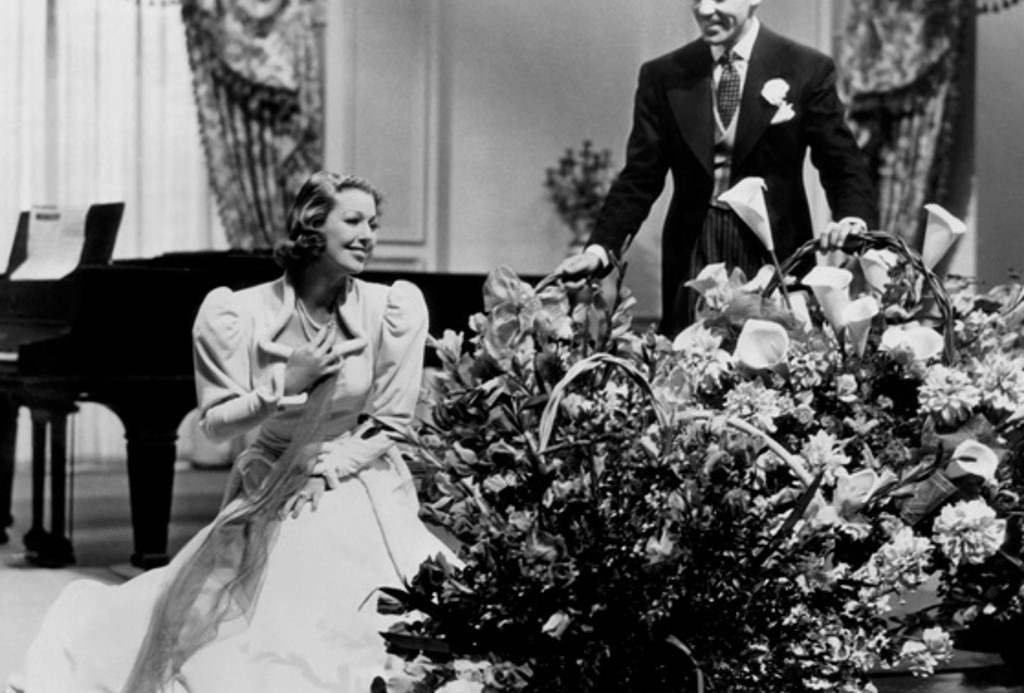
Loretta Young, a Hollywood class act of dignity and elegance,
plays Doris as the embodiment of the dreamy society woman who
runs on pure emotion and impulse, and essentially plays
straight-man to Baxter's practical manner. (The role was,
reportedly, originally to be played by Myrna Loy, perhaps in
hopes to recreate the magic she had created opposite William
Powell.) They are an unlikely couple but the affection they
exhibit for one another is palpable and makes the romance
work.
The terrific Binnie Barnes made a career of tough-minded
dames and other woman roles and is in excellent form here as
Cecil, working her seductive smile and bedroom eyes on
Leonard, who is nervous at best and oblivious at worst, much
to her consternation. One feels the mighty power of the
production code in the way that director Gregory Ratoff (who
directed Ingrid Bergman in her American debut in
Intermezzo the same year) and screenwriter/producer
Nunnally Johnson (who adapted James M. Cain's short story
"Two Can Sing") effectively scrub most suggestions of
infidelity out of the film. Romero, whom one expects to make
a pass at his star pupil, is left to largely skulk through
the background of Wife, Husband and Friend.
Running a brisk 75 minutes, the lightweight comedy is a silly
little distraction with charming moments. Gravel-voiced
character actor Eugene Pallette makes the most of his brief
role with his trademark delivery of sardonic quips and
little-known Ruth Terry brings a kind of Judy Garland
innocence to her turn as Leonard's secretary. The score
features a mix of opera selections and concert hall pieces
with popular standards, notably a rendition of "On The Road
to Mandalay" that Leonard delivers at a high society party.
(Warner Baxter, Loretta Young and Binnie Barnes all lip-synch
their musical performances, of course, but the real singers
are not identified in the credits.)
Wife, Husband and Friend is one of the last films that
Loretta Young made under contract to 20th-Century-Fox. When
her contract was up, the actress declined to be re-sign for
Fox or any other studio, which would put her at the mercy of
the studio bosses. Many predicted that her career would
flounder as the studios snubbed her services, but after a
lean year she was back in major productions and subsequently
won an Oscar® for the 1947 The Farmer's Wife.
Producer: Nunnally Johnson
Director: Gregory Ratoff
Screenplay: Nunnally Johnson (based on the novel Two Can
Sing by James M. Cain)
Cinematography: Ernest Palmer
Art Direction: Richard Day, Mark-Lee Kirk
Costume Design: Royer
Set Decoration: Thomas Little
Cast: Loretta Young (Doris Borland), Warner Baxter (Leonard
Borland), Binnie Barnes (Cecil Carver), Cesar Romero (Hugo),
George Barbier (Maj. Blair), Eugene Pallette (Mike Craig).
BW-75m.
by Sean Axmaker
Wife, Husband and Friend
by Sean Axmaker | January 16, 2009
SIGN UP FOR OUR NEWSLETTERS

CONNECT WITH TCM