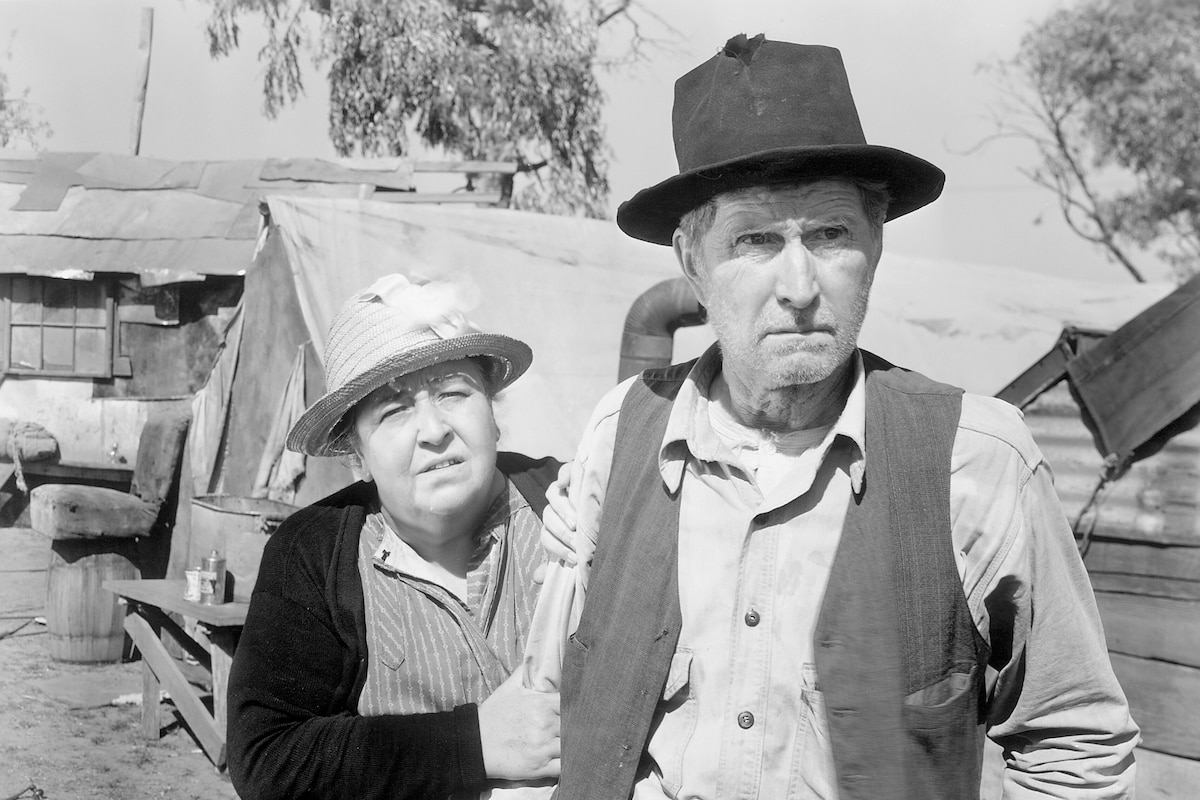
John Steinbeck was invited to a pre-release screening of The Grapes of Wrath which Darryl F. Zanuck had promised him. The author proclaimed it "a hard, straight picture in which the actors are submerged so completely that it looks and feels like a documentary film, and certainly it has a hard, truthful ring." He also said Henry Fonda's performance as Tom Joad made him "believe my own words."
Concerned about controversy, even up to the film's expected opening, Zanuck decided to premiere The Grapes of Wrath outside of California, hoping it would be more sympathetically received elsewhere. The movie opened in New York in late January 1940, to glowing reviews, in Los Angeles a month later, and then in wide release in mid-March.
For the publicity campaign, Zanuck hired noted American artist Thomas Hart Benton to illustrate the ads rather than using production stills. As one glowing review after another flooded in, Zanuck changed the ads to a series of Benton illustrations of the characters with the line, "Us Joads thank New York!"
For The Grapes of Wrath's release in Great Britain, a brief prologue was added explaining the social and historical context of the story.
Few people notice that in the film Tom's brother Noah simply vanishes from the picture after the scene of the family bathing in the river.
John Steinbeck was awarded the Nobel Prize for literature in 1962.
Other Steinbeck works that have been successfully adapted to film include Of Mice and Men (1939), East of Eden (1955), The Red Pony (1949), Tortilla Flat (1942), The Moon Is Down (1943), The Wayward Bus (1957), and The Winter of Our Discontent (1983, TV). The first three have been remade several times. In addition, Steinbeck has contributed to stories and scripts written directly for the screen: Lifeboat (1944), Viva Zapata! (1952).
While writing the book, Steinbeck visited Arvin Federal Government Camp near Bakersfield, portrayed as "Weedpatch Camp" in the book. The camp still exists today and is still used by migrant workers.
Henry Fonda worked with John Ford a total of nine times and on some of the finest films of Fonda's career. Although they had great respect for each other's talents, their relationship became strained during the filming of Fonda's stage hit Mister Roberts (1955), largely over Ford's abusive behavior fueled by severe alcoholism.
Screenwriter Nunnally Johnson wrote nearly 70 films in his 40-year career between 1927 and 1967, including Jesse James (1939), The Woman in the Window (1944), How to Marry a Millionaire (1953), and The Dirty Dozen (1967).
Steinbeck and Johnson remained friends for life, as did the author and Henry Fonda, who read poetry at Steinbeck's funeral in 1968.
When Fonda died in 1982, Tom Joad's final speech was read at his funeral.
Frank Nugent was a highly influential critic at the New York Times. After he wrote his very favorable review of The Grapes of Wrath, Darryl Zanuck offered him three times his newspaper pay to come work for Fox. Because Nugent had at times been a severe critic of that studio's films, some people speculated Zanuck was giving him the job to buy him and prevent future bad notices, but Nugent accepted and became a script doctor for several years. When opportunities to become a producer failed to materialize, he returned to film journalism. While in Mexico to do a story about John Ford's production of The Fugitive (1947), Nugent was offered a scriptwriting job by the director. Over the next 18 years he wrote 11 films for the director (as well as occasional work for others), including Ford's critically acclaimed Western The Searchers (1956).
Although they were having considerable relationship difficulties during the production of The Grapes of Wrath, writer Nunnally Johnson and actress Dorris Bowdon eventually married and remained together until his death in 1977. After appearing in the screen version of another Steinbeck novel, The Moon Is Down (1943), also adapted by her husband, she retired from acting to raise their children.
Many of the cast members of The Grapes of Wrath were from Ford's famous stock company of actors who worked with him numerous times, including John Carradine, Ward Bond, John Qualen, Russell Simpson, his brother Francis Ford, and former silent star Mae Marsh in an uncredited bit. The star of such films as The Birth of a Nation (1915) and Intolerance (1916) and once considered a successor to Lillian Gish, Marsh retired in 1918 on the eve of her marriage. When the Great Depression wiped her and her husband out financially, she returned to films and appeared in 17 Ford movies between Drums Along the Mohawk (1939) and Cheyenne Autumn (1964).
The youngest Joad, Winfield, was played by child actor Darryl Hickman, who has acted, produced, and written for 70 years. His younger brother Dwayne played the title role in the television comedy series Dobie Gillis.
The Grapes of Wrath was reportedly banned in the Soviet Union by Joseph Stalin because it showed that even the most destitute Americans could afford a car.
Although The Grapes of Wrath did well enough at the box office, it was not a runaway success, taking in about $1.59 million, roughly double its cost.
Memorable Quotes from THE GRAPES OF WRATH
MULEY (John Qualen): Blowin' like this year after year, blowin' the land away, blowin' the crops away. Blowin' us away now.
MULEY: You mean get off my own land?
AGENT (Adrian Morris): Now don't go blamin' me. It ain't my fault.
MULEY'S SON (Hollis Jewell): Whose fault is it?
AGENT: You know who owns the land. The Shawnee Land and Cattle Company.
MULEY: Who's the Shawnee Land and Cattle Company?
AGENT: It ain't nobody; it's a company.
MULEY'S SON: They got a president, ain't they? They got somebody who knows what a shotgun's for, ain't they?
AGENT: Now, son, it ain't his fault. Because the bank tells him what to do.
MULEY'S SON: All right, where's the bank?
AGENT: Tulsa. But what's the use pickin' on him? He ain't nothin' but the manager. And he's half crazy hisself trying to keep up with his orders from the East.
MULEY: Well, then who do we shoot?
AL (O.Z. Whitehead): Ain't you gonna look back, Ma? Give the ol' place a last look?
MA (Jane Darwell): We're going to California, ain't we? All right then let's go to California.
AL: That don't sound like you, Ma. You never was like that before.
MA: I never had my house pushed over before. Never had my family stuck out on the road. Never had to lose everything I had in life.
TOM JOAD (Henry Fonda) reading note left with the body of his grandfather: This here is William James Joad, died of a stroke, old, old man. His folks buried him because they got no money to pay for funerals. Nobody kilt him. Jus' a stroke and he died.
TOM: I'll be all around in the dark. I'll be everywhere, wherever you can look. Wherever there's a fight, so hungry people can eat, I'll be there. Wherever there's a cop beatin' up a guy, I'll be there. I'll be in the way guys yell when they're mad. I'll be in the way kids laugh when they're hungry and they know supper's ready, and when the people are eatin' the stuff they raise and livin' in the houses they build, I'll be there, too.
MA: Well, Pa, a woman can change better'n a man. A man lives sorta, well, in jerks. Baby's born or somebody dies, and that's a jerk. He gets a farm or loses it, and that's a jerk. With a woman, it's all in one flow, like a stream, little eddies and waterfalls, but the river, it goes right on. Woman looks at it that-a way.
MA: Rich fellas come up an' they die, an' their kids ain't no good an' they die out. But we keep a'comin'. We're the people that live. They can't wipe us out; they can't lick us. We'll go on forever, Pa, 'cause we're the people.
Compiled by Rob Nixon
Trivia - The Grapes of Wrath - Trivia & Fun Facts About THE GRAPES OF WRATH
by Rob Nixon | May 12, 2009
SIGN UP FOR OUR NEWSLETTERS

CONNECT WITH TCM