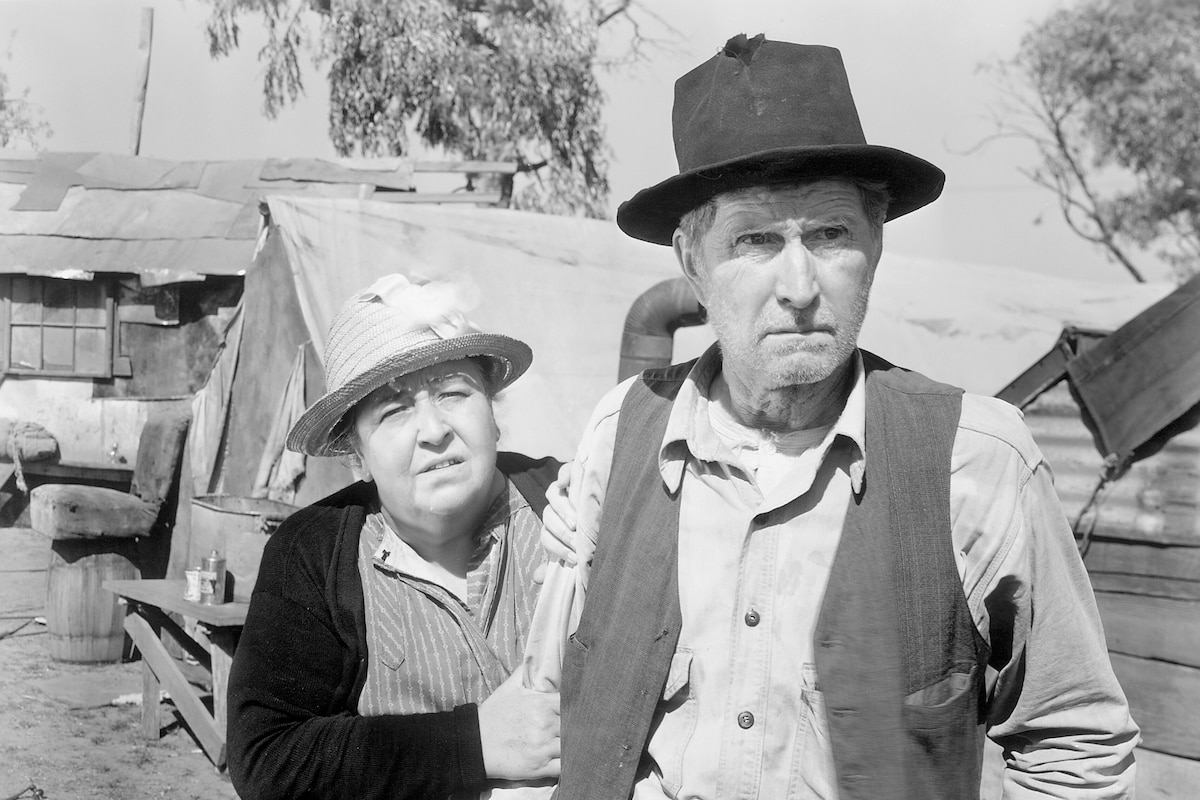
Famed Depression photographer Horace Bristol was asked to help with the casting of The Grapes of Wrath, which he later said was the reason many of the characters in the film resemble the real people in his photographs.
The benevolent director of the fictional government camp in the film resembles then President Franklin Roosevelt. He was in fact modeled after Tom Collins, the director of the actual camp in California on which Steinbeck's Weedpatch Camp was modeled. Steinbeck dedicated the book to him, and Collins also served as technical adviser to the film (and not the actor Tom Collins, who is sometimes mistakenly cross-referenced as the technical adviser). Collins's advice on the dress, manners, habits, speech, and culture of the migrants contributed greatly to the film's authentic feel.
In the late 1980s, Chicago's Steppenwolf Theater Company adapted Steinbeck's book for the stage, with his original tone and the famous downbeat ending intact. It also ran successfully on Broadway. Actor Gary Sinise played Tom Joad. It was adapted for public television in 1991.
A 25-hour radio reading of Steinbeck's novel was broadcast on Los Angeles radio station KPFK-FM on its 50th anniversary in 1989, featuring the voices of Carl Reiner, Kris Kristofferson, and Laraine Newman.
An opera based on the novel was co-produced in 2007 by the Minnesota Opera and Utah Symphony and Opera, with music by Ricky Ian Gordon and libretto by Michael Korie.
After seeing The Grapes of Wrath in 1940, Woody Guthrie recorded a ballad called "Tom Joad," set to a traditional American folk tune. The song, so long it had to be recorded in two parts, summarizes the plot of the book and movie, which Guthrie described as "the best cussed pitcher I ever seen."
Several other musicians have referenced Steinbeck's story in their work, including Pink Floyd, Kris Kristofferson, Rage Against the Machine, and most famously by Bruce Springsteen, who said his song and album, "The Ghost of Tom Joad," were first based on the film.
Author T.C. Boyle published a 1995 book called The Tortilla Curtain about the lives of contemporary Mexican immigrants, which he said was inspired by the effort Steinbeck made to remedy injustice in a world that hasn't changed as much as we would like to believe.
A 1959 Bugs Bunny cartoon was titled "Apes of Wrath."
"I think it is well done, but I wonder if it will convey to many people the reality of what they are seeing....I did not feel the tragedy gripped the audience. They did not seem really to know what this story actually meant." First Lady Eleanor Roosevelt in her daily column after seeing the film in Florida in 1940.
by Rob Nixon
Pop Culture 101 - The Grapes of Wrath
by Rob Nixon | May 12, 2009
SIGN UP FOR OUR NEWSLETTERS

CONNECT WITH TCM