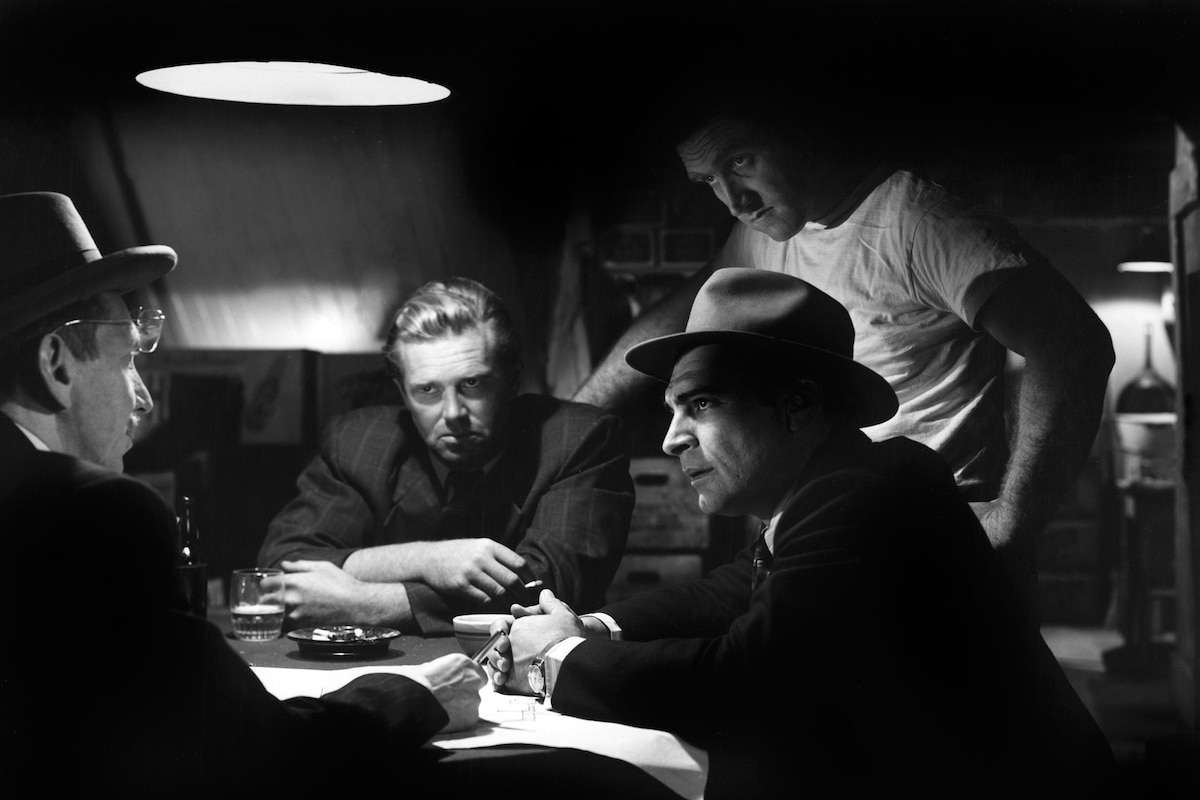
The Asphalt Jungle marked a departure for director John Huston. As
e
xemplified by his spectacular directorial debut, The Maltese Falcon
(1941),
Huston rarely took his camera beyond the confines of an interior
setting, whether
it be a shady tenement or a moody police station. With the
The Asphalt
Jungle, Huston now had the story to allow him and his camera
to move out from
under a roof. However, Huston still kept the film behind the
walls at MGM Studios
in Culver City, California. Most of the urban thriller was
filmed there, with the
last scene shot in Lexington, Kentucky.
The menacing
urban environment inspired other filmmakers to actually set and shoot
their
tough little melodramas outside the controlled environment of the studio set.
T
he creators behind films like Killer's Kiss (1955), and The Phenix
City
Story (1955) opted for the city or on-location shooting because it was
cheaper
than studio shooting and the reality of on-location lent an immediacy to
the story
being told. Ironically, without having been shot in a real city,
The Asphalt
Jungle showed how city street realism could make a film noir
narrative come
alive with a pervasive sense of menace.
The Asphalt Jungle has influenced a
number of films about elaborately
planned heists, like The Killing (1957),
also starring Sterling Hayden in
a very similar role. Others include Ocean's
11 (1960), Dog Day
Afternoon (1975), Reservoir Dogs (1992),
Heat (1997), and more
recently, The Score (2001) and Heist
(2001).
Another debtor,
The Usual Suspects (1995), even alludes to the line of
dialogue about
crime being a left-handed form of human endeavor. So far, there
have been three
remakes of The Asphalt Jungle: The Badlanders
(1958),
Cairo (1963), and Cool Breeze (1972).
The Asphalt Jungle was not the first W.R. Burnett novel John Huston
adapted
for the screen. In 1941, Huston wrote the screenplay for High
Sierra, an
adaptation of a Burnett novel and starring Ida Lupino and
Humphrey Bogart.
by Scott McGee
Pop Culture 101 - The Asphalt Jungle
by Scott McGee | May 12, 2009
SIGN UP FOR OUR NEWSLETTERS

CONNECT WITH TCM