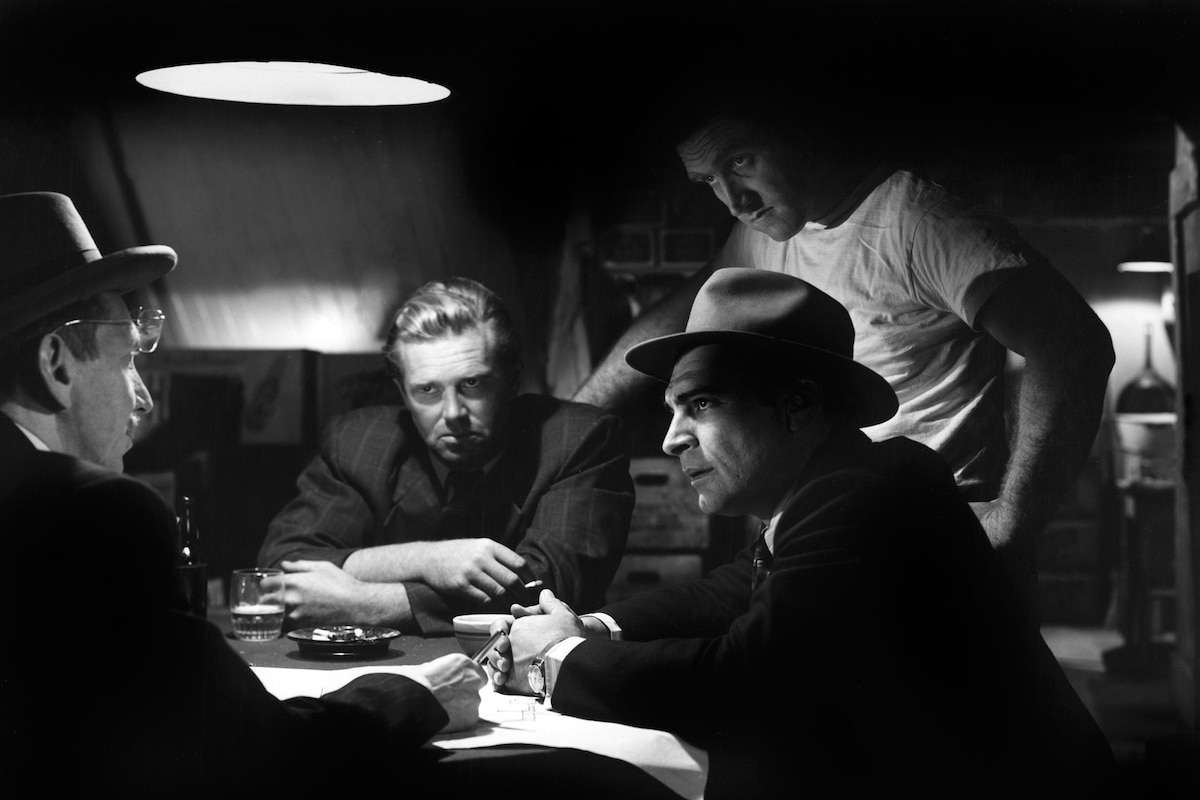
When the script for The Asphalt Jungle was completed, Huston decided to
cast
the film with relative unknowns. Huston first firmed up the role of Doc
with his
old friend Sam Jaffe. Huston also handpicked Louis Calhern, James
Whitmore, Jean
Hagen, and Marc Lawrence, who had played Ziggy, one of the
gangsters in Key
Largo (1948).
For the lead role of Dix Handley, Huston chose Sterling Hayden, whom the
director
met in Washington, D.C. during a protest against the House of Un-
American
Activities Committee investigation. When the pair met to discuss the
project,
Huston said to Hayden, "I've admired you for a long time, Sterling.
They don't know
what to make of a guy like you in this business." Huston was
honest with Hayden
about his chance for the lead role in The Asphalt
Jungle. Hayden recounts
in his biography Huston's pitch: "Now, Sterling, I
want you to do this part. The
studio does not. They want a top name star.
They say you mean nothing when it
comes to box office draw-I told them there
aren't five names in this town (that)
mean a damn thing at the box office.
Fortunately, they're not making this picture.
I am. Now let me tell you about
Dix Handley....Dix is you and me and every other
man who can't fit into the
groove." Rumored to be fighting severe alcohol and
psychiatric problems, Hayden
landed Dix Handley, his first major starring role,
over the objection of MGM
executive Dore Schary. Hayden's gritty performance
proved many Hollywood
naysayers flat wrong. For instance, Hayden himself was
nervous about the
climactic scene in the picture, when Dix breaks down in tears in
front of Jean
Hagen. According to the director though, Hayden did not have
anything to worry
about. After the actor delivered the scene beautifully, Huston
took Hayden
aside and said, "The next time somebody says you can't act, tell them
to call
Huston."
Marilyn Monroe was a bit actress under contract to Fox and had not yet had a
s
peaking role; Fox eventually dropped her contract. At least two versions exist
as
to how Monroe came to be cast in MGM's production of The Asphalt
Jungle.
One version has an employee of MGM's talent department suggesting
that John Huston
try out Monroe for the part of Louis Calhern's mistress, with
Huston immediately
recognizing her as perfect for the role after her sensual
audition. But another
version, as supported by MGM archives, has Monroe as a
"dark horse" contender for
the role. Huston had reportedly already chosen a
blond actress named Lola Albright
for the role. When a very nervous Monroe
auditioned for the part, Huston was not
impressed. But Albright had recently
found success with a supporting role in
Champion (1949), so it was
unlikely she would accept a small role in the
crime melodrama. Huston tested
eight other starlets, but Monroe stayed in the
running, mainly because of the
persistence of MGM talent director, Lucille Ryman
Carroll. Huston remained
adamant that Monroe wouldn't fit the bill, until Carroll
prevailed by taking
advantage of an ironic coincidence.
It turned out that Huston,
an avid
horseman, had a team of Irish stallions boarded and trained at Carroll's
ranch,
and he happened to be $18,000 in arrears for payments to the ranch. On a
Sunday
afternoon in September, Carroll and her husband invited Huston out to the
ranch
and made him an offer he couldn't refuse, to borrow a line from another
movie.
Carroll informed Huston that if he did not allow Monroe another shot at
the
role, the ranch would sell his stallions and collect the money due. Huston did
n
ot refuse the terms, and Monroe got another screen test, only this time, she
had
the support of MGM chief Louis B. Mayer and MGM hair stylist Sidney
Guilaroff.
Monroe got the small role, of which she would eventually regard as
one of her best
performances, particularly the last scene with Calhern. When
Fox chief Darryl F.
Zanuck saw The Asphalt Jungle, he again assumed her
contract.
The censors had a conniption over Louis Calhern's suicide as written in the
o
riginal script. In the rejected scene, Calhern was to write a short, moving
letter
to his wife, then take a pistol out of his desk and do the deed. While
suicide was
a top no-no on the list of forbidden acts, what made the scene more
objectionable
to the censors was the fact that Calhern's character was
apparently in his right
mind. They reasoned that no man in his right mind would
commit suicide. According
to John Huston, the rewritten suicide in the final
film ironically made for a much
better scene.
During the production of The Asphalt Jungle, Walter Huston
came to
Hollywood for his son John's forty-fourth birthday party. Two days later,
with
John at his side, the legendary actor of stage and screen, died of heart
failure
at the age of sixty-six.
When The Asphalt Jungle was being prepared for a British bow, the
producers
hesitated because the film was so full of American slang. At the
time, films heavy
with slang were usually redubbed for English audiences.
Gerard Fairlie, the British
author of the Bulldog Drummond adventure stories,
was called upon as a consultant,
and he advised against redubbing, even though
some words would go right over the
heads of British viewers. The film was not
redubbed and earned boffo box-office in
England.
by Scott McGee
Behind the Camera - The Asphalt Jungle
by Scott McGee | May 12, 2009
SIGN UP FOR OUR NEWSLETTERS

CONNECT WITH TCM