SYNOPSIS:
A stylish, corrupt lawyer,
Alonzo D. Emmerich, puts his money up for an elaborate jewel
heist, hatched by criminal mastermind Doc Riedenschneider and
executed by a crew of career thieves, made up of Dix Handley,
Gus Ninissi, and Louis Ciavelli. But the
meticulous planning for the heist begins to unravel, causing the den of thieves
to spiral towards its ultimate fate.
Producer: Arthur Hornblow, Jr.
Director: John Huston
Screenplay: Ben Maddow, John Huston, from the novel by W. R. Burnett
Cinematography: Harold Rosson
Film Editing: George Boemler
Art Direction: Cedric Gibbons, Randall Duell
Music: Miklos Rozsa
Cast: Sterling Hayden (Dix Handley), Louis Calhern (Alonzo D. Emmerich), Jean Hagen
(Doll Conovan), James Whitmore (Gus Minissi), Sam Jaffe (Doc Riedenschneider), John
McIntire (Police Commissioner Hardy), Marc Lawrence (Cobby), Anthony Caruso (Louis
Ciavelli), Marilyn Monroe (Angela Phinlay), Brad Dexter (Bob Brannom), Dorothy Tree
(May Emmerich).
BW-113m. Closed captioning. Descriptive Video.
Why THE ASPHALT JUNGLE is Essential:
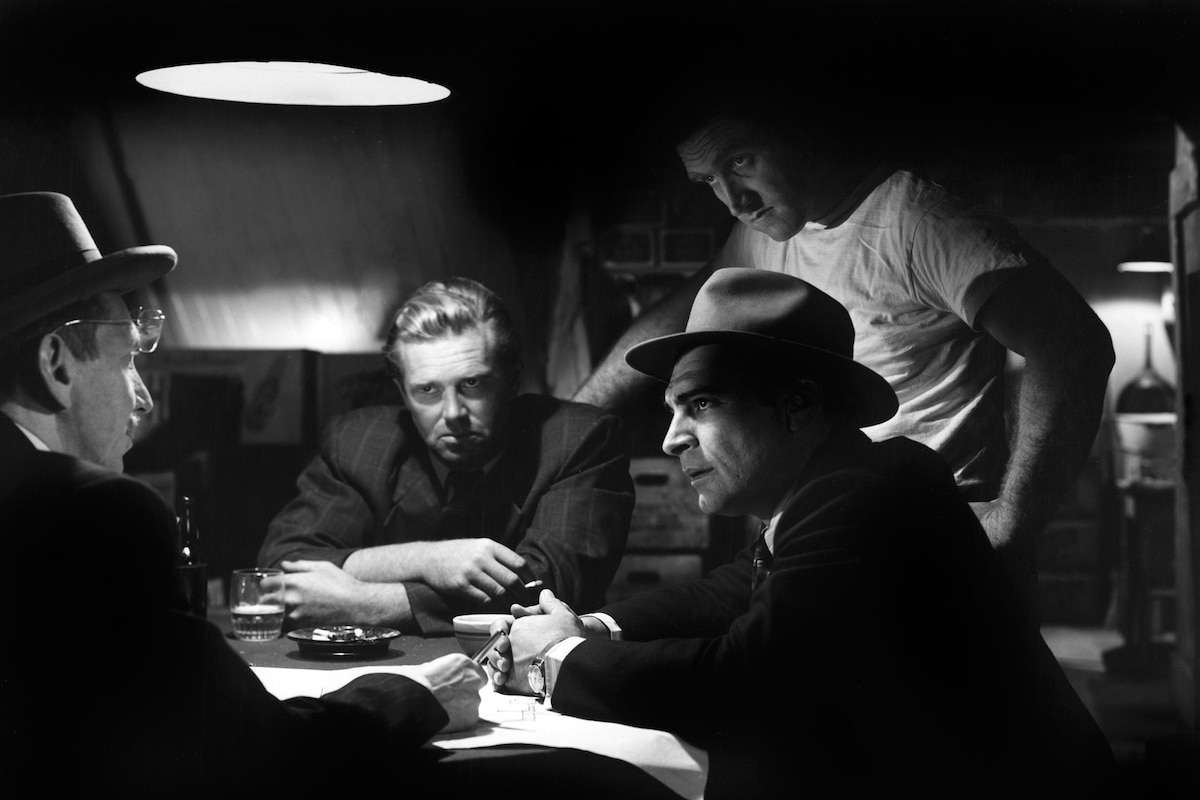
The Asphalt Jungle is a different kind of film noir from John Huston,
director of The Maltese Falcon (1941) and Key Largo (1948), two
key entries from the heyday of the classic noir period. Instead of the cramped,
claustrophobic settings of The Maltese Falcon and Key Largo,
Huston adopts an open, smooth, and uncluttered style of framing. This is an
ironic gesture, since other films noir, such as The Stranger on the Third
Floor (1940) and the later Killer's Kiss (1955), are oppressive and
threatening. But the city is more than an incidental setting of the plot. It
is a crucial element to the story, one that influences the story, the
characters, and how we respond as viewers. Huston understood that the city was, in
a sense, the most important character in the film.
The Asphalt Jungle was also different in that the criminal element is
given human dimensions. Huston not only creates sympathy for the gang, but he
shows respect for the way they do their jobs. Furthermore, instead of painting
them as soulless, murderous brutes, Huston imbues them with human weaknesses,
frailties, and certain aspects of humanity that viewers at the time would not
expect in a movie about criminals. Gone are the uncomplicated, unethical
killers like Tom Powers (James Cagney) of The Public Enemy (1931) and
Tony Camonte (Paul Muni) of Scarface (1932). The hoods in The Asphalt
Jungle are family men, proud professionals who perform their crimes with
proud precision, and essentially good men who happen to steal things. This is a
far cry from the psychotic Cody Jarrett (James Cagney) in the previous year's
White Heat (1949). Additionally, the women in The Asphalt Jungle
are not femme fatales, dangerous females that the male protagonists of film noir
should usually avoid like a bad habit. Rather, it is the man's obsession with
women that causes his downfall.
"Although MGM did not tamper with it, The Asphalt Jungle was criticized for
its liberal attitude toward the underworld," wrote film scholar Carlos Clarens in
Crime Movies: An Illustrated History. "In Huston's word: 'My defense...was
that unless we understand the criminal...there's no way of coping with him.' This is
a proposition that Huston conveyed , at its simplest, by having the straights
misconstrue the hoods, their dark-mirror images. 'When I think of all those awful
people you come in contact with, downright criminals, I get scared,' says the
lawyer's crippled wife (Dorothy Tree); to which her husband replies, 'There's
nothing so different about them.'
Today, The Asphalt Jungle is regarded by film historians and critics as a
seminal movie in the film noir genre and its style and storyline were imitated
repeatedly in a string of crime thrillers that followed in its wake. Among the
remakes it spawned are The Badlanders (1950), a Western starring Alan Ladd,
Cairo (1962) with George Sanders and Cool Breeze (1972), a
'blaxploitation' version featuring Thalmus Rasulala. More importantly, The
Asphalt Jungle garnered three Oscar nominations - for Best Director, Best
Screenplay and Best Cinematography - and gave Marilyn Monroe one of her first
significant roles as the naive mistress of Louis Calhern's crooked lawyer.
by Scott McGee
The Essentials - The Asphalt Jungle
by Scott McGee | May 12, 2009
SIGN UP FOR OUR NEWSLETTERS

CONNECT WITH TCM