The Critics' Corner: THE MAN WHO CAME TO DINNER
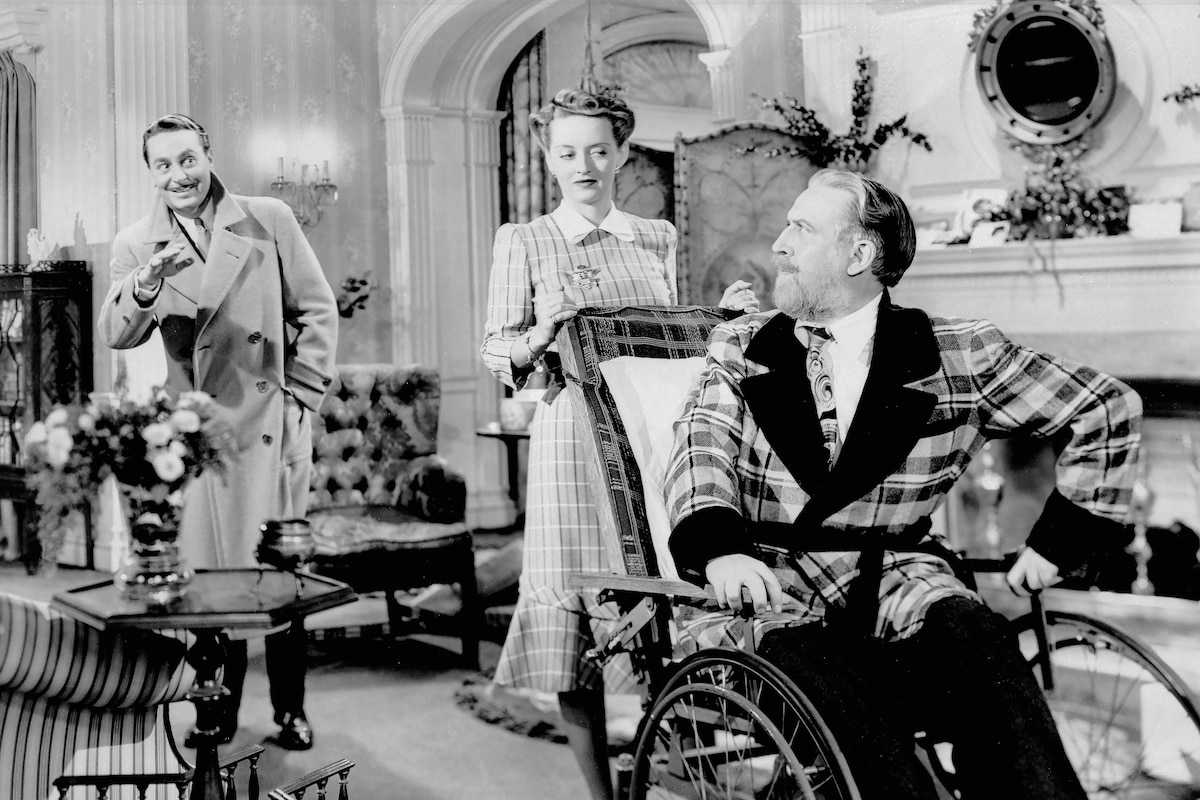
"Just in time to slip under the wire as the niftiest comedy of 1942 (to date), the Warners' meticulous screen version of the George S. Kaufman-Moss Hart play, The Man Who Came to Dinner, kept an appointment at the Strand yesterday and pealed off more concentrated merriment than did the New Year's bells...in the space of something like an hour and fifty-two minutes, is compacted what is unquestionably the most vicious but hilarious cat-clawing exhibition ever put on the screen, a deliciously wicked character portrait and a helter-skelter satire, withal...Also the Warners were most wise when they finally decided to cast Monty Woolley in the title role which he so handsomely played on the stage. For Mr. Woolley makes The Man Who Came to Dinner a rare old goat. His zest for rascality is delightful, he spouts alliterations as though he were spitting out orange seeds, and his dynamic dudgeons in a wheelchair are even mightier than those of Lionel Barrymore. A more entertaining buttinsky could hardly be conceived, and a less entertaining one would be murdered on the spot. One palm should be handed Bette Davis for accepting the secondary role of the secretary, and another palm should be handed her for playing it so moderately and well. Ann Sheridan, too, as an actress of definitely feline breed, gives a tartly mannered performance, and Jimmy Durante plays Jimmy Durante with so much gusto that it is just as well for our diaphragms that his part is comparatively brief. He's a killer while in there, though. And Reginald Gardiner, Billie Burke, Grant Mitchell, Mary Wickes, a new young actor named Richard Travis and a cast which is perfect to a man assist most competently...It makes laughing at famous people a most satisfying delight."
The New York Times
"The Man Who Came to Dinner...continues the glorification of that rococo personality, Monty Woolley...Actor Woolley merely transfers to celluloid, for the exquisite benefit of cinemaddicts and posterity, the unexpurgated version of Alexander Woollcott which he played for two years on Broadway. The switch from Broadway to Hollywood is scarcely noticeable...Although there is hardly room for the rest of the cast to sandwich in much of a performance between this fattest of fat parts, Bette Davis, hair up, neuroses gone, is excellent as Woolley's lovesick secretary...Jimmy Durante, as himself; Billie Burke and Grant Mitchell, as the insulted and injured hosts; Reginald Gardiner, as Noel Coward, are tops...Possessor of the most Edwardian visage of his era, bon vivant, trust-funder, darling of Manhattan's cafe society, onetime Yale English instructor, 53-year-old Actor Woolley plays Sheridan Whiteside with such vast authority and competence that it is difficult to imagine anyone else attempting it. As one of his intimates has remarked: 'At last the old party has got the role he's been rehearsing for all his life.'"
- Time Magazine
"In the 30s, the unctuous, sentimental Alexander Woollcott was loved by millions of radio listeners; Woollcott the outrageous master of euphonious insults was loved and hated by a small circle. Two members of this circle, George S. Kaufman and Moss Hart, made him the hero and the target of their 1939 Broadway hit-a cheerful spoof on celebrity in that period. In this film version, the devastatingly adroit Monty Woolley (a former professor of drama at Yale) plays the arrogant, infantile Sheridan Whiteside, who goes on a lecture tour and breaks his hip while attending a dinner in his honor at the home of boring, worshipful fans. Stuck in that home until his hip mends, he takes it over and orders the residents around. Woolley has a wonderful way of looking at these hick fans with compassionate contempt-he feels sorry for them because they're too obtuse to appreciate how brilliant he is. The play, however, was built on topical jokes and a series of vaudeville turns, and in this version the jokes are flat and the turns seemed forced and not very funny. With Bette Davis as Whiteside's secretary, Reginald Gardiner impersonating Noel Coward, Jimmy Durante in the role based on Harpo Marx, Ann Sheridan as the sexpot actress, and Billie Burke, Richard Travis, George Barbier, and Grant Mitchell. Directed by William Keighley; the script, by the Epstein brothers, changed only a few lines."
Pauline Kael
"One of the most welcome comedies of the season...Monty Woolley is even better than he was in the Broadway version...Bette Davis has, if anything, built up her star stature by accepting the secondary part."
- Variety
"...it is Woolley that makes The Man Who Came to Dinner the outstanding film that it is. Woolley is given many great lines, but it is timing and personality that makes them as funny as they are. When Whiteside delivers an insult, it is blistering and devastating."
- Brian Koller, filmsgraded.com
"It's rather unimaginatively directed, but the performers savour the sharp, sparklingly cynical dialogue with glee."
- Geoff Andrew, TimeOut Film Guide
"Delightfully malicious caricature of Alexander Woollcott which, though virtually confined to one set, moves so fast that one barely notices the lack of cinematic variety, and certainly provides more than a laugh a minute, especially for those old enough to understand all the references."
- Halliwell's Film & Video Guide
"Monty Woolley enthusiastically recreated his stage performance and Bette Davis skillfully portrayed the secretary; the film bears the marks of its stage origins but William Keighley maintained an effectively frantic comic pace."
- The Oxford Companion to Film
"Delightful adaptation of George S. Kaufman-Moss Hart play"
- Leonard Maltin's Movie Guide
"From this frenetic, slapsticky staging, it's difficult to see what kept the New York audiences coming back; it's only Bette Davis, in the sole straight part, who manages to rise above the general atmosphere of laugh-begging desperation."
- Dave Kehr, Chicago Reader
"The Man Who Came to Dinner brilliantly combines screwball and drawing room comedy, yet its superb writing hides the nuts and bolts of its complicated construction. Screenwriters Julius J. and Philip G. Epstein (who would pen Casablanca later the same year) open up the play just enough to let it breathe, but wisely retain most of the original dialogue and all of the chaotic action. And what wacky chaos it is! How many other films feature an octopus, roaming penguins, a saintly boys choir, and a bona fide Lizzie Borden all vying for attention? Yet despite such zany distractions, The Man Who Came to Dinner still presents a focused narrative and tempers its lunacy with several scenes of heartrending warmth and meaning. The film mirrors You Can't Take It With You (another Kaufman and Hart gem) in style and structure, as it introduces a host of seemingly disjointed subplots that somehow intertwine by the final curtain. And with such an eccentric cast of characters, even the smallest bit players find a way to shine."
- David Krauss, www.digitallyobsessed.com
Compiled by Andrea Passafiume
Critics' Corner - The Man Who Came to Dinner
by Andrea Passafiume | May 12, 2009
SIGN UP FOR OUR NEWSLETTERS

CONNECT WITH TCM