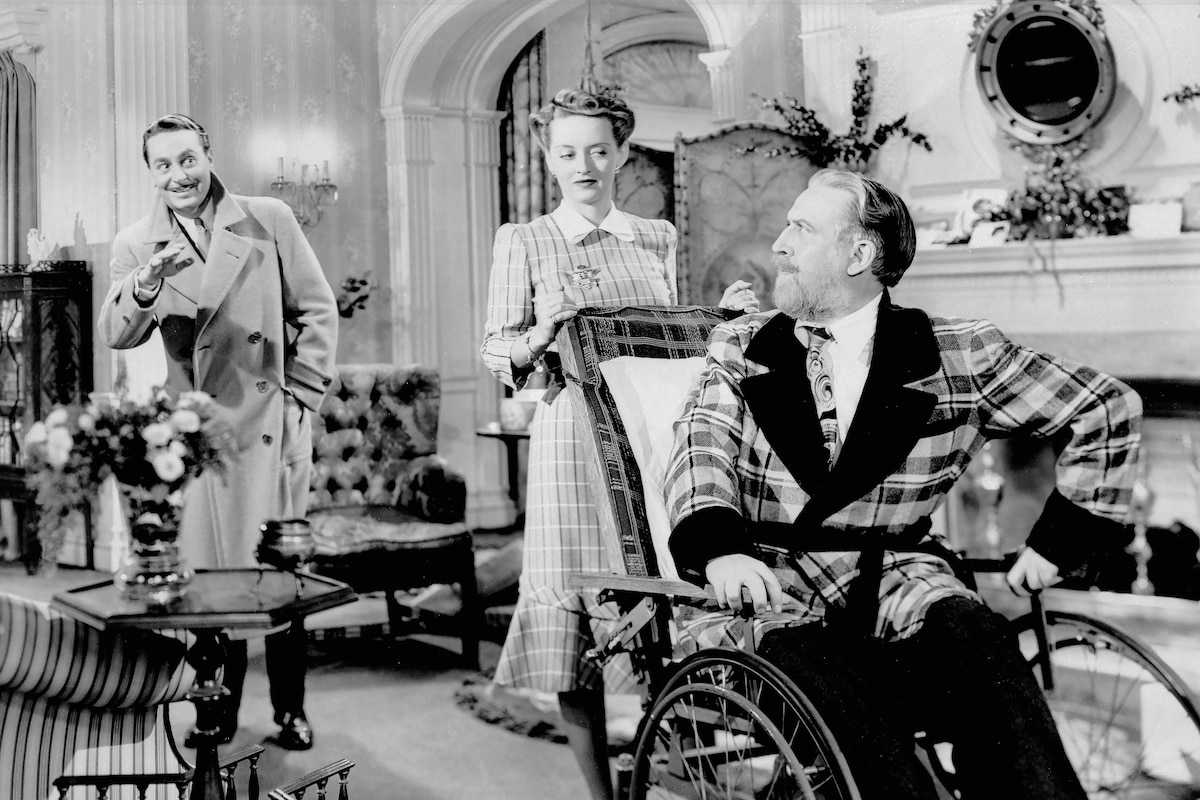
Shooting began on The Man Who Came to Dinner in July 1941. Bette Davis, who had gone into the film disappointed with the choice of Monty Woolley as Sheridan Whiteside, put aside her differences and gave her best as an actress. Though she still wished that John Barrymore was playing Whiteside, she eventually warmed up to Woolley and the two got along fine.
The filming of The Man Who Came to Dinner proceeded smoothly with the cast working well together as an ensemble. Ann Sheridan had a particularly stressful time making the film because she was shooting another film, Kings Row (1942), simultaneously. When Sheridan was asked later if she had run into any trouble with the notoriously temperamental star Bette Davis, she denied it. "Oh, no. Very little," she said. "She wasn't happy about a lot of things...But this had nothing to do with me. I adored her. Wouldn't dream of fighting with her at all so she got very nice. She was just temperamental. Who isn't now and then?"
The only real snafu that happened during the making of The Man Who Came to Dinner was a bizarre one: Bette Davis' dog bit her hard on the nose, leaving a noticeable wound. Davis had to retreat to her home in New Hampshire for several weeks, according to Hal Wallis, in order to heal and be presentable for the camera. She eventually returned to the set before her nose was fully healed. "We shot for two days with Bette's back to the camera," said Wallis. "This was fine, except that every time the other actors saw her, they broke into fits of giggling led by Monty Woolley. It became impossible for them to speak their lines."
The Man Who Came to Dinner opened in January 1942. It was a solid hit and received much critical praise, though surprisingly it did not receive any Academy Award nominations. Bette Davis expressed later that she blamed the direction. "I felt the film was not directed in a very imaginative way," she said in 1974. "For me it was not a happy film to make that it was a success, of course, did make me happy. I guess I never got over my disappointment in not working with the great John Barrymore."
Audiences, however, loved Monty Woolley as Sheridan Whiteside. The characterization was one of the funniest and most unique ever put on the screen. The film not only was a comic treasure, but it also helped forever cement the legacy of the impossible yet irresistible figure of its inspiration, Alexander Woollcott. "...it turned his insults into high comedy," said writer Edmund P. Hoyt in his 1968 book Alexander Woollcott: The Man Who Came to Dinner, "and undoubtedly prevented his being socked in the jaw at least twice a week."
by Andrea Passafiume
Behind the Camera - The Man Who Came to Dinner
by Andrea Passafiume | May 12, 2009
SIGN UP FOR OUR NEWSLETTERS

CONNECT WITH TCM