The Man Who Came to Dinner all began with Alexander Woollcott. Woollcott, a larger-than-life character and fixture of the famed Algonquin Round Table, was one of the most eminent critics and radio personalities of the 1920s and 30s. As writer Jared Brown describes him in his 2006 book Moss Hart: A Prince of the Theatre, Woollcott "was one of the most famous men in the United States, a critic of such influence that a word from him could make or break a play or novel, a raconteur whose witticisms and invective were constantly quoted, a frequent visitor to the White House and the homes of the world's most famous artists and statesmen." While many prominent people called Woollcott a friend, he was also known for his acid tongue and demanding, impossible-to-please attitude. He could be charming and generous one minute; petulant and venomous the next.
Woollcott counted among his friends the highly successful playwriting team of George S. Kaufman and Moss Hart. One evening while Woollcott was visiting Moss Hart, he made an unusual request. He wanted Hart and Kaufman to write a new play for him to star in. Woollcott had dabbled in acting before and thought that being in a play would be a new way in which to reach his massive audience. Somewhat dubious but not wanting to disappoint his friend, Hart agreed to give the matter some thought.
Hart and Kaufman started kicking around the idea of what sort of play they could write for Woollcott. Should it be a comedy? A drama? What sort of role would suit him best? They weren't able to come up with any idea that seemed to work. Then Hart remembered a particular overnight visit that Woollcott had made to his Pennsylvania country home earlier in the year.
Woollcott's visit had been an unmitigated nightmare. His behavior was outrageous. "He made one irritating demand after another," describes Jared Brown, "insisting, for example, that he would not go to bed unless a milkshake and chocolate cookies were prepared for him, demanding that all the heat in the house be turned off, and refusing to sleep in any room other than Hart's bedroom. He also accused the servants of dishonesty." When Hart later read Woollcott's entry in the guestbook he kept in the house, the disagreeable guest had written: "I wish to say that on my first visit to Moss Hart's house I had one of the most unpleasant evenings I can ever recall having spent."
When describing the disastrous visit to Kaufman, Moss Hart punctuated his story with the thought, "Wouldn't it have been awful if [Woollcott] had broken a leg and been on my hands for the rest of the summer?" The two of them looked at each other and something clicked. This should be the idea for the play.
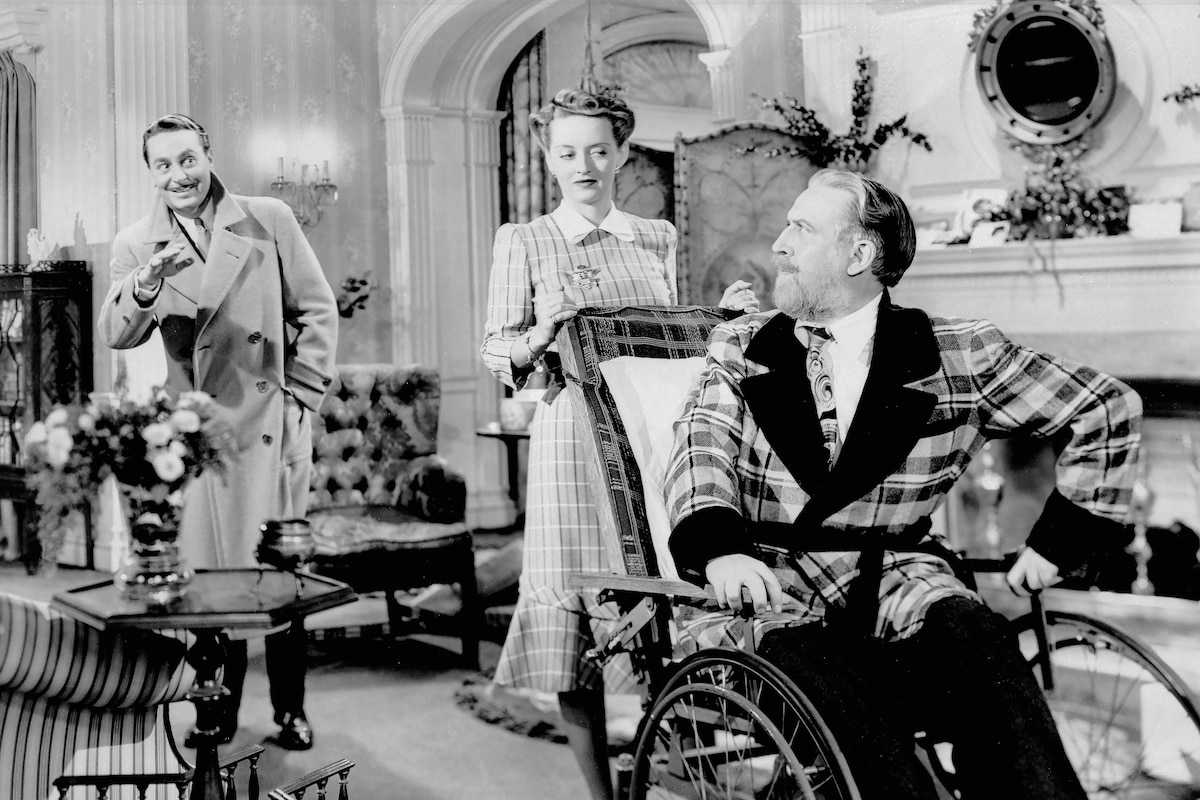
The play The Man Who Came to Dinner opened on Broadway to great acclaim on October 16, 1939. It starred Monty Woolley as the Woollcott inspired character Sheridan Whiteside. Far from being insulted, Woollcott loved the play, but felt he was too close to the character to play him on stage.
Warner Bros. bought the film rights to the play for $275,000 and assigned the task of writing the screenplay to the filial team of Julius J. and Philip G. Epstein. William Keighley (The Bride Came C.O.D. [1941]) was assigned to direct. At first Alexander Woollcott resisted giving Warner Bros. his permission for a film version to be made. Some said that he was fearful of losing control over how the character of Sheridan was played. Others believed that Woollcott simply wanted to be sure that he got credit for being the initial inspiration for the play. In a characteristically prickly note to George S. Kaufman, Woollcott wrote: "I thought and still think of [the $12,375 Warners offered him] as a token payment acknowledging the considerable indebtedness to me in the matter of the whole venture, which neither you nor Hart had ever recognized or at least admitted." Eventually, Woollcott did grant his permission for the film project to move forward.
Bette Davis had gone to see the stage play of The Man Who Came to Dinner while on a visit to New York and loved it. She thought that the part of Maggie, Sheridan Whiteside's long suffering secretary, would be a good part for her. It would be a chance for her to break from her usual heavy dramatic roles and do a light comedy for a change, something unusual for her.
Warner Bros. was surprised when Davis lobbied to play Maggie in the film version. Davis, a two-time Oscar® winner for Best Actress, was one of Warner Bros. top stars. The Man Who Came to Dinner was an ensemble piece and Maggie was a supporting character that would have to play second fiddle to Sheridan Whiteside. The studio felt that the role might be better suited to Rosalind Russell or Jean Arthur, but Davis continued to push. She knew that it was a good piece and simply wanted to be a part of it. Warner Bros. relented and gave her the part knowing that it certainly wouldn't hurt to have Davis' star power behind the film.
The starring role of Sheridan Whiteside was the most difficult part to cast. It was such a rich role that several Hollywood actors were interested. Bette Davis desperately wanted producer Hal Wallis to cast John Barrymore, but Barrymore's drinking problem got in the way. "Bette Davis urged me to use John Barrymore," said Hal Wallis in his 1980 autobiography Starmaker, "but I couldn't risk it. The dialogue in The Man Who Came to Dinner was tremendously complicated, and Barrymore was drinking so heavily that he had to read his lines from cue cards." While Monty Woolley had been brilliant in the play, he was not a name actor that would be recognizable to movie audiences and the studio resisted using him. Wallis kept looking.
Academy Award-winning actor Charles Laughton also wanted the role. "...Laughton was desperate to play the part," said Wallis, "and even offered to test for it. His agent, Phil Berg, sent me an endless stream of notes urging me to consider him. Jack Warner was afraid that Laughton, a homosexual, might be effeminate in the role. Director Edmund Goulding handled his test very carefully, but Jack turned out to be right. We had to tell his agent that his client was out of the question." Laughton was upset. "Laughton, a very emotional man," said Wallis, "broke into tears when he heard the news. Berg called and asked me to give him another chance...I was touched by the call and gave Laughton another test. But it was a disaster, worse than the first. When he left the studio, Laughton's face was a picture of despair."
The studio tested Laird Cregar who had been making a name for himself in films for Twentieth Century-Fox such as Blood and Sand (1941) and The Black Swan (1942) as well as actor Robert Benchley. Though talented, Wallis found Cregar's interpretation of Sheridan Whiteside "overblown and extravagant." Benchley's test he found "too mild mannered." Even Cary Grant was suggested by Jack Warner, though Wallis found Grant "far too young and attractive."
Orson Welles threw his hat into the ring also to play Sheridan Whiteside. However, he also wanted to direct the film. Warner Bros. liked the idea of his acting in the film, but not directing. Welles said that he would do the part, but only if Leo McCarey or Howard Hawks would direct. The plans were thwarted, however, when it turned out that neither McCarey nor Hawks was available. Additionally, RKO Studios called Hal Wallis and made it clear that Welles was under contract to them and they would refuse to let him make The Man Who Came to Dinner. According to Hal Wallis, even the First Lady herself, Eleanor Roosevelt, called him personally to convince him to put Orson Welles in the film. "I referred her to George Schaefer [at RKO]," said Wallis. "Apparently even her unique powers of persuasion could not overcome that tough man's decision."
Finally, with time slipping away, Wallis and Warner thought again of Monty Woolley, who had made such a hit with his performance in the stage version. "In desperation, we went back to Monty Woolley," said Wallis. "Jack [Warner] was afraid that Woolley's homosexuality would be obvious in the scenes. Bette Davis hated him and threatened that she wouldn't work with him, but we tested him anyway...He was excellent. His acid, piercingly sharp delivery of the lines, spoiled-child mannerisms, and outbursts of petulant rage were perfection itself. We felt that Bette and a strong enough cast could make up for the fact that Woolley wasn't a box office name."
Rounding out the cast were Ann Sheridan as Whiteside's delectable actress friend Lorraine, Richard Travis as Maggie's local love interest Bert, Jimmy Durante as the manic entertainer Banjo, Reginald Gardiner as the Noel Coward-esque Beverly Carlton, Billie Burke and Grant Mitchell as the put-upon hosts the Stanleys, Mary Wickes reprising her stage role as Miss Preen, and Ruth Vivian also reprising her original stage role as the batty Harriet.
by Andrea Passafiume
The Big Idea - The Man Who Came to Dinner
by Andrea Passafiume | May 12, 2009
SIGN UP FOR OUR NEWSLETTERS

CONNECT WITH TCM