Used to working with Otto Preminger, who would scream at her even before the first take to get the performance he wanted, Jean Seberg had trouble adapting to Jack Arnold's gentler directing style. It often took as many as 20 takes for her to get through a scene.
Seberg only had one line in the first scene shot, which she shared with Peter Sellers and Leo McKern. For the first several takes, she stepped forward for her line, then back when she was finished. When Arnold pointed this out to her, she said she didn't even know she was doing it. By the time she got her movements under control, she couldn't remember the line. After 25 takes, Arnold postponed the scene until a few days later.
Arnold soon learned that Sellers did his best work on the first take and was usually useless by take three. The actor, schooled in improvisation, couldn't keep the lines fresh if he had to say them over and over.
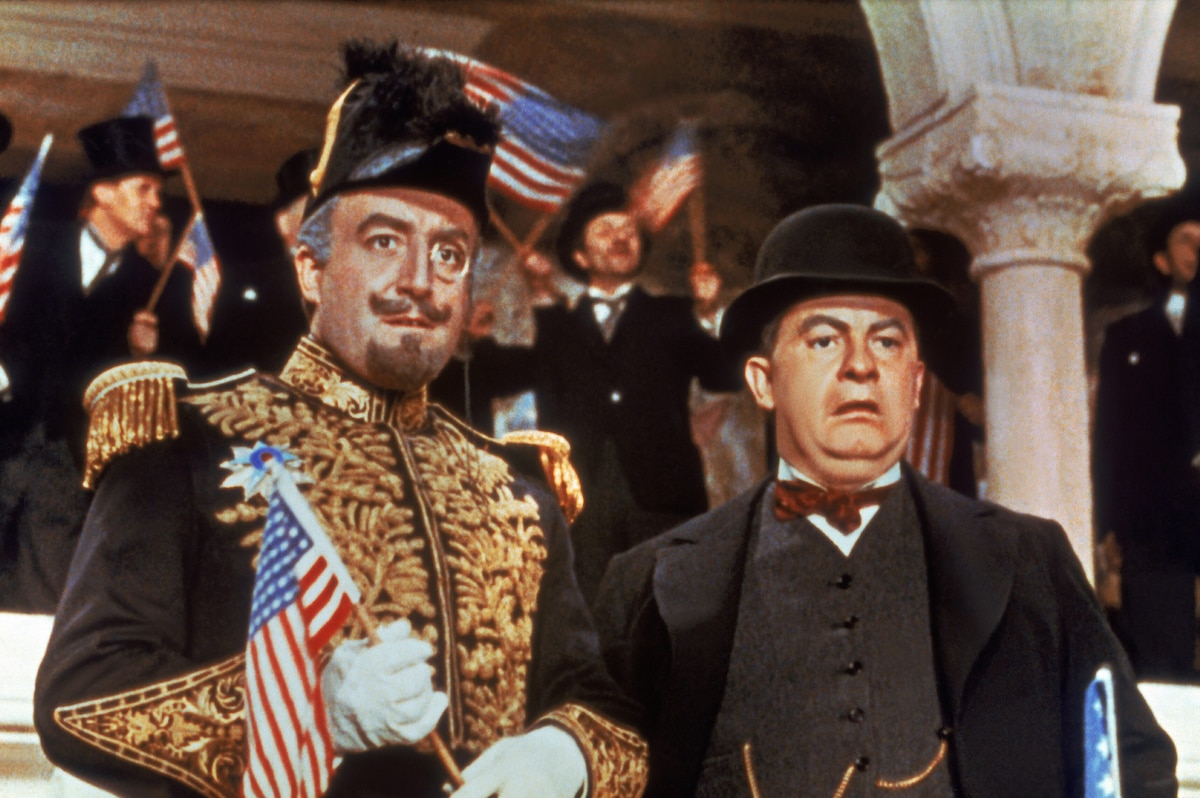
Sellers modeled the Grand Duchess on his grandmother, but also used shtick he had developed for the radio series Ned's a Laugh, on which one of the characters he played was an eccentric old woman named Crystal Jollibottom. The Prime Minister was modeled on Alec Guinness' interpretation of Disraeli in The Mudlark (1950).
While filming The Mouse That Roared, Sellers was acting on stage in the comedy Brouhaha, which also dealt with a mythical kingdom whose ruler develops an outlandish plot to secure U.S. aid. Five days a week, he had to be at the studio at 6:30 a.m. for makeup and wardrobe, then get himself to the theatre by 7 p.m. During location shooting, a driver picked him up at the theatre after the performance and he slept in the car on the way to the film shoot.
The scenes in the ports of Marseilles and New York were both shot in Southampton. By luck, the Queen Elizabeth was just landing there at the time, so Arnold had extras on the Fenwick tugboat get as close to the luxury liner as possible and fire arrows at her. Later he added a scene with Stuart Sanders as the Queen Elizabeth's captain reacting to the attack.
The castle of Grand Fenwick was a façade built on the back lot of England's Shepperton Studios. Arnold also used the surrounding countryside as the forests of Fenwick.
The invasion of Manhattan in The Mouse That Roared was shot in a section of London that had been completely rebuilt after being bombed heavily during World War II. The glass and concrete high rises provided a perfect stand-in for New York. Arnold also filmed background shots on the streets of New York early one Sunday morning, when traffic was at a minimum.
Although Arnold and Shenson thought the dailies were hilarious, Foreman and Columbia's European head didn't get it. Their lack of response was so discouraging, Arnold stopped going to the daily screenings.
Arnold did not ask the studio's permission to make fun of the Columbia logo, convinced they would say no. At the film's opening, "Miss Columbia" discovers a mouse under her skirts and runs off screaming. At the end she returns to her pedestal. Studio executives first heard of the joke when they attended the New York previews, where it got a huge laugh. After that, there was no thought of cutting it, though it is absent from some television prints.
Columbia previewed The Mouse That Roared at two different New York theatres, the Trans-Lux, which was an art house, and Loew's 84th Street, which showed more popular entertainment. Both audiences roared with laughter. As a result, Foreman recalled the prints so the titles could be changed from "High Road presents" to "Carl Foreman presents."
by Frank Miller
Behind the Camera - The Mouse That Roared
by Frank Miller | June 01, 2009
SIGN UP FOR OUR NEWSLETTERS

CONNECT WITH TCM