SYNOPSIS
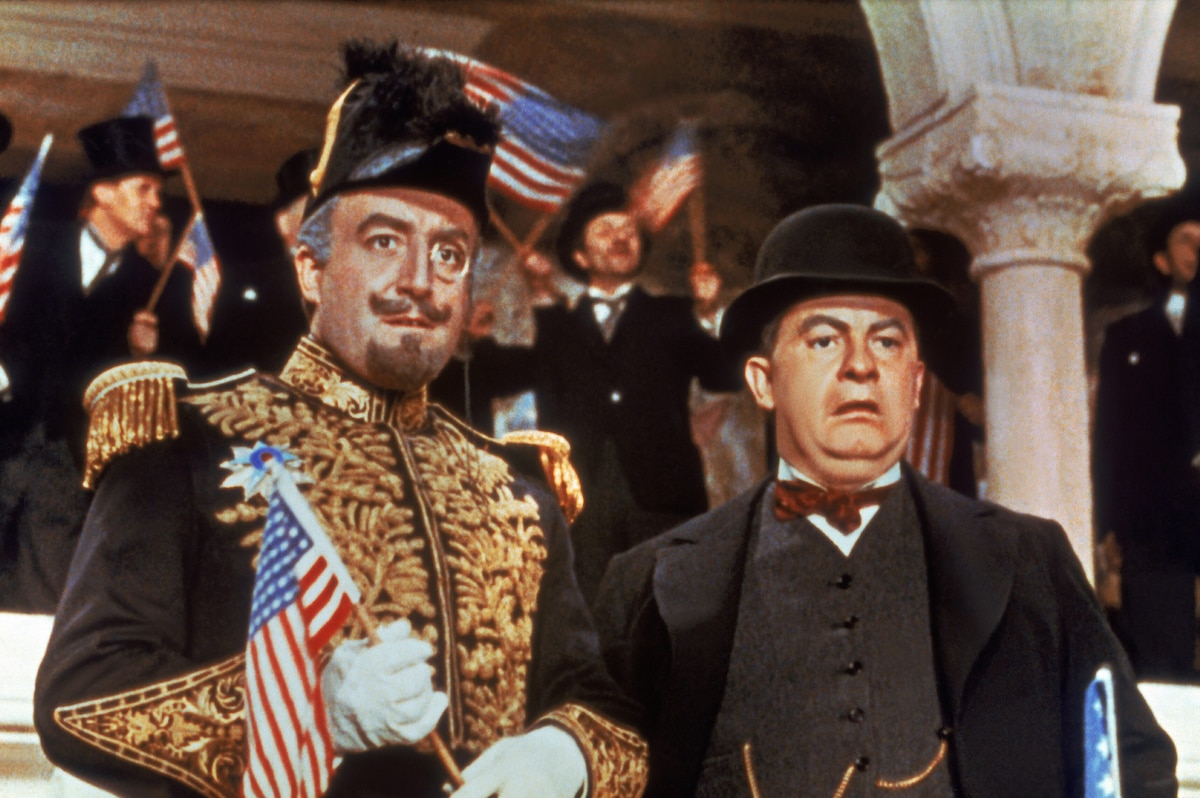
Faced with an insurmountable financial crisis, the Duchy of Grand Fenwick decides to declare war on the United States so they can lose and collect financial aid. The Prime Minister's plan goes awry, however, when the invading army of 20, led by the inept Field Marshall Tully Bascombe, manages to kidnap the inventor of the world-shaking Q-bomb. Bascombe's bungling of the scheme suddenly puts Fenwick and its doddering grand duchess at the center of international intrigue, while the Field Marshall finds himself drawn to the inventor's beautiful daughter.
Director: Jack Arnold
Producer: Carl Foreman, Jon Penington, Walter Shenson
Screenplay: Roger MacDougall, Stanley Mann
Based on the novel by Leonard Wibberley
Cinematography: John Wilcox
Editing: Raymond Poulton
Art Direction: Geoffrey Drake
Music: Edwin Astley
Cast: Peter Sellers (Tully Bascombe/Grand Duchess Gloriana XII/Prime Minister Count Mountjoy), Jean Seberg (Helen), David Kossoff (Prof. Kokintz), William Hartnell (Will), Monte Landis (Cobbley), Leo McKern (Benter), Bill Nagy (U.S. Policeman)
C-83m.
Why THE MOUSE THAT ROARED is Essential
After years of supporting roles and outstanding work on radio and television, Peter Sellers shot to international stardom with his three roles in The Mouse That Roared.
The film was the first feature in which Peter Sellers demonstrated his versatility by playing multiple roles, thus paving the way for similar acting stunts in the classic anti-war comedy Dr. Strangelove or: How I Learned to Stop Worrying and Love the Bomb (1964), as well as such later comedies as Undercovers Hero (1974), The Prisoner of Zenda (1979) and his last film, The Fiendish Plot of Dr. Fu Manchu (1980).
With its satire of the nuclear arms race, The Mouse That Roared anticipated such Cold War comedies as Dr. Strangelove, The Russians are Coming, the Russians Are Coming (1966) and The President's Analyst (1967).
After starting his career as a documentarian and then spending years at Universal-International making science fiction films, director Jack Arnold moved into comedy with this film, the genre in which he would specialize for the rest of his career, mostly directing television sitcom episodes. The film's opening, a mock documentary on the history of Grand Fenwick, and the scenes in which New Yorker's mistake the invaders for Martians, echo the director's earlier work.
by Frank Miller
The Essentials - The Mouse That Roared
by Frank Miller | June 01, 2009
SIGN UP FOR OUR NEWSLETTERS

CONNECT WITH TCM