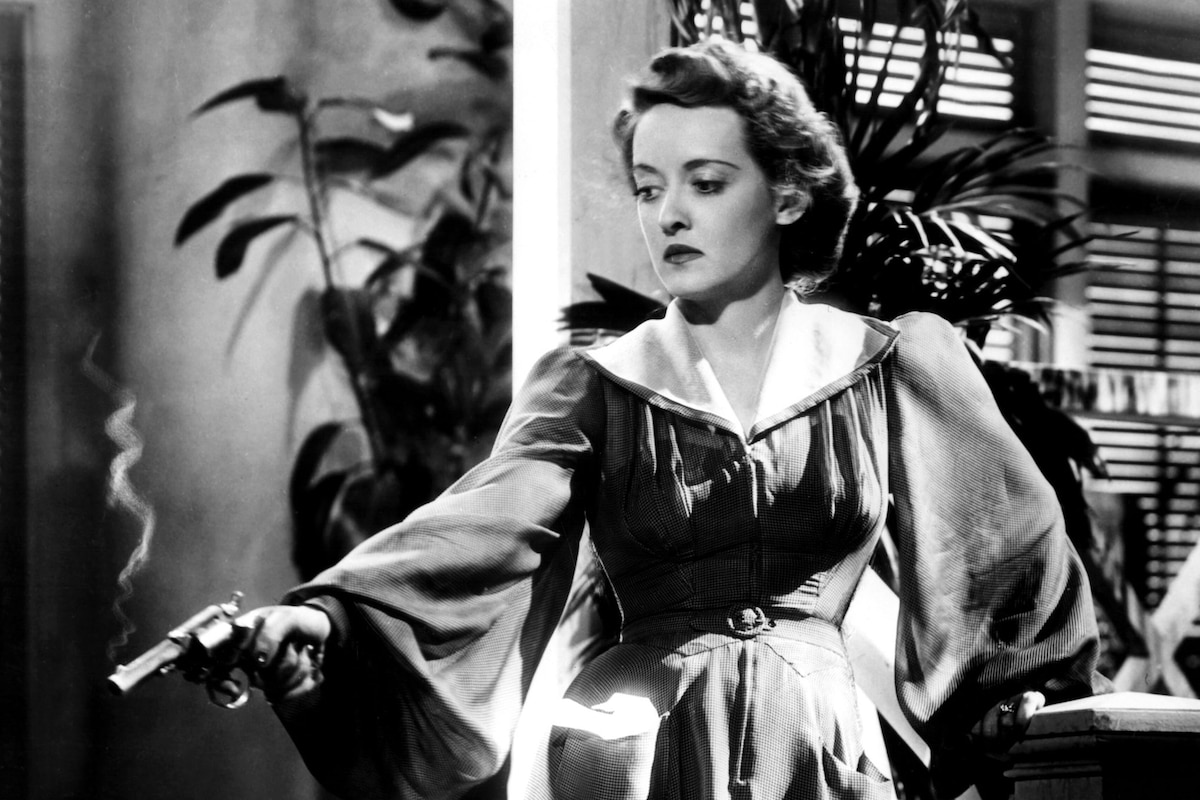
Shooting began on The Letter in May 1940 on the Warner Bros. studio lot. The first scene that William Wyler shot was the famous opening shot in which we see Leslie shoot Geoffrey Hammond. "I felt this opening shot should shock you," said Wyler. "To get the full impact of the revolver being fired, I thought everything should be very quiet first. I also wanted to show where we were, give a feeling of the dank, humid jungle atmosphere of rubber plantation country."
The opening shot, which lasted two minutes on screen, took an entire day to film, and that was before even a single word of dialogue was spoken. The studio expected him to shoot at a rate of 3-4 script pages a day, but the opening shot reflected a mere paragraph on page one. Wyler had a reputation for taking a long time to shoot, but he also had a reputation for doing excellent work. Still, his slow pace had some studio executives up in arms. "Wyler had a mania for endless takes," said producer Hal Wallis in his 1980 autobiography Starmaker, "and on The Letter, it became an obsession."
The shooting schedule for the opening scene, according to Wallis, was a particular bone of contention with the studio brass. "It was a simple setup," explains Wallis, "and could easily have been done in two or three takes, but Wyler insisted on shooting thirty-three. Bette kept running out of ammunition, the extra playing the shot man kept brushing his tuxedo free of dust, and the white cockatoo had to be taken out and brought back again and again so that it would respond to the sound of the bullets. Everyone grew weary, especially Bette, who by the last take was so exhausted she could hardly raise the gun."
Angry, Hal Wallis and Jack Warner demanded an explanation from Wyler about why it was taking so long. "He had no explanation," said Wallis. "I think he simply enjoyed the scene so much he wanted to spend two days doing it over and over."
The frustrated Wallis took the footage from all thirty-three takes of the opening shot home to look at. "I sat up all night watching the thirty-three takes," Wallis said, "then made a selection of one of them. When the picture was completed, I ran it for Wyler and asked him if he was pleased with the opening scene. He said, 'Yes. Now you see the value of doing it thirty-three times.' 'I'm sorry to inform you,' I replied, 'that I used the first take.'"
Even though there were clashes over the opening scene, there was no denying that the end result was stunning. It set the moody tone for the whole film. Bette Davis loved it. "This long opening shot in The Letter," she said in 1974, "is, in my opinion, the finest opening shot I have ever seen in a film. This was due to the genius, and I use the word advisedly, of William Wyler, our director."
Wyler, who loved a challenge, used several long scenes in The Letter, feeling that the drama would often play out better that way. For instance, regarding the scene in which Leslie's lawyer confronts her in his office Wyler said, "We rehearsed longer and longer stretches. Instead of cutting, I thought, 'why not go on?' It was not done by design, but there was just no reason to stop. James Stephenson and Bette Davis were superb, every emotion was in it and every one came through. The scene ran on and on, for some eight minutes." When Wyler looked at the footage later, however, he felt that a close-up was needed of Stephenson in the middle of the scene, which would mean making a cut. "I sort of debated with myself," said Wyler. "'Hell. To have to cut up the scene, put in the close-up.' But does the audience care whether it's all in one shot? No. So I cut the scene and put in a close-up."
According to Bette Davis, actor James Stephenson would often get into fights with William Wyler during the making of The Letter and walk off the set out of frustration from time to time. "Every time Jimmy would leave," said Davis, "I would run after him and make him come back, saying, 'It will be worth it, Jimmy don't go. You will give the great performance of your career under Wyler's direction.'" Each time Stephenson would return to work and shooting would resume.
Bette Davis herself walked off the set once in a fight with William Wyler over the film's climactic scene in which Leslie says to her husband, "With all my heart I still love the man I killed." It was a crucial line, and the way it was delivered was of utmost importance to the drama. Wyler believed that Davis should look her husband's character in the eye as she delivered the devastating blow. Davis, however, disagreed. "It was such a cruel thing to say to the husband," said Davis in her 1962 memoir The Lonely Life, "I felt I could not say it to his face. I couldn't conceive of any woman looking into her husband's eyes and admitting such a thing. I felt it would come out of her unbeknownst to herself, and therefore she would not be looking at him. Willie disagreed with me - most definitely. I walked off the set! Something I had never done in my whole career...I could not see it his way, nor he mine. I came back eventually - end result, I did it his way. It played validly, heaven knows, but to this day I think my way was the right way. I lost, but I lost to an artist."
After shooting was completed on The Letter, Wyler watched a rough cut and decided that he wanted the character of Leslie to be more sympathetic. He ordered some re-writes and planned to shoot them. Bette Davis was not happy. "I was heartbroken," she said, "as I felt, after reading the rewrites, that my performance could be ruined with these additions. I asked Willie if I could see the film before doing the retakes. To my horror I was crying at myself at the end of the showing. There was dead silence in the projection room when the lights came up. I said, 'If we film these retakes, we will lose the intelligent audience. It is impossible to please everyone with any one film. If we try to accomplish this, we can lose all audiences.' Plus, to my shame, even though I played the part, I deeply sympathized with Leslie Crosbie. We only made one small addition to the original film. Wyler had agreed with me. Thank God!"
The Letter opened in November 1940 to widespread critical praise. It was a solid box office hit and garnered seven Academy Award nominations. It was the fifth film directed by William Wyler in a row to be nominated for Best Picture. It marked Wyler's third nomination for Best Director and Davis' fifth nomination for Best Actress.
James Stephenson, who was also nominated for an Academy Award as Best Supporting Actor, was singled out with praise for his performance as Howard Joyce. It was the break he had been waiting for his entire career. He didn't forget how Bette Davis had convinced him to stay on The Letter when he had walked off the set. "We were both having lunch in the Green Room at Warner Bros.," recalled Bette Davis, "He came to my table and said, 'Bette, I'll thank you all my life for making me stay on the picture.'" Unfortunately, Stephenson didn't get to enjoy his triumph for very long. Just months after The Letter was released, he died suddenly of a heart attack at the age of 53.
"The Letter was a magnificent picture due to Willie," said Bette Davis, summing up her feeling about the film. "Willie believed in one thing while directing a film. It didn't matter how many differences of opinion or how many upsets occurred during filming the only thing that mattered was the finished product, what was on the screen after the film was completed."
by Andrea Passafiume
Behind the Camera - The Letter - Behind The Camera on THE LETTER
by Andrea Passafiume | December 30, 2008
SIGN UP FOR OUR NEWSLETTERS

CONNECT WITH TCM