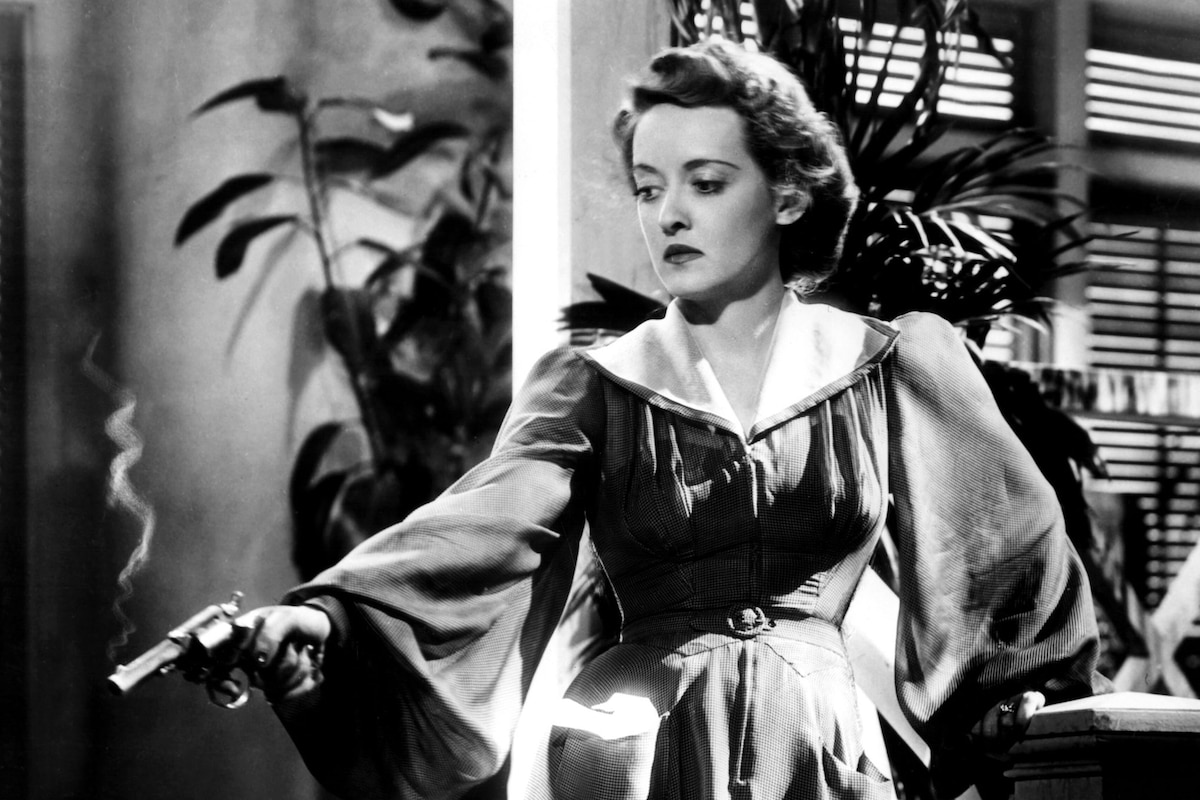
The Letter began as a play by W. Somerset Maugham originally published in 1925. After a successful stage production in London's West End in 1927 starring Gladys Cooper, the play opened on Broadway later the same year with Katharine Cornell starring as Leslie. In 1929 Jeanne Eagels starred in the first film version of The Letter for Paramount. The role of Leslie Crosbie was a challenging and complex character study that attracted many strong actresses, including Bette Davis a decade later.
Warner Bros., Bette Davis' home studio, had bought the rights to The Letter for their top actress to star in. Before they could move forward with the production, however, the studio first had to get the material approved by the strict Production Code Administration. With its subject matter rife with themes of adultery, greed, deception, lust and murder, that was no easy task.
In a memo to Jack Warner from Production Code Administration (PCA) Director Joseph Breen dated April 18, 1938, Breen condemns the material. "We have read with great care the playscript of The Letter, by W. Somerset Maugham," wrote Breen. "In the development of this story we have the murder of the lover; all the sordid details of the illicit sex relationship between the married woman and her lover; and very pointed and very numerous references to the second mistress of the murdered man, who is characterized as a China woman...Because of all this, we could not, of course, approve a motion picture, based upon this story."
A few months later writer Robert Lord wrote to producer Hal Wallis expressing his wishes to work on a treatment of the screenplay that could potentially get around the objections of the PCA. In a memo to Wallis dated December 20, 1939, Lord wrote, "I will try a scheme which I believe will enable us to get by the censors. I do not guarantee that we will get by, but it is certainly worth trying; because, in my opinion, if we can follow the play very closely and manage to get by the censors, we will have one of the most powerful and different motion pictures ever made." Together he, along with writer Howard Koch, pounded out what they hoped would be an acceptable treatment for The Letter. They changed the character of the murder victim's Chinese mistress into his Eurasian wife, and they made sure that Leslie's character would be severely punished for her crime.
The plan worked and The Letter was green-lighted at Warner Bros. on the strength of the completed final screenplay by Howard Koch. William Wyler, who was on loan out from Sam Goldwyn, agreed to direct. It was the second film he would direct for Warner Bros. His previous film for them, Jezebel (1938), had been a triumph for everyone involved and the studio was happy to have him.
Bette Davis was thrilled that William Wyler would be directing her in The Letter. Wyler had directed her Academy Award-winning performance two years earlier in Jezebel and she adored him. He was one of the very few directors she trusted completely and who knew how to handle her. "I personally, after Jezebel, would have jumped into the Hudson River if he had told me to," she said. "That's how much belief I had in his judgment as a director." It was also no secret that she and Wyler had had an affair during Jezebel. According to producer Hal Wallis in his 1980 autobiography Starmaker, Davis had even left her husband Ham Nelson for Wyler at the time. Their relationship ended, but they always had a strong mutual respect and worked well together. Though the affair was long over by the time they made The Letter, Wallis believed that their romantic history gave a charge to the finished film. "I do believe," writes Wallis, "the emotional tension between them added an extra quality to the pictures they made together: the air hummed with feeling from first frame to last."
Actor Herbert Marshall was hired to play Leslie's forgiving husband, Robert. Interestingly, Marshall had played the part of Geoff Hammond, Leslie's lover, in the 1929 film version. Gale Sondergaard, a Caucasian actress, was brought on to play Mrs. Hammond, the Eurasian wife of Leslie's murdered lover. "Gale Sondergaard was very good," said William Wyler in 1973. "Today you would take a Chinese [actress], but there weren't any then. Anna May Wong was the only Oriental actress I could have used and she was kind of a sex kitten and too young."
The role of Leslie's conflicted lawyer Howard Joyce was a meaty part, and Wyler wanted a strong actor for it. Jack Warner called Wyler up and recommended James Stephenson. Under contract to Warner Bros., Stephenson, a fine actor, had worked steadily but had not yet achieved stardom. Wyler gave Stephenson a screen test and liked what he saw. When he told Jack Warner that he wanted to hire him, however, Warner balked. Apparently Warner hadn't realized what a tremendous opportunity the part of Howard Joyce was for an actor and thought the role should be filled by a bigger name star. Wyler found himself in the position of fighting Warner to use Stephenson, whom Warner had suggested in the first place. Wyler won the battle, and James Stephenson finally had the role of a lifetime. It was an opportunity that he wouldn't waste.
With shooting set to begin on The Letter in May 1940, Wyler still had some business to finish with the script. Ever the perfectionist wanting his work to be the very best it could be, Wyler went to screenwriter Howard Koch. "He came to me and said, 'I don't know what it is,'" Koch recalls. "'There's something missing. An image. Something to unify the story that isn't there now.' I thought about it for a while. He was searching for a fundamental image - something that by its recurrence would reveal the woman's suppressed guilt behind the façade of her protested innocence. Finally I came up with an idea and went to Willie. 'Why don't we use the moon?' He thought that was interesting. We had decided to have a full moon the night she did the shooting. Now we would really make use of it. From then on, starting with that night, she would draw away from the moonlight to avoid the memory of what she'd done."
by Andrea Passafiume
The Big Idea - The Letter
by Andrea Passafiume | December 30, 2008
SIGN UP FOR OUR NEWSLETTERS

CONNECT WITH TCM