SYNOPSIS
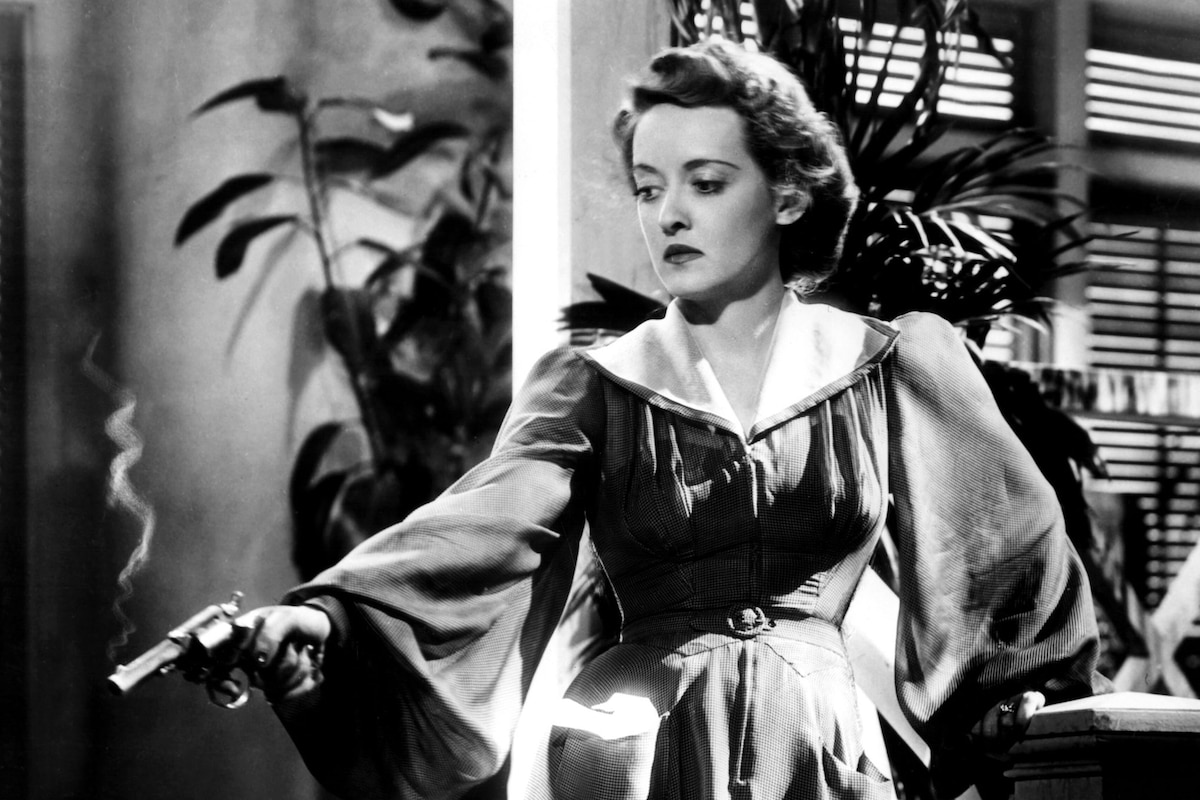
On a sultry night on a Malayan rubber plantation, Leslie Crosbie shoots and kills Geoff Hammond, an old family friend. She claims self-defense and immediately sends for her devoted husband Robert. Leslie, the perfect picture of a respectable society lady, has a stellar reputation, and with the help of lawyer Howard Joyce she is all but sure of being acquitted. However, when an incriminating letter turns up and blackmailers want $10,000 to suppress it, it looks like all is not as it seems.
Director: William Wyler
Producer: Hal B. Wallis (Executive Producer), Robert Lord (Associate Producer)
Screenplay: Howard Koch
Based on the play The Letter by W. Somerset Maugham
Cinematography: Tony Gaudio
Editing: George Amy, Warren Low
Music Composer: Max Steiner
Costume Designer: Orry-Kelly
Cast: Bette Davis (Leslie Crosbie), Herbert Marshall (Robert Crosbie), James Stephenson (Howard Joyce), Frieda Inescort (Dorothy Joyce), Gale Sondergaard (Mrs. Hammond), Bruce Lester (John Withers), Elizabeth Earl (Adele Ainsworth), Cecil Kellaway (Prescott), Sen Yung (Ong Chi Seng), Doris Lloyd (Mrs. Cooper), Willie Fung (Chung Hi), Tetsu Komai (Head Boy), Leonard Mudie (Fred), John Ridgely (Driver), Charles Irwin (Bob's Friend), Holmes Herbert (Bob's Friend), Douglas Walton (Well-wisher).
BW-95m. Closed Captioning.
Why THE LETTER is Essential
The Letter reunited director William Wyler and star Bette Davis for the second time, and they both do some of their best work together. The two had first worked together on the highly acclaimed Jezebel (1938) which had earned Davis the Best Actress Academy Award. Wyler was one of the few directors whom Davis trusted and was able to handle her notoriously difficult personality. "I personally, after Jezebel," she said, "would have jumped into the Hudson River if he had told me to. That's how much belief I had in his judgment as a director."
As the calculating and duplicitous Leslie Crosbie, Bette Davis gives one of the best, most nuanced performances of her career. Davis, proving once again that she was never afraid of tackling a complicated or unsympathetic character, received her fifth Academy Award nomination as Best Actress for her work in The Letter. Pauline Kael famously said of her performance, "Davis gives what is very likely the best study of female sexual hypocrisy in film history."
The Letter features one of the most talked-about opening shots in movie history. Setting the scene in one breathtaking shot, William Wyler carefully conveys the suspense of a tense tropical night that ends in murder.
There are several versions that have been made of W. Somerset Maugham's original play The Letter. In 1929 Jeanne Eagels starred as Leslie, and in 1947 a version called The Unfaithful was made starring Ann Sheridan. There was even a TV movie made in 1982 with Lee Remick. It is the William Wyler-Bette Davis version, however, that remains the definitive standard.
Warner Bros. contract player James Stephenson had been making films for years, but had never reached stardom. When the meaty part of lawyer Howard Joyce in The Letter came along, he knew he had the opportunity of a lifetime. At the age of 51 Stephenson finally received some long deserved attention and was nominated for an Academy Award as Best Supporting Actor.
The Letter was nominated for seven Academy Awards including ones for Best Picture, Best Actress, Best Director, Best Supporting Actor (James Stephenson), Best Cinematography, Best Editing and Max Steiner's arresting dramatic musical score.
by Andrea Passafiume
The Essentials - The Letter
by Andrea Passafiume | December 30, 2008
SIGN UP FOR OUR NEWSLETTERS

CONNECT WITH TCM