Producer Dore Schary first conceived the project in 1947 as head of production at RKO. Although the trend of war pictures had passed, Schary felt America would experience the same sort of disillusionment and doubt about the value of its involvement in a global conflict that it went through after World War I. He felt it was important to do a film "that would say the war was worth fighting despite the terrible losses....There was something at stake. It was the first time in a long, long time, hundreds of years, that there had been a real danger of a takeover by a very evil and strong force."
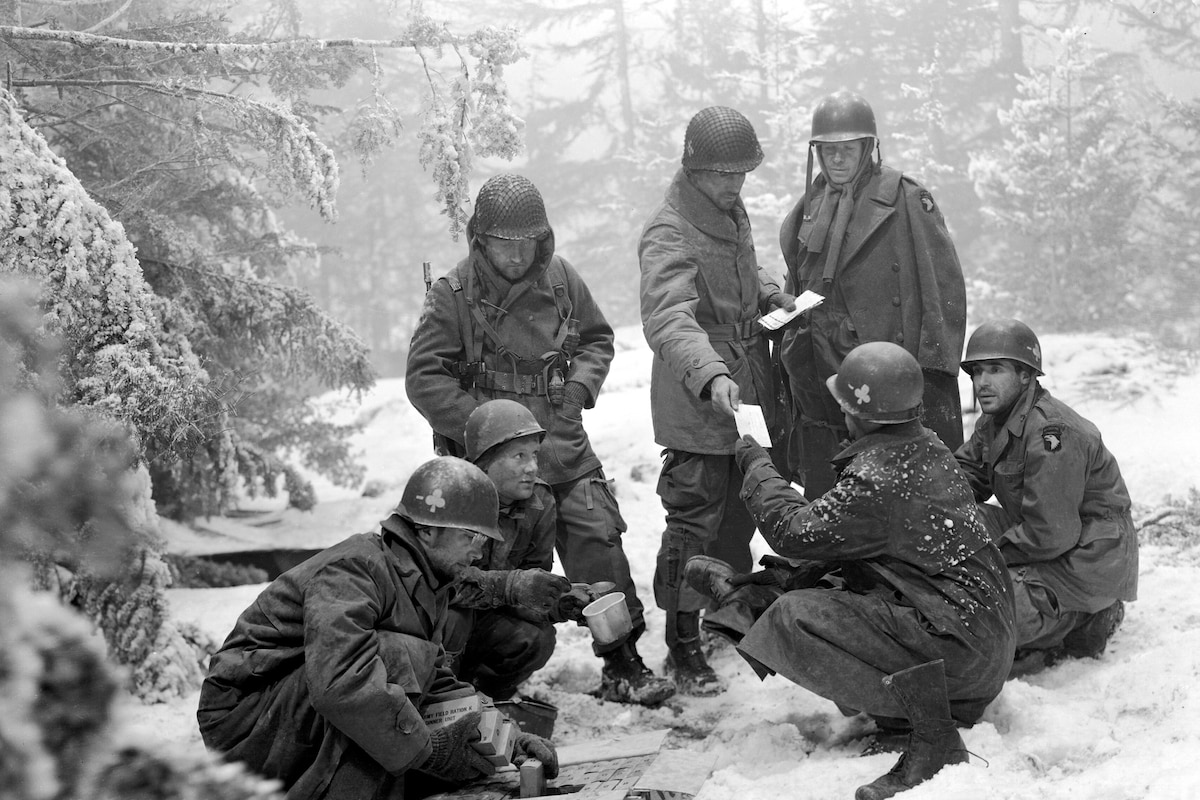
To drive home both the sense of sacrifice and the real threat of a Nazi victory, Schary looked for a situation in which the Allied cause was in jeopardy. He found it in the crucial siege of the Belgian town of Bastogne during the Battle of the Bulge.
Schary was lucky to find writer Robert Pirosh, whose most recent credit was adapting the hit stage military comedy Up in Arms (1944). Pirosh leaped at the chance to tell a story he knew first hand; he had fought in the Battle of the Bulge during the war. In April 1947, he traveled to Europe to revisit the battlefields where he had fought and decided to tell a more intimate story, portraying a single squad in a way that "would not be an insult to the memory of those we left there." The important thing, for Pirosh, was to find something universal to all those who had fought in the war, no matter where, by showing "what did it do to us? How did we feel?"
Although Pirosh had fought in the war, he was not with the 101st Airborne, the division that had been surrounded at Bastogne for eight days. Concerned he might not be able to paint an accurate portrait of the experience, he approached division commander General Anthony McAuliffe, whose reply to a German demand for surrender, "Nuts!", had been a symbol of American determination during the war. McAuliffe assured Pirosh, "You were fighting under the same kind of conditions. You were just as cold, the fog was just as thick, the suspense was just as great. Go ahead and write it the way you feel it." The General strongly supported the project and served as technical adviser on the screenwriting phase of Battleground.
Schary, meanwhile, queried RKO sales reps about the market for a war film. When they responded negatively, he polled exhibitors across the country. They were more positive, although they qualified their assessment with questions about where it would be set, what it would be about, and who would be in it. Without answering, Schary decided to move forward, but he gave the picture a working title as far removed from the subject as possible, "Prelude to Love," in order to keep the project secret and not allow other studios to get a jump on RKO with war films of their own.
Pirosh finished the first draft of the Battleground screenplay by mid-January 1948, and Schary approached director William Wellman, who made one of the war years' finest films, Story of G.I. Joe (1945). Wellman deemed it "a hell of a script" and accepted, with the understanding that it would not be another G.I. Joe. "I'll just make a picture about a very tired group of guys," he said.
Schary contacted MGM to see if he could borrow two of that studio's contract players, Van Johnson and Ricardo Montalban. He was told by MGM's casting director Billy Grady there was no chance of getting anyone from the studio because executives there thought the script was "a stinker."
At this point in the project, millionaire industrialist and Hollywood dabbler Howard Hughes bought RKO. Schary had a clause in his contract allowing him to leave his job if a new owner took over, but initially he tried to work with Hughes. It soon become apparent, though, that his new boss intended to be very hands on, and when Hughes ordered him to remove Battleground from the production schedule, Schary resigned. His only request was to ask Hughes to sell him the script. Hughes agreed, for the bargain sum of $20,000, and Schary brought Pirosh with him to his new job at MGM.
Schary wanted Battleground to be his first project as the new production head of his former employer MGM, the company he had quit several years earlier over conflicts with studio head Louis B. Mayer and other executives. Although they didn't favor the project, Mayer and Nicholas Schenck, president of MGM's parent company, didn't want to butt heads again with their new executive, so they gave him a go-ahead, with the notion in mind that if it failed, they would have more leverage over future production decisions. The project quickly became known as "Schary's folly."
Schary was now able to get the actors he wanted from the start, adding John Hodiak and George Murphy to the cast with Johnson and Montalban. He also cast James Whitmore, an actor with only one other film to his credit (The Undercover Man, 1949), in the key role of the tough-talking Sgt. Kinnie. Schary had been impressed with Whitmore's award-winning performance on Broadway in the war-themed play Command Decision. Although trade papers announced Robert Taylor and Keenan Wynn would also star, neither appeared in the film.
Although Wellman was reportedly against adding a female role to the picture, he and Schary personally interviewed the single woman in the cast, French actress Denise Darcel as a kindlyand sexyBelgian who quarters the squad in Bastogne for a night. From the producer's own statements, she appears to have been cast exclusively on the basis of her physical attributes.
by Rob Nixon
The Big Idea - Battleground
by Rob Nixon | April 16, 2009
SIGN UP FOR OUR NEWSLETTERS

CONNECT WITH TCM