SYNOPSIS
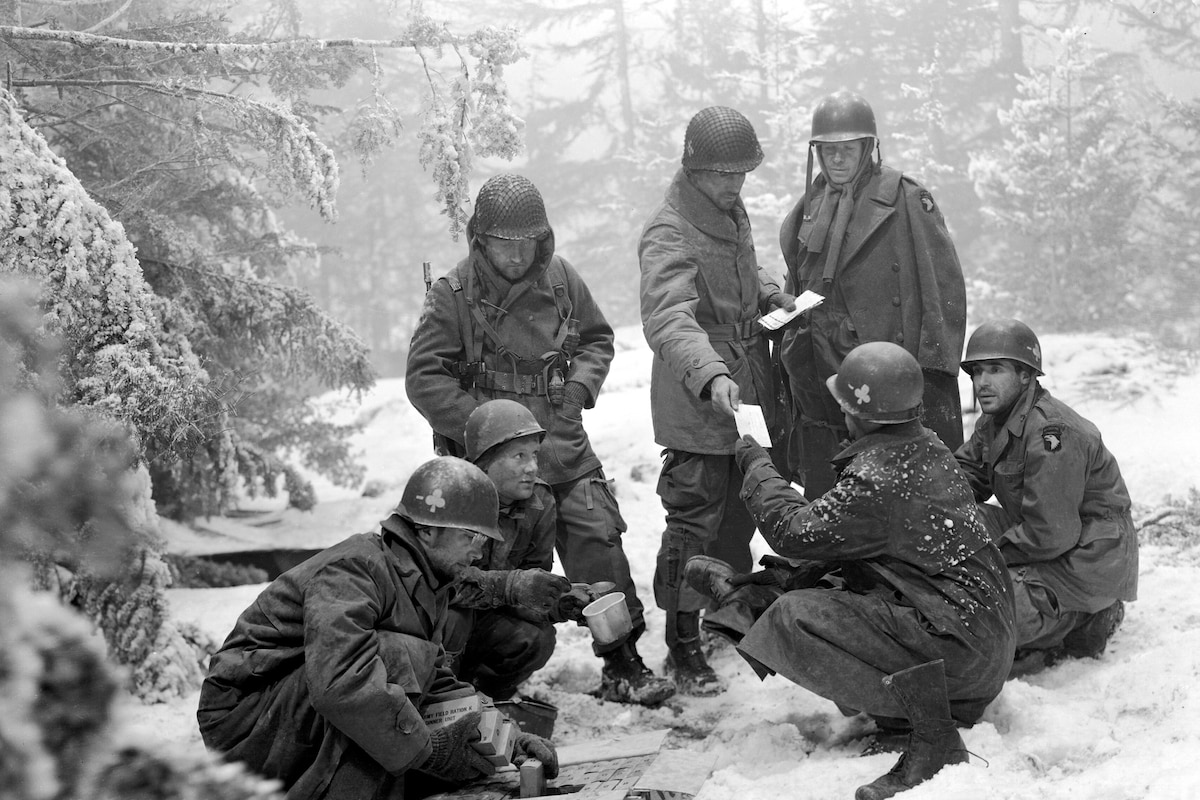
A single company of soldiers of the U.S. 101st Airborne Division are assigned the daunting task of holding back the 47th German Panzer Corps who are advancing through Allied lines near Bastogne, Belgium. The group is a cross-section of American men, average Joes who find themselves surrounded by the enemy with no air support. How they survive, how they try to keep their humor and humanity in the face of overwhelming odds, and how they ultimately triumph is the real focus of this true-life World War II incident.
Director: William Wellman
Producer: Dore Schary
Screenplay: Robert Pirosh
Cinematography: Paul Vogel
Editing: John Dunning
Art Direction: Hans Peters, Cedric Gibbons
Original Music: Lennie Hayton
Cast: Van Johnson (Holley), John Hodiak (Jarvess), Ricardo Montalban (Roderigues), George Murphy ("Pop" Stazak), James Whitmore ("Kinnie").
Why BATTLEGROUND is Essential
"Was this trip necessary?" That's the "$64 question" delivered to an exhausted, diminished, battle-weary group of soldiers in the midst of one of the bloodiest and most difficult conflicts of World War II, the Battle of the Bulge in the Ardennes Forest during December 1944. The speaker is a military chaplain giving a Christmas sermon to a congregation who must have questioned the death and hardship they were enduring so far from home and loved ones. It's also the question the producers of Battleground intended to raise in the minds of its audience, and to answer with a resounding "yes," as the chaplain does in this key scene by reminding the troops why fascism had to be defeated. Four years after the end of the war, the creators of Battleground were taking a chance that Americans were ready to revisit those times, and so the question was not only a reaffirmation of all that had been gained, and lost, by our involvement in the global conflict. It also expressed the hope that audiences would answer affirmatively that it had, indeed, been worth the trip to the theater to see a story about men in battle, and that's just what they did, in huge numbers that made Battleground the second-highest grossing in its year of wide release (1950). Yet the film almost didn't get made.
The production history of Battleground is axiomatic of the studio system, particularly during the uncertain times in which it found itself in the late 1940s. It was rescued from the micromanaging new owner of RKO, Howard Hughes, by producer Dore Schary, who had made it a pet project with writer and former soldier Robert Pirosh, a veteran of the Battle of the Bulge a few years earlier. Schary took it to his new job at MGM, where he ran into conflict with longtime studio boss Louis B. Mayer, eventually getting the green light only because Mayer thought its certain failure would result in Schary's forced departure from the studio.
By Mayer's assessment, which was not completely clouded by professional rivalry, Battleground should not have worked as well as it did. The popular battle pictures of a few years earlier (Bataan [1943], Wake Island [1942]) had succeeded because the country's attention was overwhelmingly on the war, an event that was immediate in everyone's daily life. Like those pictures, Battleground had the formulaic plot about a group of men from all backgrounds, ethnicities, regions, etc. What it lacked was the immediacy, the extra connection provided by the concern felt on the homefront for the outcome of the war and the individual fates of those on the front lines. Yet, by giving each character a recognizable trait - Roderigues's wonder at the sight of snow, Pops's arthritis and chance for being sent home, Abner's tagline and habit of sleeping with his boots off - and injecting humor wherever possible, writer Pirosh was able to elicit audience sympathy and interest.
In addition, the last great films of the war, Story of G.I. Joe (1945) and A Walk in the Sun (1945), had taken an almost documentary approach to its subject. Director William Wellman (who also made Story of G.I. Joe) chose instead to shoot Battleground almost entirely in the studio, an unusual choice for an action subject. But what emerged from this rather consciously fictitious mise en scene was a character drama focused more on the human condition than on the locations and mechanics of warfare, highlighting the loneliness and frustration, the struggle against the elements, and the frequent sense of hopelessness that characterizes the war experience as much as action itself. Lastly, the liberal Schary, a producer given to making what were often derisively called "message pictures," proved that a movie could work as both popular entertainment and social commentary, in this case reminding the country (and the industry) of its anti-fascist commitment in a time of mounting right-wing backlash and political witch hunts.
If for no other reason, Battleground would have a place in cinema history for the role it played in the downfall of L.B. Mayer, one of the most powerful men in the business and a shaper of the Hollywood system (he was forced out of MGM in 1951). The movie also serves as a footnote to the ultimate demise of RKO under Howard Hughes. Ultimately, however, Battleground was that rare example of a movie that enjoyed unanimous critical acclaim as well as a huge box office success.
by Rob Nixon
The Essentials - Battleground
by Rob Nixon | April 09, 2009
SIGN UP FOR OUR NEWSLETTERS

CONNECT WITH TCM