Despite the legends that grew up around him and the reverence accorded his homespun steadfastness and concern for the "little guy" evident in this movie, Daniel Webster had a controversial political career. Historian Arthur Schlesinger once questioned how the American people could "follow [Webster] through hell or high water when he would not lead unless someone made up a purse for him." An early hero of farmers, he later went to work for the big business interests they often fought. Considering some of the cases Webster argued before the Supreme Court, Schlesinger also remarked that the real miracle of The Devil and Daniel Webster was not a soul sold to the devil, or the jury of ghostly traitors, but Webster speaking against the sanctity of contract.
Stephen Vincent Benet first tried his hand at screenwriting with the script for D.W. Griffith's Abraham Lincoln (1930), which starred Walter Huston.
Screenwriter Dan Totheroh was the brother of Roland "Rollie" Totheroh, Chaplin's chief cinematographer between 1915 and 1947.
William Dieterle began his career in his native Germany as an actor and writer in the early 20s before moving on to directing later in the decade. He came to Hollywood in the early 1930s under contract to Warner Brothers, first as director of the German language versions of the studio's films for export, then making a number of hit pictures for the American market with such stars as Bette Davis, Edward G. Robinson, and Kay Francis. He had his first prestige success as co-director with German theater great Max Reinhardt of the all-star A Midsummer Night's Dream (1935) and received his only directorial Academy Award nomination for The Life of Emile Zola (1937), one of several pictures he made with Paul Muni. At the end of the decade, he moved to RKO and directed the studio's box office smash The Hunchback of Notre Dame (1939) with Charles Laughton. Dieterle continued to work steadily throughout the 40s, notably on several films for David O. Selznick starring Selznick's wife, Jennifer Jones. Toward the end of the decade, although never officially blacklisted, he was badgered for his political associations (among them, helping to bring writer Bertolt Brecht and composer Kurt Weill to the states in 1941, around the time of The Devil and Daniel Webster). As a result, Dieterle's career went into a decline in the '50s. He eventually returned to Europe where he lived and worked until 1966. He died there in 1972 at the age of 79.
Robert Wise is best known today as the award-winning director of such films as The Day the Earth Stood Still (1951), West Side Story (1961), and The Sound of Music (1965). Yet he started out at RKO first in the sound department then as one of their most valuable editors. Dieterle was so pleased with his work that he requested Wise's services for his next film, Syncopation (1942). Orson Welles, however, wanted Wise to edit his new production, The Magnificent Ambersons (1942), as Wise had done on Citizen Kane (1941), and offered to pay him out of his own pocket to secure him. A compromise was reached whereby Wise would edit Dieterle's film and act as editing supervisor for Welles's project. Eventually, Robert Wise was assigned the task of severely cutting Ambersons while Welles was out of the country on another project. The editing of that movie (none of the lost footage exists) is considered by many to be one of the biggest tragedies of studio interference. In 1942, Wise married Patricia Doyle, who had a small part as Dorothy the servant girl in The Devil and Daniel Webster. It was her second and last screen appearance, after a bit in Stagecoach (1939), but she worked at RKO throughout the 1930s as a stand-in for Katharine Hepburn.
Cinematographer Joseph August had a propensity for light and shadow that he used to good effect on The Devil and Daniel Webster. His other films in this vein included Mary of Scotland (1936) for John Ford and The Hunchback of Notre Dame (1939) and Portrait of Jennie (1948), both directed by William Dieterle. August died on the set of Jennie, and the shooting was completed by Lee Garmes.
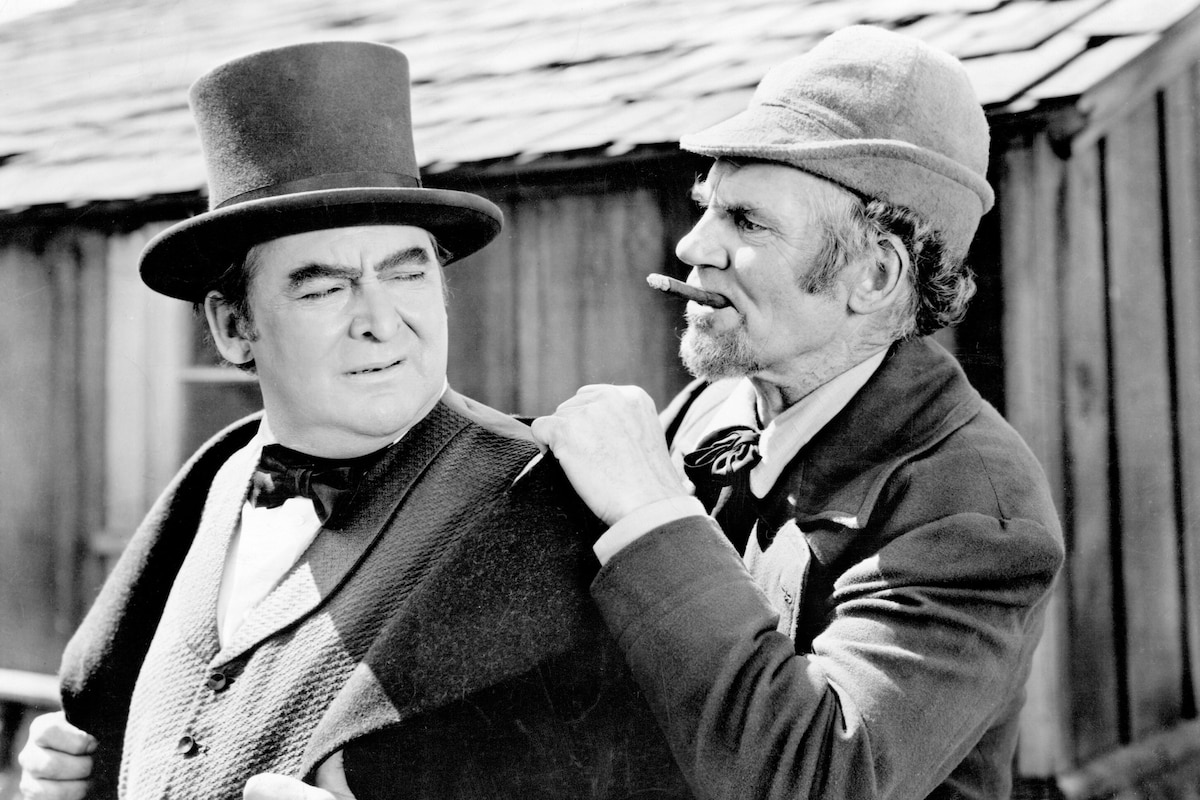
Walter Huston started his acting career on stage and didn't make his film debut until 1929 at the age of 45. Although not the leading man type, he worked steadily and to usually positive notices throughout the 30s on such films as D.W. Griffith's Abraham Lincoln (1930), as a fictional U.S. president in the fantasy drama Gabriel Over the White House (1933), and Dodsworth (1936), for which he received his first Best Actor Oscar nomination. His second Best Actor nomination, for The Devil and Daniel Webster, boosted his career even more, pushing his earnings to $6,000 a week for a number of acclaimed supporting roles, including Yankee Doodle Dandy (1942, and a Best Supporting Actor nomination as James Cagney's father) and The Treasure of the Sierra Madre (1948), directed by his son John and finally earning him a Best Supporting Actor award. Huston's last film was the Anthony Mann Western The Furies (1950), which was released a few months after his death at the age of 66.
James Craig (Jabez Stone) was once seen as a Clark Gable type (he shaved his mustache for The Devil and Daniel Webster). Although his character is the main protagonist in The Devil and Daniel Webster and he previously made a big splash opposite RKO's "Queen of the Lot," Ginger Rogers, in Kitty Foyle (1940), Craig was not as famous or as experienced as several of his co-stars which was why he didn't receive top billing. He never achieved significant stardom but he worked steadily through the early 1970s. His biggest success came as a realtor, a career that made him very wealthy.
Anne Shirley, as Jabez's wife Mary, also did not receive high billing in The Devil and Daniel Webster. Born Dawn Paris in 1918 in New York, she made her debut in films at the age of 4 as Dawn O'Day, a name she worked under for 12 years. In 1934 she played the lead in Anne of Green Gables, and her name was changed by studio publicists to that of her character, Anne Shirley, which was her billing throughout the remainder of her brief career. She received a Best Supporting Actress Academy Award nomination for her work as Barbara Stanwyck's daughter in Stella Dallas (1937). She retired from the screen at 26 after Murder, My Sweet (1944), a decision she never regretted.
Gene Lockhart (Squire Slossum) was a well-known character actor of his day. He was the father of June Lockhart, best known for TV's Lassie and Lost in Space.
H.B. Warner (Judge Hathorne) achieved screen immortality playing Jesus in the silent version of The King of Kings (1927), and he was a favorite character actor for Frank Capra in the 30s and 40s, most memorably as the hapless pharmacist Mr. Gower in It's a Wonderful Life (1946).
French actress Simone Simon (Belle) came to Hollywood in the mid 1930s, but her career did not take off here and she returned to France. The Devil and Daniel Webster was her first film back in the U.S. in four years, and on the basis of her performance as Belle, Val Lewton cast her in her biggest Hollywood films, Cat People (1942) and The Curse of the Cat People (1944).
Jeff Corey (Grange organizer Tom Sharp) was a promising young actor who made close to 70 films between his debut in 1939 and 1951, when he was blacklisted because of his past association with the Communist Party. During the decade he was banned from films, he began a new career as a highly respected acting teacher and drama coach, with such students over the years as James Dean, Barbra Streisand, Anthony Perkins, Robin Williams, Kirk Douglas, and Jack Nicholson. He was able to return to movies and television in 1960 (thanks in large part to the intercession of Pat Boone), making another 150 or so appearances in both media until his death in 2002.
Actor-writer-producer William Alland was cast in The Devil and Daniel Webster as a character known only as "Guide," but his scenes were cut. He was a founding member of Orson Welles's Mercury Players on stage and radio in New York and made his movie debut in Welles's Citizen Kane as the shadowy reporter trying to piece together the truth about Charles Foster Kane.
"What a pity that such music [Herrmann's score] will not be really heard and appreciated by the people who see our picture. I know what we can do. We'll run the score separately and give them a real double feature." Director William Dieterle in an interview around the time of the film's release
"I played a real troublemaker, going around organizing, trying to get the farmers to go on strike. It was a very political film as far as I was concerned." Jeff Corey (Tom Sharp), who was later blacklisted for his leftist associations, in a 1991 interview
"[Huston] was so great in that part, it was like a revelation. It was one of the great performances of all time. If you liked acting, you had to like him." Jeff Corey
The 1990s restoration of The Devil and Daniel Webster used scenes taken from inferior prints of the movie, but an original preview print was found not long after in Dieterle's estate. This is the version that now exists and is available on DVD.
Memorable Quotes from THE DEVIL AND DANIEL WEBSTER
PROLOGUE: It's a story they tell in the border country where Massachusetts joins Vermont and New Hampshire. It happened, so they say, a long time ago. But it could happen any timeanywhereto anybody. Yes, it could even happen to you.
MA STONE (Jane Darwell): Look at that sky. Big cracks in it, like it was ice on the mill pond, crackin' up to show us spring's a'comin'. If that ain't enough for a God-fearin' New England family, I want to know.
JABEZ (James Craig): When they were handing out hard luck, the farmer got there first.
MA: As for what you're callin' hard luck, we made New England out of it. That and codfish.
JABEZ: They say when he [Daniel Webster] speaks, the stars and stripes come right outa the sky.
JABEZ: What does it mean here, about my soul?
MR. SCRATCH (Walter Huston): Why should that worry you? A soul? A soul is nothing. Can you see it, smell it, touch it? No. This soul, your soul, are nothing against seven years of good luck. You'll have money and all that money can buy.
MA: When a man gets his money in bad way, when he sees the better course and takes the worse, then the devil's in his heart. And that fixes him.
JABEZ: A man could always change that, couldn't he?
MA: A man can always change things. That's what makes him different from the barnyard critters.
SCRATCH: I promised you money and all that money can buy. I don't recall any other obligations.
DANIEL WEBSTER (Edward Arnold): We have time to christen a jug. Old Medford rum, there's nothing like it. You know, somehow or other waiting becomes wonderfully shorter with a jug. I saw an inch worm once take a drop of this and he stood right up on his hind legs and bit a bee.
DANIEL: Well, I never heard of the de I never heard of you claiming American citizenship.
SCRATCH: And who has a better right? When the first wrong was done to the first Indian, I was there. When the first slaver put out for the Congo, I stood on the deck. Am I not still spoken of in every church in New England? It's true the North claims me for a Southerner and the South for a Northerner, but I'm neither. Tell the truth, Mr. Webster, though I don't like to boast of it, my name is older in the country than yours.
SCRATCH: (to Webster) You'll never be president. I'll see to that!
Compiled by Rob Nixon
Trivia - The Devil and Daniel Webster - Trivia & Fun Facts About THE DEVIL AND DANIEL WEBSTER
by Rob Nixon | April 09, 2009
SIGN UP FOR OUR NEWSLETTERS

CONNECT WITH TCM