The Devil and Daniel Webster was shot almost sequentially, an unusual and often costly practice for the time.
The first scene filmed was the sequence of disastrous events befalling Jabez and his family. Many takes were needed because the piglet used in the scene would not stop squealing loudly. Finally, a prop man suggested massaging the animal's scrotum, which did the trick. The pig became calm enough for the scene to be completed.
The Devil and Daniel Webster was shot on studio sets, with optical effects, art direction, and striking cinematography helping to create the mix of earthy location and supernatural atmosphere.
Scratch's entrance into the picture, emerging out of the smoke and eerie light, was done with double exposure and optical printing. The same techniques were used for the first appearance of Belle beside the fireplace.
Optical printing was also used to create the effect of Jabez's ax bursting into flame mid-air after his frustrated attempt to chop down the tree with his contract date burned into it. The ax was thrown in one shot, a still image of an ax was matted in, and optical printing added flame effects to that.
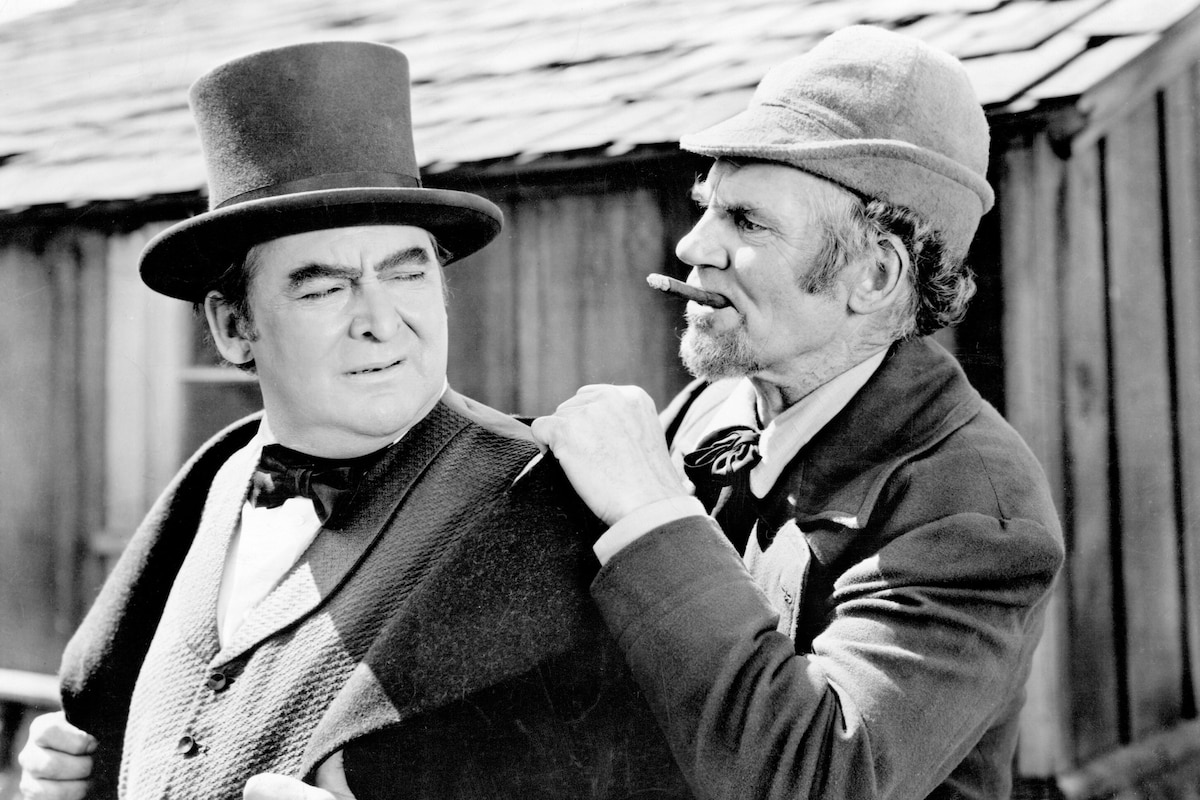
Six weeks into shooting, Thomas Mitchell had an accident on set. In the scene with Daniel and Jabez's son riding in the carriage, the horses suddenly bolted, and Mitchell was thrown into the side of a parked vehicle, knocking him unconscious with a fractured skull. Doctors at first thought he would suffer permanent brain damage, and he was laid up for seventeen weeks, forcing him out of the part. Edward Arnold was called in on one day's notice to take over. Because two-thirds of Mitchell's scenes had been filmed (right up to the trial sequence), the necessary re-shoots skyrocketed the budget of the already expensive picture. Mitchell can still be seen in some fleeting long shots.
The dinner scene between Mary Stone (Anne Shirley) and Daniel Webster had been shot with Thomas Mitchell before his accident. Rather than redoing the entire scene, Dieterle used close-ups of Shirley from the first take. He did close-ups of Edward Arnold separately, then re-did the two-shots of both characters, and cut it all together. Shirley later noted what a strange experience it was to watch the scene the first time.
One visual detail that was added during filming was the tree with the date of Jabez's reckoning burned into its trunk. It provided a very effective visualization of the unholy deal.
Dieterle was known to have some eccentricities as a director. He believed in astrology and started shooting a few days ahead of schedule because his horoscope indicated he should.
Dieterle had a habit of directing with white gloves on. Robert Wise (the future director who edited The Devil and Daniel Webster) said everyone thought it was because he had a germ or dirt phobia. During shooting of one scene, Dieterle noticed there wasn't enough mud on a carriage wheel. He pulled off his gloves, grabbed some mud, rubbed it onto the wheel, then wiped his hands on his pants and put the gloves back on to continue directing.
Jeff Corey later related an incident in which a child actor was supposed to shout, "Daniel Webster's here!" Dieterle had the boy do the take over and over without telling him specifically what was wrong with how he did it. After approximately seventy takes, the dialogue coach pulled the boy aside and told him to do the line in a German accent like Dieterle's. The boy did, and Dieterle was pleased, however that shot was not used in the final film.
James Craig was unable to do a suitably sinister laugh in the scene where Jabez gloats over his neighbors' ruined crops. Edward Arnold recorded the laugh and it was dubbed in.
The dressing room of Gene Lockhart (who played Squire Slossum) adjoined the changing room of the actress who played Belle (Simone Simon). He reported hearing the 57-year-old Walter Huston making romantic overtures to the young actress.
Huston contributed much to The Devil and Daniel Webster by giving Scratch a folksy but sinister quality. In the original story, the character was much darker and more soft-spoken.
Reverse-image (negative) shots of Walter Huston were processed and inserted at key moments, such as the scene where accidents and misfortunes keep happening to the Stones. These very brief, unsettling shots were cut after previews before the picture's general release.
A late addition to the project was 29-year-old Bernard Herrmann, a radio composer and conductor who had just made a big impact with his first motion picture score, for Citizen Kane (1941). Herrmann already had a connection to the picture, having orchestrated music for broadcasts of Benet's three Daniel Webster stories for the Columbia Workshop. Dieterle, who chose Herrmann over the many studio contract composers at his disposal, gave him the freedom to experiment, and Herrmann came up with what is widely considered one of his finest scores. Heavily influenced by the blend of American musical motifs and modernist dissonance in the work of his idol, Charles Ives, Herrmann mixed simple folk melodies with innovative electronic effects. Critics have noted with admiration his use of the old American folk song "Springfield Mountain" throughout the film and the way he scored the music to actors' speeches, such as Walter Huston's monologue in the hailstorm scene. The score Herrmann created is not just musical background but a key element of the narrative.
Typically, movie scores were written after principal photography, but Herrmann wrote the music for The Devil and Daniel Webster as it was being shot. Dieterle introduced him to the cast and invited him to watch the rushes. Herrmann considered Dieterle to be one of the most sophisticated directors he ever worked with.
Herrmann worked closely with sound recorder James G. Stewart to be sure the score and the sound effects meshed harmoniously. In some cases, Herrmann dictated how diagetic sounds (those that arose directly out of what was happening on screen) would be used. In the scene of Jabez's pursuit of Mary and Daniel on horseback, no hooves are heard, only the music.
In later years, Herrmann told how he created the strange, almost subliminal sound heard during Scratch's first entrance in the barn. He said he sent a crew to San Francisco at 4:00 in the morning to record the hum of phone lines. He combined these with the overtones of the musical note C painted directly onto the soundtrack, which when run through a projector created a sustained phantom tone, a "fundamental."
The intense and nerve-wracking sound of Scratch frantically playing the fiddle at the barn dance was achieved by having a violinist play "Pop Goes the Weasel" four times in slightly different versions, then overdubbing them to get the impossible music. When it was pointed out to him that Herrmann could have recorded four violinists playing the piece, he responded that it would have sounded like a quartet playing, not one person producing multiple sounds. "It's only a small point in the film, and yet I feel a composer who doesn't pay as much attention to a small point like that is really being overpaid and should be dismissed," he later said.
Herrmann said his favorite part of the score was the "Miser's Waltz," in which Belle dances Miser Stevens to death.
The title and length of The Devil and Daniel Webster were in constant flux from the beginning. The studio didn't want to use Benet's title for two reasons. They thought many exhibitors, especially in the Bible Belt, would reject advertising a movie with the word "devil" in the title. In addition, "Daniel Webster" would have placed it in the historical past, and period films rarely did that well at the box office unless they were Westerns or swashbuckling adventures, or a solidly pre-sold epic like Gone with the Wind (1939). Shot under the name "A Certain Mr. Scratch," previews for the film were announced as The Devil and Daniel Webster, but by the time of its July 16, 1941 preview it was being run under the title "Here Is a Man" at 109 minutes long. Two or three minutes were cut and the title changed to All That Money Can Buy for its October 1941 premiere at Radio City Music Hall. It went into wide release shortly after the premiere, using an ad campaign that made it appear to be a steamy morality tale about marital temptations. Within a couple of years, some prints circulated with the current title (Benet's). It was edited down to 85 minutes and re-released in 1952 as simply "Daniel and the Devil." The film was restored to its full length in the 1990s and given the original Benet title.
In 1991, Anne Shirley said everyone involved in the production of The Devil and Daniel Webster believed they were making a great film.
by Rob Nixon
Behind the Camera - The Devil and Daniel Webster
by Rob Nixon | April 09, 2009
SIGN UP FOR OUR NEWSLETTERS

CONNECT WITH TCM