In 1787, the HMS Bounty left England for Tahiti on a mission to pick up breadfruit trees and take them to the West Indies, where the government hoped they would provide a source of cheap food for the slaves. The ship's humane, accomplished captain, William Bligh, promoted his young friend Fletcher Christian to second-in-command during the voyage. When discipline slipped during the crew's stay in Tahiti, Bligh tried to reassert his authority back at sea, only to have Christian -- who had left behind a pregnant Tahitian wife -- join the ship's malcontents in a mutiny. Christian turned the captain and his supporters loose on a longboat and sailed the Bounty back to Tahiti. Miraculously, Bligh piloted the boat 3,618 miles to the nearest settlement. On his return to England, another ship, the Pandora, was sent to apprehend the mutineers. By that time, Christian and most of his supporters had moved to Pitcairn Island, where Tahitian tribesmen eventually murdered Christian. The men who remained in Tahiti were eventually arrested and taken back to England for trial. Four were acquitted, two convicted but pardoned, and three executed. Although, in accordance with Navy policy at the time, Bligh was court-martialed for losing his ship, he was pardoned and eventually rose to the rank of Vice Admiral.
The story of Captain Bligh and Mister Christian first reached the screen in Australia as the silent epic The Mutiny of the Bounty in 1916.
Charles Nordhoff and James Norman Hall wrote three books about the historical event, Mutiny on the Bounty (1932), Men Against the Sea (1934) and Pitcairn's Island (also 1934). Although later research would contradict their rendition of the characters, they drew on legend to depict Captain Bligh as a sadistic tyrant and Fletcher Christian as his noble opponent. For the first book they invented the character of Robert Byam to serve as narrator. Byam was loosely based on Captain Peter Heywood, who was court-martialed for mutiny but pardoned.
In 1933, Errol Flynn made his film debut as Fletcher Christian in an Australian adaptation of the novel called In the Wake of the Bounty. When Flynn became a star, Warner Bros.' publicity department claimed he was a descendant of Christian. Actually, he was descended from Midshipman Young, who does not appear in the MGM version.
Director Frank Lloyd acquired the rights to the Nordhoff and Hall novel, planning to direct himself as Captain Bligh and shoot the film on a replica of the original Bounty during an extended ocean voyage to Tahiti. When he sold the rights to MGM, production chief Irving Thalberg convinced him (mainly by raising the fee for the rights) to stick to directing and forgo the ocean voyage. Some sources claim that Lloyd only agreed if the makeup department would outfit the actor in the role with bushy eyebrows like his own. Others state that Laughton was so intrigued by his eyebrows he asked the MGM makeup department to copy them for the role.
When Louis B. Mayer balked at the expense of making Mutiny on the Bounty, particularly since the story had no roles for MGM's leading ladies, Thalberg told him "People are fascinated by cruelty, and that's why Mutiny will have appeal."
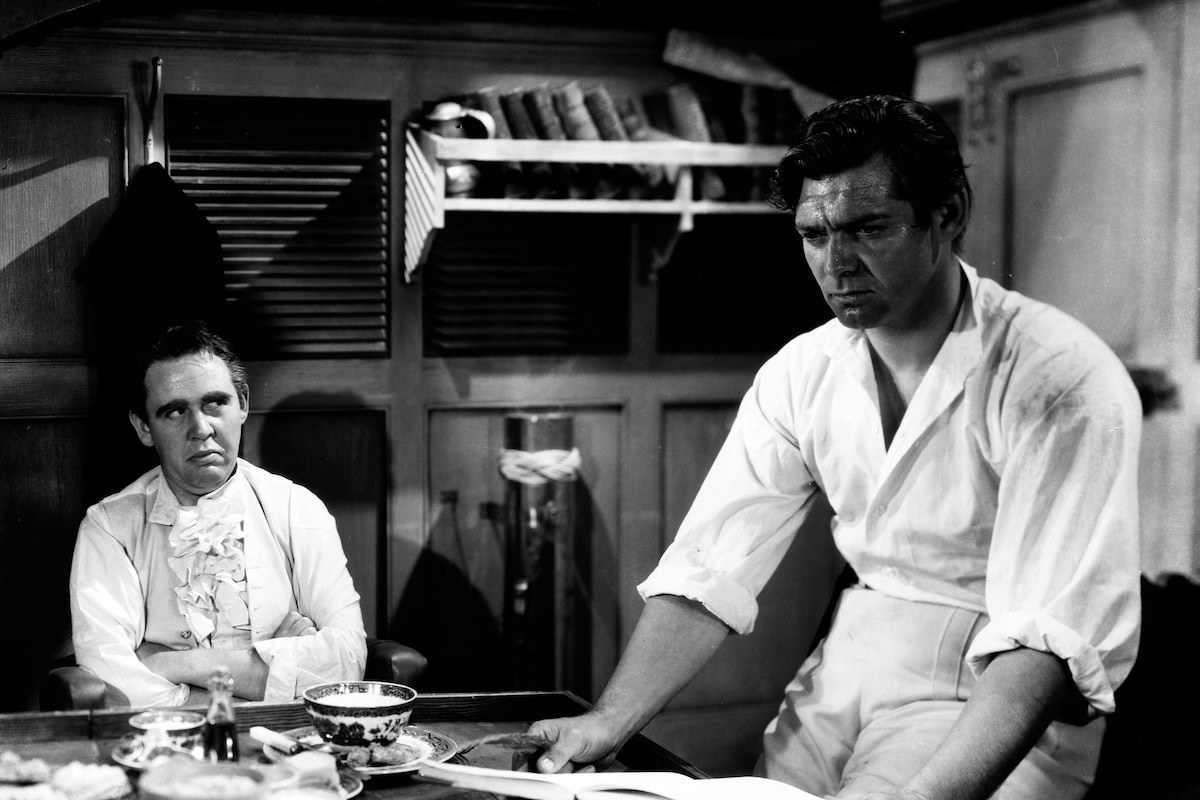
Feeling himself ill suited for period roles, Clark Gable tried to get out of playing Fletcher Christian. In particular, he objected to wearing the breeches that were part of the British naval uniform of the time, feeling they were too feminine.
Another objection Gable had to the role was that it would require him to shave his trademark moustache. Facial hair was forbidden under British maritime law during the film's period.
Gable's friend journalist Ben Maddox tried to talk him out of doing Mutiny on the Bounty, arguing that he would never be able to master a British accent (none of the film's American actors did except Eddie Quillan) and could not hold his own against Charles Laughton. It didn't help when Gable's father told the press that the period pigtail and breeches, not to mention having to shave his moustache, would make his son look like a sissy.
Thalberg finally got him to accept the role by promising never to ask him to take another part he didn't want if Mutiny on the Bounty didn't become his biggest hit.
The first screenplay, by Carey Wilson and John Farrow, didn't please Thalberg, so he sent it to Talbot Jennings. Then Robert Hopkins was brought in to add some comedy. Allen Rivkin added more comedy. Eventually the script was credited to Wilson, Jennings and Jules Furthman.
The script drew on all three Bounty novels and, on Thalberg's orders, focused largely on the conflict between Bligh and Christian.
Thalberg hoped that some real life animosity between Gable and whoever played Captain Bligh would add to the dramatic fireworks on screen, so he offered the latter role to Wallace Beery. The actor disliked Gable so much, however, that he didn't want to spend the long location shoot working with him.
When Thalberg turned to Charles Laughton to play Bligh, he hoped that Gable, a notorious homophobe, would dislike the gay actor. He also thought Gable would be intimidated working with the classically trained British actor. Adding to the animosity between the two was Laughton's belief that he should have been nominated for the Oscar® and won for his performance in The Barretts of Wimpole Street (1934). Gable had won that year for It Happened One Night.
Laughton was only available to play Bligh because plans to make a long-dreamed-of film version of Cyrano de Bergerac fell through.
Robert Montgomery was the first choice to play Byam, but his MGM schedule wouldn't allow for the lengthy location shoot.
MGM also wanted to cast Cary Grant as Byam, but his home studio, Paramount, refused the loan out.
Eventually the role went to Franchot Tone, a member of Broadway's Group Theatre whose patrician good looks had won him an MGM contract. He had been languishing in secondary roles since signing with the studio.
Gable didn't care for Tone either, since the two had been rivals for Joan Crawford's attentions (she married Tone after the film was completed). During location shooting, however, they bonded because of their mutual interests in alcohol and romantic conquests.
During his research for the role, Laughton discovered the original order for Captain Bligh's uniform at Gieves, Ltd., the famous tailor's on Bond Street in London. He had duplicates made there at his own expense and wore them in Mutiny on the Bounty.
by Frank Miller
The Big Idea - Mutiny On the Bounty ('35)
by Frank Miller | April 09, 2009
SIGN UP FOR OUR NEWSLETTERS

CONNECT WITH TCM