General Lew Wallace's source novel was the first work of fiction to be blessed by a Pope.
Wallace was born in 1827 in Brookville, Indiana. He studied law under his father, the state governor, and fought in the Mexican War. After the war, he finished his law studies and married Susan Arnold Elston, a writer whose novel Ginevra, or the Old Oak Chest was a famous tear-jerker of its day. In the Civil War he served as major-general at Shiloh and distinguished himself in the Battle of Monocacy. After the war, he wrote his first novel, a romance about the conquest of Mexico, followed by a stint as Governor of the Territory of New Mexico. In 1881, a year after publishing Ben-Hur: A Tale of the Christ (dedicated to his wife), he was appointed Minister to Turkey by President James Garfield. Wallace died in 1905, and his image represents the state of Indiana in the Statuary Hall in the nation's Capitol.
Ben-Hur held the record for the most Academy Awards for a single film (11) until it was tied by Titanic (1997). With an equal number of awards going to Lord of the Rings: Return of the King (2003), it's now a three-way tie between these three movies.
Well before the release of Ben-Hur, MGM had created considerable buzz by mounting a full schedule of interviews a year and a half before it ever hit the screen, as Charlton Heston noted with some dismay in his production diary. The filming of the chariot race, in particular, provided a great deal of fodder for the studio's publicity machine.
Joseph Vogel, president of Loew's Inc. (MGM's parent company), told the Wall Street Journal the studio was "being besieged by theater owners from all over the world" clamoring for special showings of Ben-Hur. Many even offered to spend up to $50,000 in renovations just to be worthy of exhibiting the epic.
Vogel announced that ticket prices for Ben-Hur would be higher than usual, with weekend seats going as high as $3.
According to a November 30, 1959, article in Time magazine, the picture had run up the biggest advance sale ($500,000) in film history.
Sneak previews of Ben-Hur were held in Denver, Dallas, and San Diego.
The film premiered in November 1959, first in New York (to an audience of Manhattan society and Wall Street bigwigs), then Los Angeles. It became an instant hit. From a budget of $15 million (the costliest movie ever made at that time) it has grossed to date (by various estimates) anywhere from 40 to 90 million. By any count, it was the top box office attraction for 1960.
For extra publicity, Charlton Heston was filmed at the theater box office selling tickets to the New York opening.
At the time of its release, Ben-Hur was the third-longest film ever released (3 hours, 37 minutes, not including a 15-minute intermission), behind Gone with the Wind (1939) at 3 hours, 42 minutes, and The Ten Commandments (1956) at 3 hours, 39 minutes.
Miklós Rózsa said that of his three Academy Awards (including Spellbound, 1945, and A Double Life, 1947), the one he most cherished was for Ben-Hur.
"It's a great lesson for any filmmaker who is confronted with trying to tell a personal story with a huge historical scope. You just remember you've got to have a great landscape but that landscape means nothing if there's not a human face to go in there." cinematographer Ernest Dickerson in the documentary Ben-Hur: The Epic That Changed Cinema (2005)
"[This year] I made the picture that may or may not be the best I'll ever make, but it'll certainly either press me into the thin, airless reaches where the supernovas drift or demonstrate conclusively that my orbit is a different one. ... Whether the film I made turns out to be memorable or not, I know the year we spent making it will be...and Rome will mark us all forever." Charlton Heston's December 31, 1958, entry in his production journal
"I don't think it is more pretentious than the story dictates. If you have to have a chariot race, you have to have stands of people around it and you have to fill the stands with five or six thousand people not because you want to, but because you can't have empty stands. We would have much preferred to have a cross-country chariot race; it would have been much cheaper. We could have gone across the hills of Rome and down dirt roads and along beaches, and we could have saved a couple of million dollars." William Wyler, in a 1967 interview in Cinema magazine, reacting to criticism of the size of the production and presentation of the story
Although the Catholic Legion of Decency gave Ben-Hur its highest rating, not all religious organizations praised it. Jesuit writers panned it, noting in particular that all Romans were portrayed as stupid and ignoble and that the film had all the subtlety of a cheap Western quickie. The Christian Century suggested Protestants challenge its "promotion of lurid distortions of the Bible." Director William Wyler responded in a UPI wire story that it was not a biblical film but first-century fiction.
Director William Wyler was born in Germany in 1902. At the age of 18 he was offered a job in Hollywood by his mother's first cousin, Universal Studios head Carl Laemmle. He directed his first picture, a Western short, in 1925, and continued to work primarily in that genre for a few more years. Wyler's long career took in crime stories (Dead End, 1937), costume dramas (Jezebel, 1938), romantic comedies (Roman Holiday, 1953), musicals (Funny Girl, 1968), and adaptations of novels and stage plays, the type of film for which he is perhaps best known: Wuthering Heights (1939), The Little Foxes (1941), The Heiress (1949), The Children's Hour (1961). He was nominated for Academy Awards 12 times and won three, for Mrs. Miniver (1942), The Best Years of Our Lives (1947), and Ben-Hur. Wyler died in 1981.
Producer Sam Zimbalist also oversaw production of the epic Quo Vadis (1951), which was also Academy Award-nominated for Best Picture. His other notable production credits included the Clark Gable vehicles Boom Town (1940) and Mogambo (1953) and the war drama Thirty Seconds Over Tokyo (1944). Because he died during production, his wife accepted the Best Picture Academy Award for Ben-Hur on his behalf. He had been a film cutter on the 1925 version of Ben-Hur.
Andrew Marton, who filmed the chariot race, was upset when he saw the final prints of the film listing him as only one of three second-unit directors, the minimum credit required by his MGM contract, instead of noting his full contribution, which he said Wyler had told him was one of the greatest cinematic achievements. Marton said he was sure that if producer Sam Zimbalist had lived, he would have been credited on screen as director of the race. Marton had also been a second unit director on Wyler's Mrs. Miniver, handling the Dunkirk sequence.
Acclaimed cinematographer Robert Surtees (1906-1985) won his third Academy Award with Ben-Hur; the others were King Solomon's Mines (1950) and The Bad and the Beautiful (1952). He was nominated 13 other times for such films as Oklahoma! (1956), The Graduate (1967), and The Last Picture Show (1971). Surtees was sometimes known as "The Prince of Darkness" for his masterful use of light and shadow, evident in some scenes of Ben-Hur.
Irish-born Stephen Boyd (Messala) made several pictures before Ben-Hur, but this was his biggest to that date, and with its success he was often typecast for costume epics. He was supposed to have played Antony opposite Elizabeth Taylor in Cleopatra (1963), a role that notoriously went to Richard Burton after numerous production delays forced Boyd out of the cast. He also appeared as Nimrod in The Bible (1966) and was in the Asian-set epic Genghis Khan (1965). He was Sophia Loren's leading man in The Fall of the Roman Empire (1964), a film whose failure he later blamed for the waning of his career. Boyd died of a heart attack while playing golf in 1977, a month before he would have turned 46.
Cathy O'Donnell, who played Judah's sister Tirzah, was married to director William Wyler's writer-producer-director brother Robert from 1948 until her death at the age of 46 in 1970 after a long struggle with cancer. She was also directed by William Wyler in The Best Years of Our Lives and Detective Story (1951). The latter film was co-written and produced by her husband.
Israeli actress Haya Harareet (Esther) was married to British director Jack Clayton (Room at the Top, 1959, The Great Gatsby, 1974) until his death in 1995.
Although only 11 years older than Charlton Heston, Martha Scott (Miriam) played his mother in this film and in The Ten Commandments. Wyler previously directed her in The Desperate Hours (1955). She was nominated for a Best Actress Oscar® for Our Town (1940).
Karl Tunberg, who wrote the first draft of Ben-Hur and successfully insisted on sole credit (despite its being substantially reworked by several other writers), was president of the Screen Writers Guild from 1950 to 1951. He contributed scripts for many films and television shows in his 40-year career and was Oscar®-nominated for this picture and (with co-writer Darrell Ware) for Tall, Dark and Handsome (1941).
According to Louella Parsons's newspaper column from July 31, 1958, Claude Heater, who played Jesus, was a young American singer discovered performing in Rome by production manager Henry Hennigson, who thought he had a very "spiritual" face (and, incidentally, a magnificent voice). He was tested and given the part because Wyler and producer Sam Zimbalist thought he resembled the traditional conception of Christ. His face is never seen in the film, but this opinion is borne out by production stills.
The day player who, as a Roman soldier, was given the line "No water for him" as Ben-Hur is being marched off into slavery, inadvertently engraved himself on the memory of those involved in the production. An American actor living in Rome, he was discovered by Wyler and sent for by the director when he realized the bit player had not been brought from the city to the set as expected. Wyler sent a special car for him and, as Charlton Heston noted in his production journal, the delay cost the studio some $15,000. When he delivered his line, it came out "No water for heem!" That became a running gag, and for years after, Heston and Wyler greeted each other with the line. According to Heston, the man never made another picture but did open a very successful restaurant in the Trastevere section of Rome.
The MGM Camera 65 process used in shooting Ben-Hur (and first employed in 1955 on Raintree County, 1957) later became known as Panavision. The company today remains a leading designer, manufacturer and supplier of film and digital cameras, lenses, and accessories for motion pictures and television.
Although uncredited, future Spaghetti Western director Sergio Leone and noted Italian writer-director Mario Soldati reportedly served as a second unit directors on Ben-Hur. MGM contract director Richard Thorpe (Three Little Words [1950], Ivanhoe [1952], Jailhouse Rock [1957]) provided some uncredited third unit direction, although on which scenes is not clear.
Frank Thring, the Australian actor who played Pontius Pilate, later played Herod in another Jesus flick, King of Kings (1961). He also played Herod in an acclaimed 1950s stage production of Oscar Wilde's Salome. His father, Frank Thring, Sr., invented the forerunner of the clapperboard still in use in film production today.
One night, during the run of the stage version in the early 20th century, there was a malfunction in the treadmill used for the chariot scene and a resulting confusion on the part of the horses that caused Messala, and not Ben-Hur, to win the race. But the cast carried on as if the hero had won after all.
Memorable Quotes from BEN-HUR
MESSALA (Stephen Boyd): By condemning without hesitation an old friend, I shall be feared.
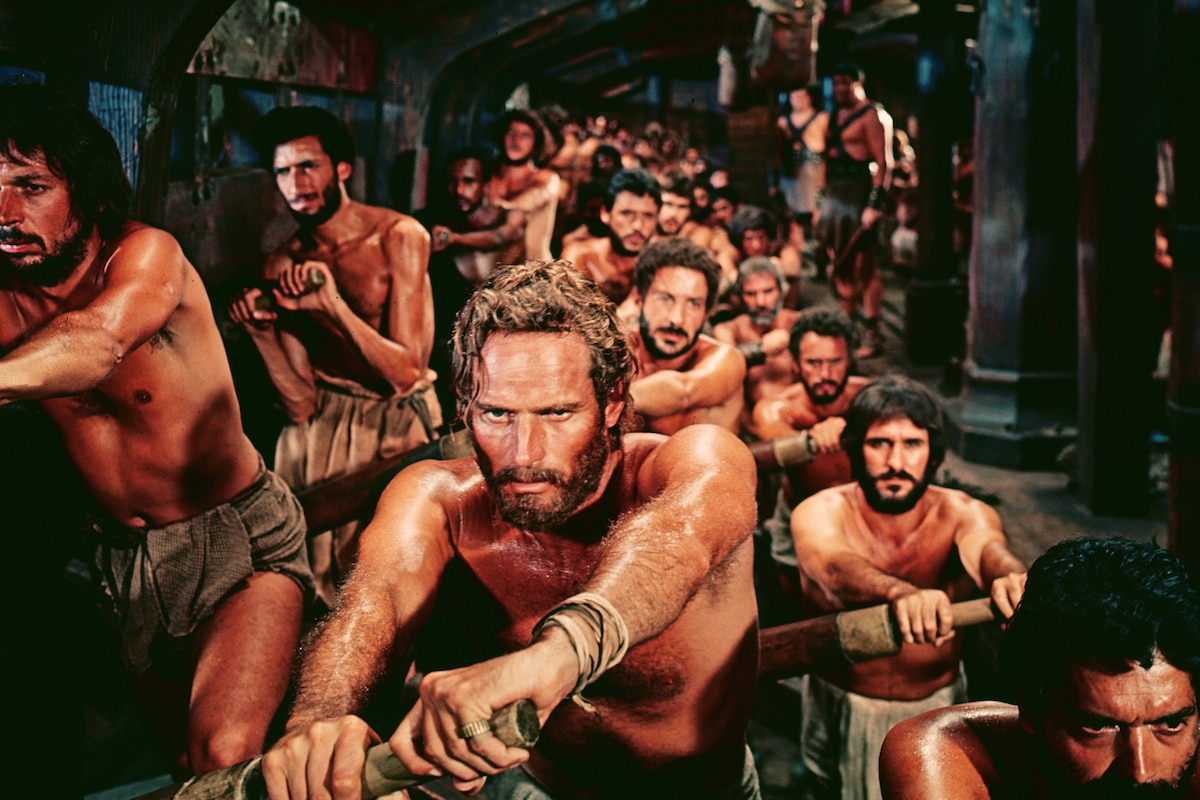
QUINTUS (Jack Hawkins): Now listen to me, all of you. You are all condemned men. We keep you alive to serve this ship. So row well, and live.
QUINTUS: (to Ben-Hur) Your eyes are full of hate, forty-one. That's good. Hate keeps a man alive. It gives him strength.
SHEIK ILDERIM (Hugh Griffith): One God, that I can understand; but one wife? That is not civilized.
SHEIK ILDERIM: You think you can treat my horses like animals?
JUDAH BEN-HUR (Charlton Heston): When the Romans were marching me to the galleys, thirst had nearly killed me. A man gave me water to drink, and I went on living. I should have done better if I'd poured it into the sand!
BALTHASAR (Finlay Currie): I see this terrible thing in your eyes, Judah Ben-Hur, but no matter what this man has done to you, you have no right to take his life. He will be punished inevitably.
JUDAH BEN-HUR: I don't believe in miracles.
BALTHASAR: Your whole life is a miracle! Why will you not accept God's judgment?
ESTHER (Haya Harareet): It was Judah Ben-Hur I loved. What has become of him? You seem to be now the very thing you set out to destroy, giving evil for evil! Hatred is turning you to stone. It is as though you had become Messala!
JUDAH BEN-HUR: Almost at the moment He died, I heard Him say, "Father, forgive them for they know not what they do."
ESTHER: Even then.
JUDAH BEN-HUR: Even then. And I felt His voice take the sword out of my hand.
Compiled by Rob Nixon
Trivia - Ben-Hur - Trivia & Fun Facts About BEN-HUR
by Rob Nixon | December 30, 2008
SIGN UP FOR OUR NEWSLETTERS

CONNECT WITH TCM