SYNOPSIS
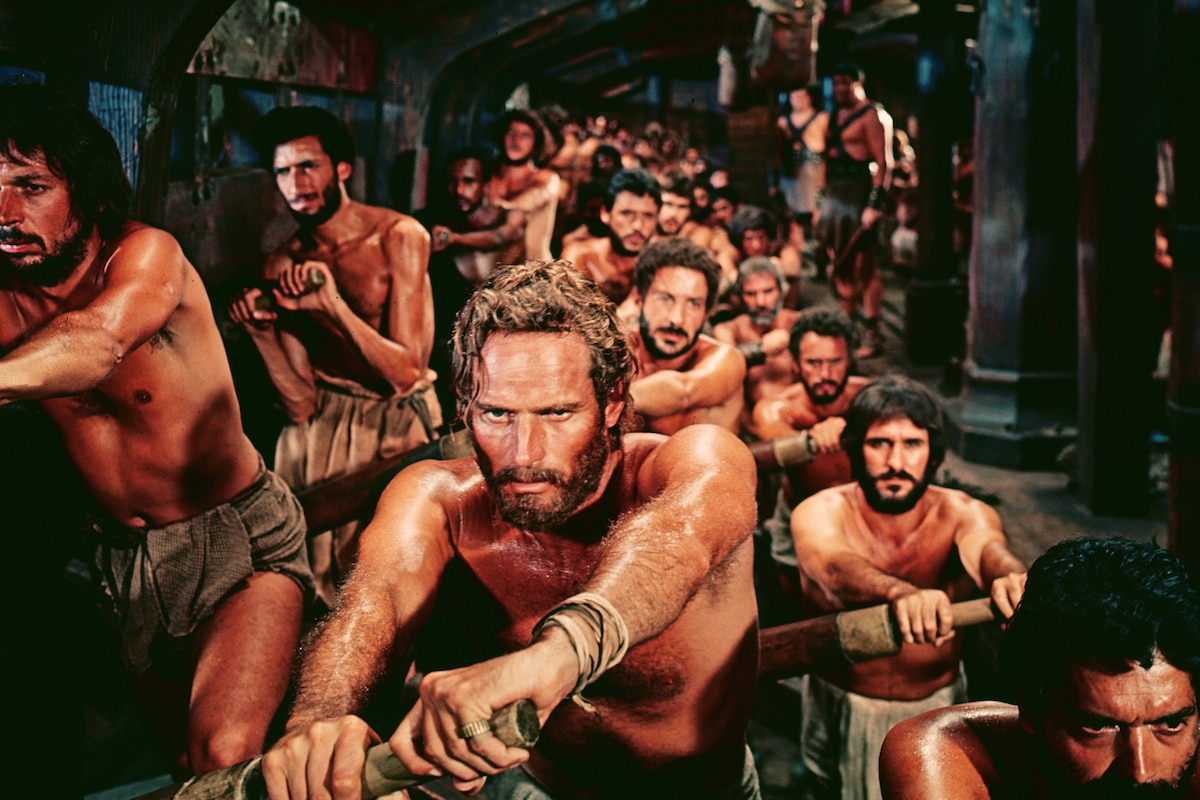
Judah Ben-Hur is a wealthy Jewish prince living with his mother and sister in 1st century Jerusalem. When his childhood friend Messala arrives from Rome as the commander of the Roman legions for the new governor, the men are thrilled at first to see each other, but it soon becomes apparent that they hold strongly opposed views on the issue of Judea's independence from Rome. They quarrel and part. Later, as Judah and his family watch the Roman governor parade through the streets, a tile from their roof comes loose, falling to the ground and injuring the official. Although he knows it was an accident, Messala arrests Judah to make an example of him, sending him off to the galleys as a slave and throwing his mother and sister into prison. Judah swears revenge against his former friend. During a sea battle, he rescues the fleet's commander and is made his adopted son. Judah rises high in Roman society and becomes a champion charioteer, all the while driven solely by vengeance. But chance encounters over the years with Jesus of Nazareth begin to lead Judah to understand that love and forgiveness are higher virtues than a thirst for blood.
Director: William Wyler
Producer: Sam Zimbalist
Screenplay: Karl Tunberg (credited); Christopher Fry, Gore Vidal, S.N. Behrman, Maxwell Anderson (uncredited); based on the novel by Lew Wallace
Cinematography: Robert Surtees
Editing: John D. Dunning, Ralph E. Winters
Art Direction: Edward Carfagno, William A. Horning
Original Music: Miklós Rózsa
Cast: Charlton Heston (Judah Ben-Hur), Jack Hawkins (Quintus Arrius), Haya Harareet (Esther), Stephen Boyd (Messala), Hugh Griffith (Sheik Ilderim).
C-223m. Letterboxed. Closed captioning. Descriptive Video.
Why BEN-HUR is Essential
Lavish period epics, particularly those set in biblical or Imperial Roman settings, were born in Italy in the early days of cinema and exported with great success to the rest of the world, inspiring and challenging American directors like Griffith and DeMille. The genre went into decline after the arrival of sound but re-emerged after World War II and not only in Italy. Hollywood soon discovered these huge productions were a perfect counterpoint to the growing popularity of television, providing the grand wide-screen spectacle the tiny tube couldn't present. Many of these American epics, among them Quo Vadis (1951) and Helen of Troy (1956), were shot all or in part in Italy in order to make use of the facilities and technicians who knew how to do the style best. But as Hollywood had done so often with European styles and innovations, they took the genre and gave it a grandeur, gravitas, and great sum of money that even the Italians, with their more vigorous and cheaply made costume adventures of the 1950s, didn't match. Ben-Hur marked the zenith of this cycle. The genre continued in popularity for a few more years, but nowhere else did it quite achieve its heights of critical respect, awards, and box office impact.
Up to this point, director William Wyler was known for literate, often intimate, character-driven dramas, and he was reluctant to take on a production he felt more suited to the likes of the bombastic Cecil B. DeMille. But once he had become convinced, impressed primarily with the theme of the Jewish people fighting for their freedom, he committed himself totally to the process, determined to give producer Sam Zimbalist the "intimate epic" he was seeking, one whose abundant action and spectacle would not overshadow the personal story of one man's path from bitterness and revenge to love and forgiveness.
Ben-Hur was the biggest and most complex undertaking of Wyler's career (with the biggest pay-off, setting him up financially for life). It was also the grandest, most expensive production the motion picture industry had seen up to that point, using more people, bigger sets and inspiring more news stories and publicity hype than ever before. And, of course, there is that justly famous chariot race. Coupled with its reputation as a thinking man's epic, a big picture with a personal drama at its core, Ben-Hur displaced the more superficial standard for the genre to that time, the DeMille-directed The Ten Commandments (1956), to achieve lasting fame as the quintessential costume epic.
by Rob Nixon
The Essentials - Ben-Hur
by Rob Nixon | December 30, 2008
SIGN UP FOR OUR NEWSLETTERS

CONNECT WITH TCM