Awards and Honors
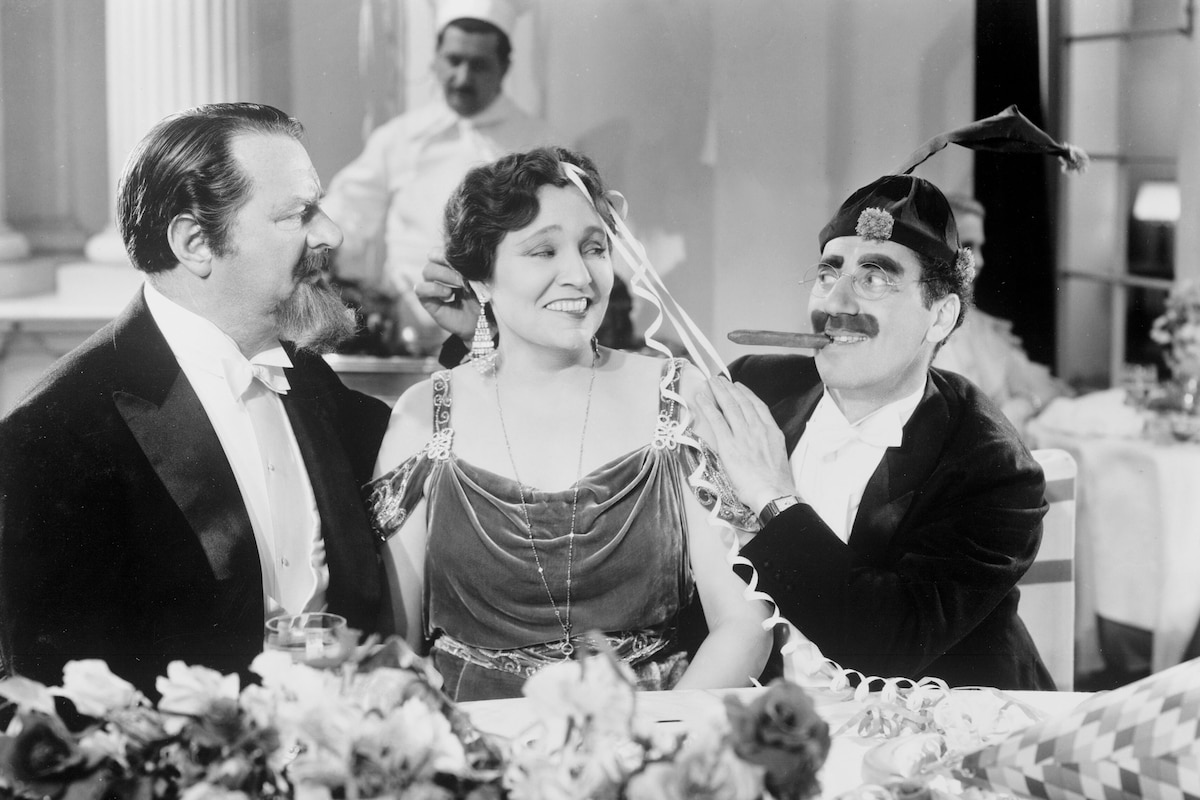
A Night at the Opera was a huge hit for the Marx Brothers and MGM, and a welcome change for the comedians whose previous film, Duck Soup (1933) had tanked at the box office. The film brought in more than $3 million on a cost of just over a million - and the Marxes, thanks to an exceptionally sweet contract, owned 15 percent of the gross.
A Night at the Opera was one of the 25 films chosen in 1993 to be catalogued in the Library of Congress as a National Treasure.
The Critics' Corner: A Night at the Opera
"The loudest and funniest screen comedy of the winter season."
- The New York Times
"None of their previous films is as consistently and exhaustingly funny, or as rich in comic invention and satire."
- The New York Evening Post
"One of the most hilarious collections of bad jokes I've laughed myself nearly sick over."
- Otis Ferguson, The New Republic
"The Marx Brothers have worn reasonably well in the three decades since they burned themselves out somewhere between A Night at the Opera and A Day at the Races."
- Andrew Sarris, The American Cinema (Dutton, 1968)
"A Marx Brothers movie is a series of sketches on a theme. But a Thalberg movie is a story clearly told. Not only does he lumber the Marxes with young lovers, but he organizes the adventure around a plot and assigns the boys set roles in that plot. Concomitantly, we lose the wonderfully surreal aspect of the Paramount Marxes, the jesting that is physically possible but socially improbable...What's odd about all this is that A Night at the Opera is second in their canon only to Duck Soup. (Some prefer it.) This proves that even Thalberg could not, finally, contain the boys, and that, perhaps not inadvertently, he had given them the sweetest challenge to their anarchic energy in utilizing opera as a background. Nothing is more alien to the Marxes than opera, with its piss-proud tenors and society divas. Nothing more surely deserves the Marxian treatment."
- Ethan Mordden, The Hollywood Studios (Knopf, 1988)
"It's a top budget job, opulent and meticulous, with its fair share of vices: this is the first Marx Brothers film where you really feel like strangling the romantic leads. But it has even more virtues: there's no Zeppo, the script's generally great (Kaufman and Ryskind), Dumont's completely great, and the Brothers get to perform some of their most irresistible routines - the stateroom scene and all."
- Geoff Brown, TimeOut Film Guide
"Best Marx Brothers picture to date. Abounds in laughs and side-splitting situations."
- Boxoffice Magazine
"The Marx Brothers sometimes said that this was their best film; it isn't, but it was their
greatest hit. Two beautifully stuffed American targets - grand opera and high society - are left
dismantled, flapping like scarecrows. (If you ever could listen to Il Trovatore with a
straight face, you can never do so again.)...This comedy has its classic sequence: the stateroom
scene, which is widely regarded as the funniest five minutes in screen history. It will sustain
you through the dreadful duets."
- Pauline Kael, 5001 Nights at the Movies
"Duck Soup was 70 minutes; A Night at the Opera was 92. But you could relieve
yourself in the breathing spaces. Opera has the Party of the First Part and the stateroom
scene, and it's clear that when that didn't work onstage it was [Irving] Thalberg who said keep it
in - because the reality of the room is different on film. My friends, that is quietly
brilliant....But don't kid yourself: Without this film, opera wouldn't be where it is in
America."
- David Thomson, Have You Seen...?
"The last vintage Marx Brothers film...Their cheekiness, their desire and ability to stultify
bourgeois decorum, and the unparalleled combination of Groucho and Chico's linguistic wit with
Harpo's demoniac miming, ensure victory for the Marxes as ever."
- Peter Cowie, Eighty Years of Cinema
"The backstage finish, with Harpo doing a Tarzan on the fly ropes, contains more action than the
Marxes usually go in for, but it relieves the strictly verbal comedy and provides a sock exit."
- Variety
"Fortunately not even the painfully sickening romance between Jones and Carlisle (including a
quayside to ocean liner duet) can detract from the effortless majesty of the Marx Brothers' comic
antics. The delirious climax sees the threesome wreck a performance of Verdi's "Il Trovatore" in a
completely irreverent assault on high culture by their inimitable blend of disreputable
shenanigans."
- Jamie Russell, www.bbc.co.uk
Compiled by Rob Nixon
Critics' Corner - A Night at the Opera
by Rob Nixon | December 30, 2008
SIGN UP FOR OUR NEWSLETTERS

CONNECT WITH TCM