SYNOPSIS
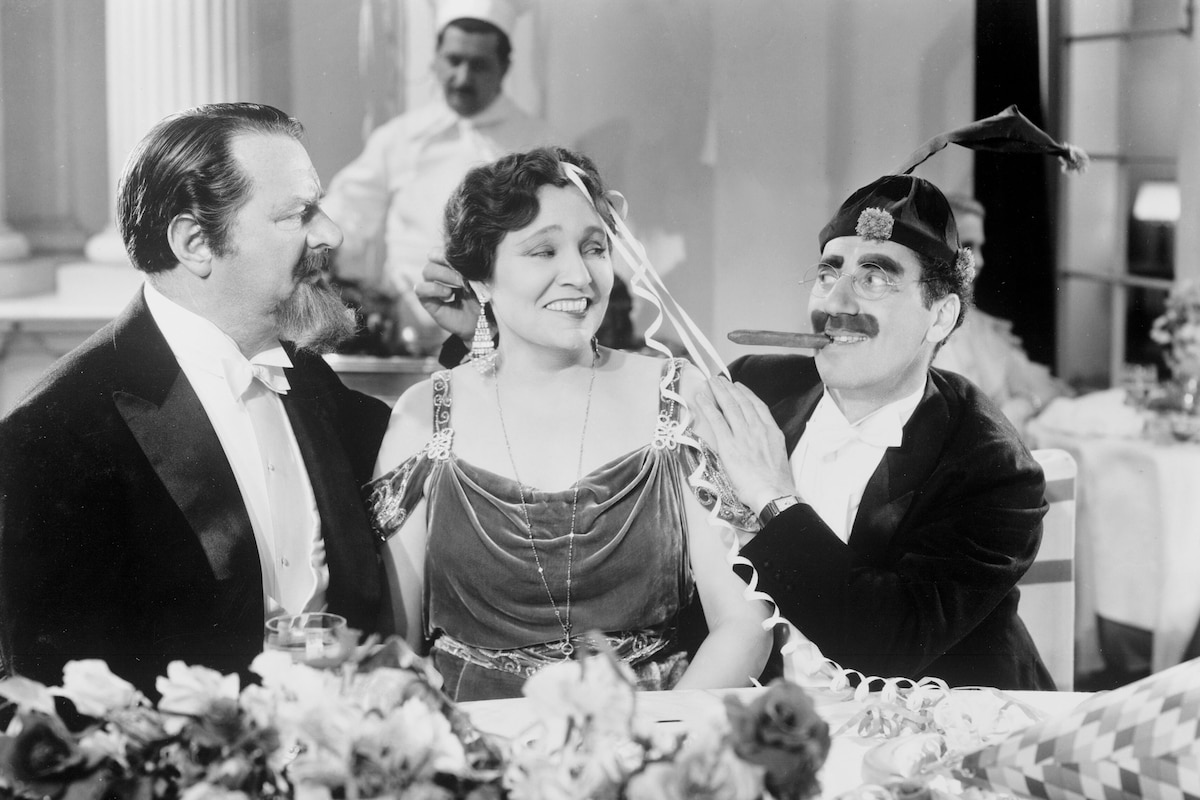
Con man and "promoter" Otis B. Driftwood is trying to woo the wealthy Mrs. Claypool into investing in an opera company by promising to secure her entry into high society. The stars of the Milan-based company are the vain, mean-spirited Rudolfo and the sweet, talented Rosa. Rosa is in love with the tenor Ricardo, who has been consigned to the chorus by his rival, Rudolfo. Ricardo's agent, Fiorello, and Rudolfo's put-upon dresser, Tomasso, also become involved in Driftwood's scheme, which brings everyone together on an ocean liner bound for New York. Once in the States, Rudolfo has both Driftwood and Rosa fired from the company. They get their revenge, however, by totally devastating the company's production of Il Trovatore, kidnapping Rudolfo, and triumphantly substituting Rosa and Ricardo in the leads.
Director: Sam Wood
Producer: Irving G. Thalberg
Screenplay: George S. Kaufman, Morrie Ryskind
Cinematographer: Merritt B. Gerstad
Editor: William LeVanway
Art Director: Cedric Gibbons
Original Music: Herbert Stothart
Cast: Groucho Marx (Otis B. Driftwood), Chico Marx (Fiorello), Harpo Marx (Tomasso), Margaret Dumont (Mrs. Claypool), Kitty Carlisle (Rosa), Allan Jones (Ricardo), Walter Woolf King (Rudolfo).
BW-92m. Closed captioning. Descriptive Video.
Why A NIGHT AT THE OPERA is Essential
Marx Brothers fans are generally divided over the quality of the early '30s Paramount period (Animal Crackers, Horse Feathers, Duck Soup, etc.) vs. the MGM period (A Day at the Races, Go West, etc.), which was kicked off by A Night at the Opera, their most successful movie. Paramount purists will hail the anarchic comedy of the earlier films, the ones more closely akin to the Marx Brothers' stage career. They are superior, they say, for their lack of both sentimentality and clear logic, for the way the brothers - unfettered by serious or consistent character motivations and definitions - run rampant over the rather fantastic worlds created in the films.
Defenders of the MGM films will usually admit that the franchise went steadily downhill over the years but they like to point out that at least the later films didn't include the boring Zeppo and it's hard to top A Night at the Opera. With its justly famous stateroom scene, the verbal bantering and punning of Groucho and Chico, and the shredding of an entire Verdi opera, this movie has outlasted all the others in the opinion of most moviegoers as the brothers' all-time classic.
The very virtues touted by those who prefer the earlier films are exactly what brought the Marxes to Metro in the first place and what made them willingly follow the advice of the studio's Boy Wonder production chief, Irving G. Thalberg. The last of the Paramount films, Duck Soup (1933), although hailed as a cult classic now and often considered the team's masterpiece, was a miserable flop both critically and commercially. The brothers found themselves without a studio, without one of their members (Zeppo, who left to pursue a career off camera), and without any future film prospects. But Chico, ever the gambler, was a bridge partner of Irving Thalberg, who happened to be a Marx fan. And so, under his powerful patronage, the team got a fresh start at the biggest studio in the business.
Thalberg thought one of the Marx Brothers' major problems was that they appealed only to a minority of moviegoers, particularly the intellectual elite, and that they were ignoring the sizable female audience that so often decided which films the family would see. He also found them to be unsympathetic characters on screen. To solve this, he strengthened the romantic musical-comedy aspect of the plots and put the Marxes into them as kindly and helpful types rather than the uninhibited anarchists they were in the Paramount comedies. The storylines became more straightforward, the brothers' characters more logically integrated, and the production values much more lavish in the typical MGM tradition.
For some, that was a loss. After all, hadn't Thalberg stripped Harpo of his trademark overcoat, in which he could conceal almost anything? And as the films became more formulaic and restrained after Thalberg's death, that opinion seemed to be justified. But the Marx Brothers themselves knew their old approach was beginning to repeat itself too much, so they were cautiously eager to let Thalberg give them a makeover.
Harpo wrote years later, "Our trouble, Irving said, was that we were a big-time act using small-time material. We belonged in A-pictures, not in, hodgepodge, patchwork jobs. Our movies should have believable plots, love stories, big casts, production numbers. We were afraid this would take us out of our element, but Thalberg said, 'Don't worry about a thing. You get me the laughs and I'll get you the story."
Get the laughs they certainly did, and audiences are still laughing at their antics today. Here are some of the most famous Marx Brothers scenes: 15 people crowding into Groucho's tiny shipboard stateroom; Groucho ordering two hardboiled eggs from the ship steward, changing it to three each time Harpo honks his horn; Groucho and Chico agreeing on the terms of Ricardo's contract by tearing away all disputed passages until they're left with only a scrap of paper. And despite the introduction of a "kinder, gentler" Marx Brothers, A Night at the Opera still contains many elements of their trademark zany, anarchic humor: Chico, Harpo and Allan Jones disguising themselves as rather strange and inexplicable bearded aviator heroes to escape the authorities; the brothers eluding a private detective by leading him on a mad chase through a hotel suite whose furniture they keep rearranging; and, of course, Groucho's one-liners, particularly those hurled at Margaret Dumont in what is half courtship, half character assassination.
Despite its eventual success, A Night at the Opera was nearly a disaster. It was previewed in Long Beach, Calif., where the audience sat stone-faced throughout the entire show. In the lobby later, Groucho was practically suicidal, and Chico, desperate for an excuse, insisted the response was because the mayor of Long Beach had recently died. Everybody, especially director Sam Wood, was ready to re-cut the picture, but Thalberg insisted they preview it in San Diego the next night before doing anything. The San Diego audience fell into the aisles laughing. To this day, no one can explain the reaction in Long Beach.
by Rob Nixon
The Essentials - A Night at the Opera
by Rob Nixon | December 30, 2008
SIGN UP FOR OUR NEWSLETTERS

CONNECT WITH TCM