"Law and justice are distant cousins, and here in South Africa they're not on speaking terms at all."
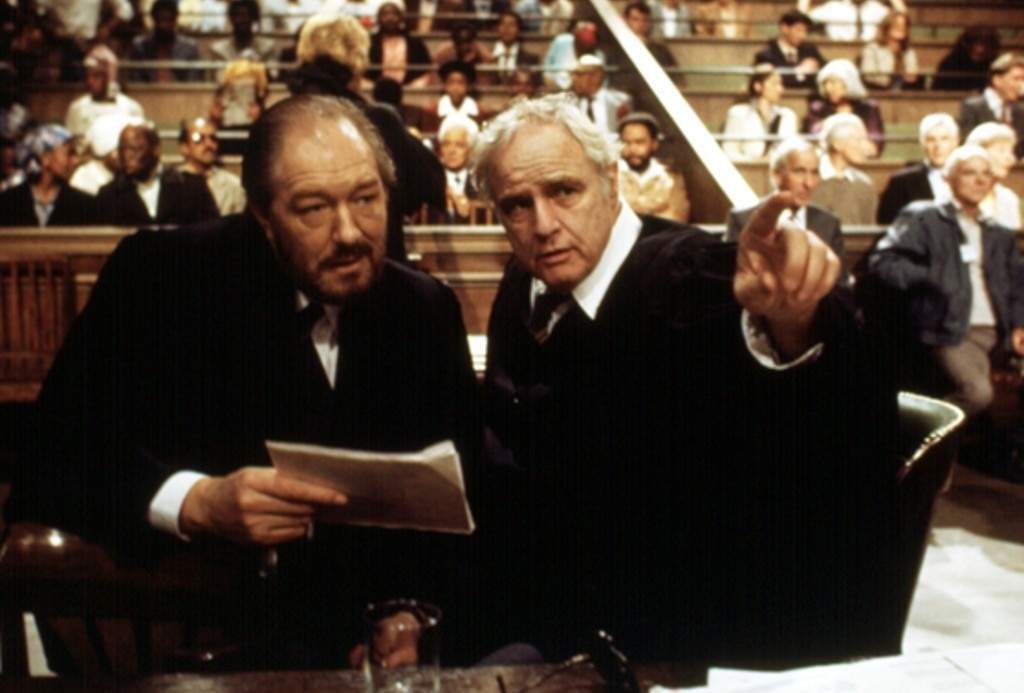
Marlon Brando in A Dry White Season
The late '80s were a hard time for South Africa on screen and with good reason. With the world's growing disgust with the nation's racially discriminatory Apartheid policies, international filmmakers tackled the subject in a series of pictures, including Richard Attenborough's Cry Freedom (1987), with Denzel Washington as Steve Biko, Chris Menges' A World Apart (1988) and the 1989 political thriller, A Dry White Season. Although all three focused primarily on white South Africans involved in the fight for equality, A Dry White Season had the distinction of being the first major Hollywood feature directed by a black woman, Euzhan Palcy, while also containing one of Marlon Brando's last great performances.
Martinique-born Palcy had first attracted attention with her 1983 account of growing up in her homeland, Sugar Cane Alley. With that film's international success (in Martinique it out-grossed that year's biggest hit, E.T.), she set out to make a film about Apartheid. But after years of struggling to find financing, she realized that nobody wanted to finance a film on the subject unless it featured a white protagonist. Fortunately, she managed to hook up with an adaptation of Andre Brink's 1979 novel that had begun at Warner Bros. with producer David Puttnam.
Brink, one of the first South African novelists to write in Afrikaans, had risen to fame with his story of a white school teacher who becomes involved in the fight against Apartheid when his black gardener and the man's son are killed by the South African police. The novel had even achieved the distinction of being banned in Brink's native land.
Puttnam was already in possession of a screenplay written by Colin Welland, who had won an Oscar® for the producer's Chariots of Fire (1981). Then the project moved to MGM, where producer Paula Weinstein took it over. Palcy had problems with Welland's script and set out to re-write it, most notably changing the ending to introduce a note of revolution not present in Brink's novel. .
Although A Dry White Season had been cast with international actors of a high caliber -- including Donald Sutherland as the schoolteacher, British actress Janet Suzman as his wife and then rising young actress Susan Sarandon as a British journalist -- it was lacking in marquee value. As a result, MGM started pushing Weinstein and Palcy to find at least one major star to flesh out the cast. Palcy thought Brando would be excellent casting for the small but flashy role of a crusading lawyer who tries to help Sutherland win one of his legal battles. She never expected him to accept the role, but Brando, who had been off-screen since The Formula in 1980, had been so impressed with her earlier film and so moved by the story's politics that he agreed to work for scale against a percentage of the gross. He even donated his paycheck to anti-Apartheid organizations.
Not that he came without problems. Whether for artistic reasons, as he claimed, or because he simply couldn't learn his lines any more, he insisted that his lines be transmitted to him over a closed-circuit receiver he wore in his ear. He would later claim that he re-wrote his few scenes and even directed them himself. When he saw the finished film, he denounced MGM for allegedly butchering the film to give the impression that Apartheid was a thing of the past. He also complained that his best scene had been cut.
Despite his complaints, Brando got some of the film's best reviews. When the year's Oscar® nominations were announced, Brando was a surprise nominee for Best Supporting Actor. There were even gasps from the press when his nomination was announced. He lost the award to Denzel Washington for Glory.
Overall A Dry White Season received only mixed reviews, with some critics lamenting the changes from Brink's novel while others complained that it was time for an anti-Apartheid film with a black protagonist. Along with Brando, the best reviews went to three South African actors, Zakes Mokae, Winston Ntshona and John Kani. All three were associates of pioneering South African playwright Athol Fugard, another anti-Apartheid activist, and all three had won Tony Awards for Broadway appearances in his plays.
Producer: Paula Weinstein
Director: Euzhan Palcy
Screenplay: Euzhan Palcy, Colin Welland
Based on the novel by Andre Brink
Cinematography: Kelvin Pike, Pierre-William Glenn
Art Direction: John Fenner
Music: Dave Grusin
Cast: Donald Sutherland (Ben du Toit), Winston Ntshona (Gordon Ngubene), Susan Sarandon (Melanie Bruwer), Janet Suzman (Susan du Toit), Marlon Brando (Ian McKenzie), Zakes Mokae (Stanley), Jurgen Prochnow (Capt. Stolz), Thoko Ntshinga (Emily Ngubene), Susannah Harker (Suzette du Toit), John Kani (Julius), Michael Gambon (Magistrate), Ronald Pickup (Louw).
C-97m.
by Frank Miller
A Dry White Season
by Frank Miller | December 17, 2008
SIGN UP FOR OUR NEWSLETTERS

CONNECT WITH TCM