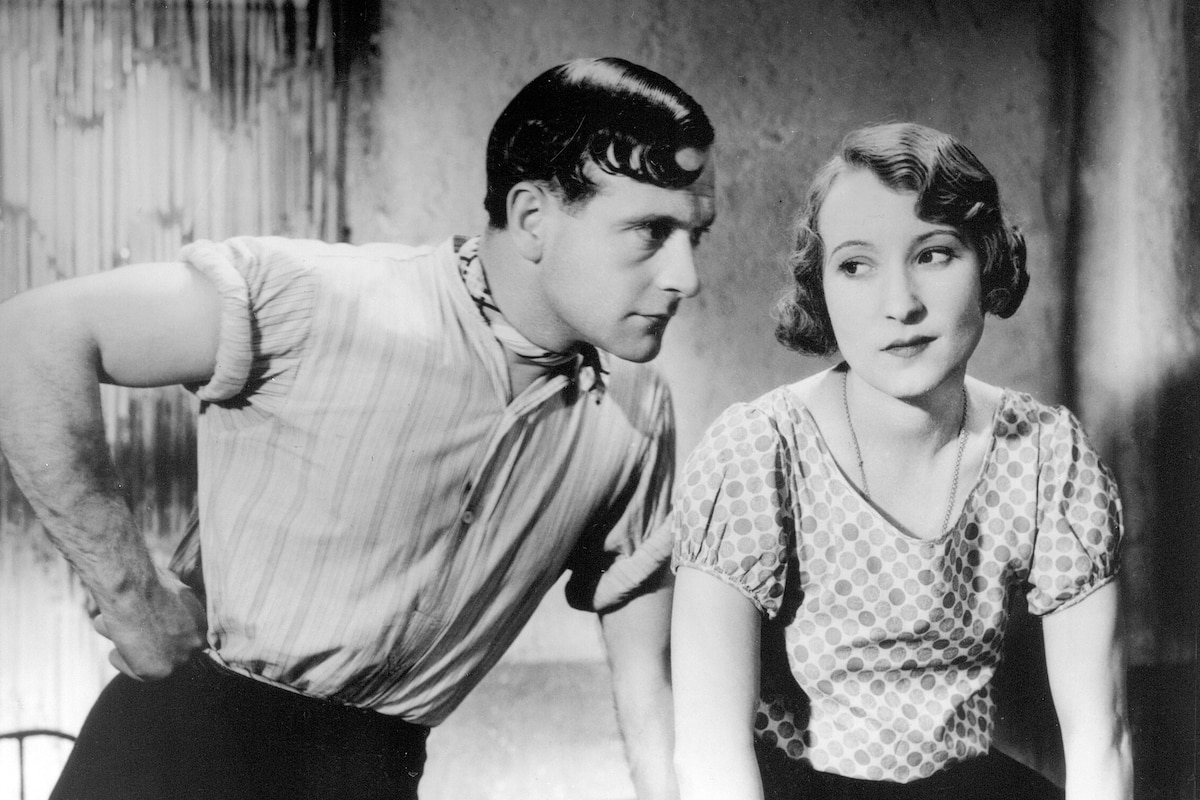
Marius (1931) is the first film in Marcel
Pagnol's trilogy about denizens of the Marseilles
waterfront. The films were based on Pagnol's very
successful plays Marius (1929) and Fanny
(1931), which were huge hits on the Paris stage. (The
third film, Cesar, which looks at the characters
twenty years later, was made in 1936, and the 1946
stage version was actually based on the film, instead
of vice-versa.)
Marius, the son of a bar owner, fights his attraction
to Fanny, the daughter of a seafood vendor, because
marrying her would mean the end to his dream of going
to sea. Fanny is courted by Panisse, an older,
well-to-do merchant who is a friend of Marius's father
Cesar, but she refuses him because she's in love with
Marius. When Marius's efforts to get a job on a ship
are unsuccessful, he at last turns to Fanny, and they
are happy for a while. But then another job on a ship
becomes available. Will Fanny hold him, or is the lure
of the sea stronger? A simple plot summary can't really
do justice to Marius or the other films in the
trilogy, which are rich in character and detail, full
of poignancy, humor, everyday life, and delightful
performances by what would become Pagnol's stock
company of character actors.
Pagnol had sold the film rights to his play to
Paramount's French division, but had retained approval
of the film adaptation. Marius would be the
first film version of Pagnol's work, and Pagnol himself
was writing the screenplay. Determined to preserve the
integrity of his play, he was proving to be difficult
to work with, so studio head Robert Kane decided to
hand the job of directing to a new arrival, Alexander
Korda.
Korda had begun his career in his native Hungary, and
had risen to become one of the nation's top directors
during World War I. Forced to leave Hungary during
political upheaval in the aftermath of the war, Korda
arrived in Vienna penniless, and began rebuilding his
career. His next stop was Berlin, then Hollywood in
1927. He did well at first, but after the coming of
sound his career declined, and he returned to Europe,
landing a job at Paramount's Paris studios directing
the German versions of French films.
Korda was very supportive of Pagnol, agreeing to use
the original cast of the stage production, and keeping
the regional accents that defined the characters. Korda
did not like the sets, which did not look like they
belonged in Marseilles, and recruited his brother
Vincent, an artist living in the south of France, to
create new ones that looked more like the region he
knew well. It was the beginning of Vincent Korda's
career as a motion picture art director. Alexander
Korda not only shot Marius quickly, he also shot
it again, just as quickly, in a German version, with a
German cast. Marius was a hit, and Kane was so
impressed with Korda's work that he offered him the job
of running Paramount's British studios. Korda moved to
London, and soon established his own studio, London
Films, launching his long and successful career as an
independent producer.
The success of Marius also paved the way for
Pagnol's cinematic career. He set up his own production
company, and its premiere film was Fanny (1932),
the sequel to Marius. Once again, Pagnol wrote
and produced, but did not direct the film, leaving that
role to Marc Allegret. By the time he made Cesar
in 1936, Pagnol had been directing for two years, and
he directed that film as well. In 1946, Pagnol became
the first filmmaker to be elected to the Academie
Francaise. His work was considered old-fashioned by
some of the French New Wave filmmakers of the 1960s,
but earned new appreciation in later years, with the
remakes of some of his films, and adaptations of his
novels and memoirs, such as Claude Berri's 1986
Manon of the Spring and Jean de Florette,
and Yves Robert's 1990 My Mother's Castle and
My Father's Glory.
But it is the Marseilles trilogy, one of French
cinema's best-loved masterpieces, that has become the
most enduring of Pagnol's work. MGM's version, Port
of Seven Seas (1938), was directed by James Whale,
written by Preston Sturges, and starred Wallace Beery
as Cesar, Frank Morgan as Panisse, and Maureen
O'Sullivan as Fanny (renamed Madelon). It is rarely
seen because of legal issues.
A 1954 Broadway musical, Fanny, compressed all
three stories into one, and starred Ezio Pinza, Walter
Slezak, and a young Florence Henderson in the title
role. It was directed by Joshua Logan, who also
directed the 1959 film version. It starred Leslie Caron
and Horst Buchholz as the lovers, and Charles Boyer and
Maurice Chevalier as the elders. The film used Harold
Rome's music from the stage musical as background only,
and was otherwise a straight dramatic film with no
songs. In France, the trilogy has been remade several
times for French television, most recently in 2000; and
a stage version of the combined stories, titled
Caesar, Fanny, Marius opened in Paris in
February of 2009. All of these adaptations had their
charms, but for many film lovers, nothing compares with
the original trilogy.
Director: Alexander Korda
Producer: Marcel Pagnol, Robert T. Kane
Screenplay: Marcel Pagnol, based on his play
Cinematography: Theodore J. Pahle
Editor: Roger Spiri-Mercanton
Production Design: Alfred Junge, Vincent Korda
Music: Francis Gromon
Principal Cast: Raimu (Cesar), Pierre Fresnay (Marius),
Orane Demazis (Fanny), Fernand Charpin (Honore
Panisse), Alida Rouffe (Honorine), Paul Dullac
(Escartefigue) Alexandre Mihalesco (Piquoiseau).
BW-130m. Closed captioning.
by Margarita Landazuri
Marius
by Margarita Landazuri | December 10, 2008
SIGN UP FOR OUR NEWSLETTERS

CONNECT WITH TCM