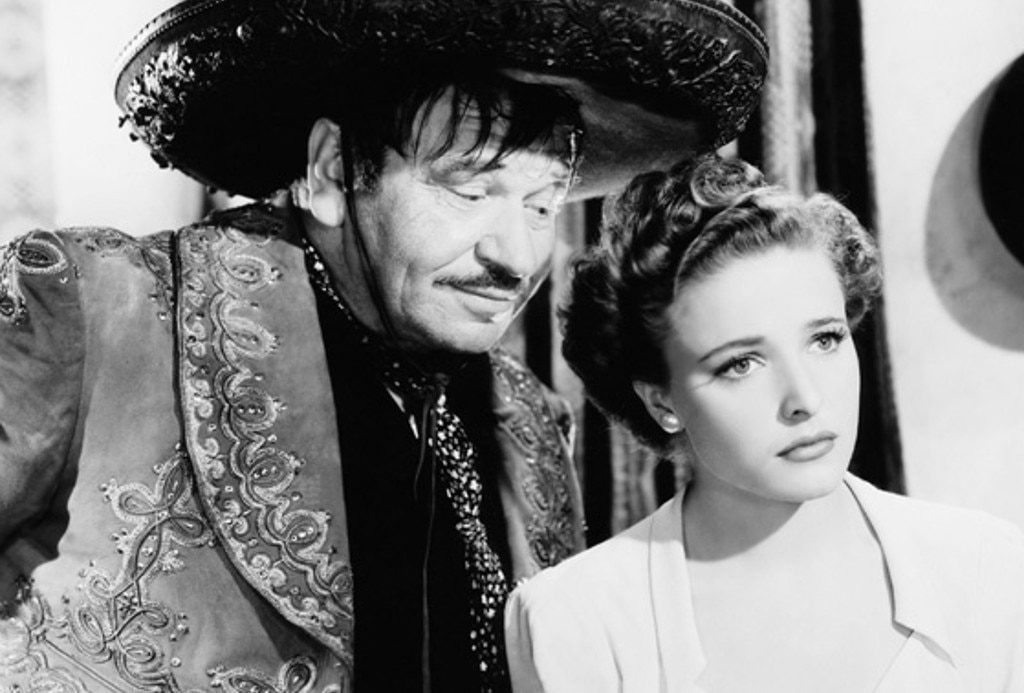
The Bad Man (1941) was the third screen version of Porter Emerson Browne's 1920 play, following a 1923 silent version, and an early sound version in 1930 starring Walter Huston, hamming it up in the title role of Mexican bandit Pancho Lopez. In the 1941 version, it was Wallace Beery's turn to chew the scenery as the lovable bad guy who plays cupid (the film British title, in fact, was Two-Gun Cupid) for stalwart young rancher Gil Jones, played by Ronald Reagan. Gil and his grandfather (Lionel Barrymore) are about to lose their ranch because they can't pay the mortgage. Also in the mix are Gil's former sweetheart (Laraine Day) and her husband, and the banker who holds the mortgage (Henry Travers) and his daughter (Nydia Westman).
By the time MGM borrowed Reagan for The Bad Man, he had been under contract at Warner Bros. for three years and had worked his way up from B-pictures to important roles in two prestige productions in 1940, Knute Rockne -- All American and Santa Fe Trail. It was Reagan's first loanout, and an indication of his growing popularity that Hollywood's top studio wanted him for one of their films. However, his role in The Bad Man was not only a supporting one, it was supporting two of the biggest scene stealers in Hollywood.
Beery was notoriously difficult, and was known to rant and storm off the set if he didn't get his way. Barrymore was more genial, but no less dangerous, according to Reagan. He told Tony Thomas, author of The Films of Ronald Reagan, "I had been warned about Beery, but nobody said anything about Barrymore....Wally never rehearsed a line the way he would say it in the scene, so you were always on edge, trying to anticipate a cue for our own line. Lionel was, of course, theater through and through, and you were made better by his great ability -- provided you kept from being run over." Reagan meant that literally -- Barrymore suffered from debilitating arthritis and was confined to a wheelchair by then. He wielded that wheelchair like a weapon. "It's hard to smile in a scene when your foot has been run over and your shin is bleeding from a hubcap blow," Reagan said.
With all that thickly sliced ham on display in The Bad Man, Reagan, Day, and the other supporting players got lost in the shuffle. The hoary old story had not been sufficiently updated for modern audiences, and there was more talk than action. But for Reagan, the loanout apparently gave him some clout at his home studio. 1941 would be one of the most important years of his film career. The Bad Man opened in the spring. By the middle of the year, a Gallup poll ranked Reagan as one of Hollywood's top 100 stars. Granted, he only ranked 82nd, but at least he made it onto the list. In August, he signed a new contract and got a big raise. Soon after, Reagan began work on one of Warner's most prestigious films of the year, Kings Row (1941). It would provide him with the role of a lifetime, in which he gave the best performance of his career.
Producer: J. Walter Ruben
Director: Richard Thorpe
Screenplay: Wells Root; Porter Emerson Browne (play)
Cinematography: Clyde DeVinna
Art Direction: Cedric Gibbons
Music: Franz Waxman (uncredited)
Film Editing: Conrad A. Nervig
Cast: Wallace Beery (Pancho Lopez), Lionel Barrymore (Uncle Henry Jones), Laraine Day (Lucia Pell), Ronald Reagan (Gilbert 'Gil' Jones), Henry Travers (Mr. Jasper Hardy), Chris-Pin Martin (Pedro), Tom Conway (Morgan Pell), Chill Wills ('Red' Giddings), Nydia Westman (Angela Hardy).
BW-70m.
by Margarita Landazuri
The Bad Man (1941)
by Margarita Landazuri | December 10, 2008
SIGN UP FOR OUR NEWSLETTERS

CONNECT WITH TCM