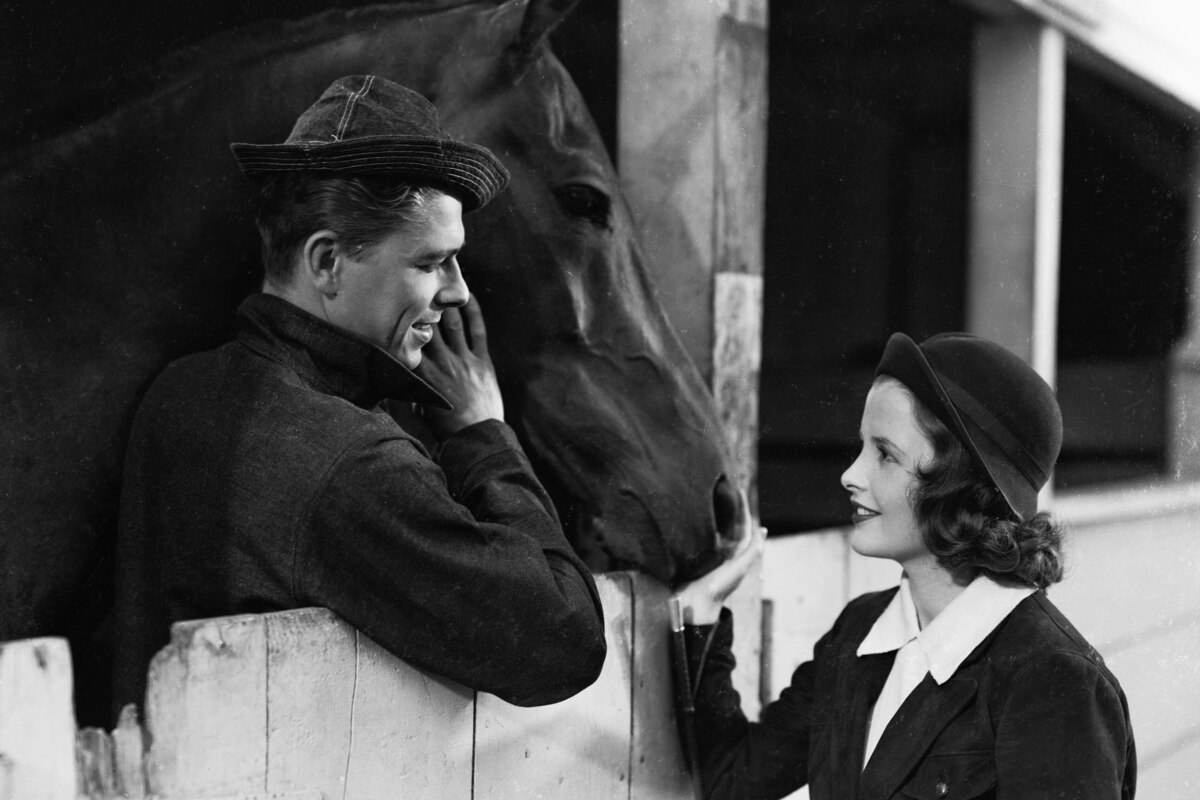
In his third film, Sergeant Murphy (1938), Ronald Reagan got to draw on his expertise as a member of the U.S. Cavalry Reserve to play a farm boy who follows his beloved horse into the Army then goes through a series of trials to try to win him back when the military decides to sell the eponymous steed. The rambling plot, something of a "shaggy horse" story, carries him from military training to Great Britain's Grand National in a sequence with interesting parallels to Enid Bagnold's classic horse story National Velvet. Six years before Elizabeth Taylor masqueraded as a male jockey to lead her Pie to victory in the famous race, Reagan snuck his equally loved horse out of quarantine to win the race, the love of a good woman and the respect of his commanding officer.
The one-time sports announcer had made his debut with a starring role in the low budget Love Is on the Air (1937) and had hoped to move up at the studio. Instead, he was assigned to Sergeant Murphy, another B movie, after James Cagney had turned it down. Of course, there was nothing unusual about that. Like most studios, Warner Bros. used its B-movie unit as a training ground for young talent (and a dumping ground for temperamental stars like Cagney). Films like Sergeant Murphy gave the inexperienced young actor the seasoning he needed while also letting the studio - which hoped to groom him as a replacement for the late Ross Alexander who had specialized in similar roles before his death - ascertain whether any further investment in the actor would be worthwhile. Reagan would churn out nine films in 1938, most of them programmers. By the end of the year, he would begin moving to bigger films with his supporting role in the military comedy Brother Rat (1938).
Sergeant Murphy was produced, without credit, by Bryan Foy, the son of musical star Eddie Foy and head of the Warner's B unit. The story had come from writer Sy Bartlett, who would achieve greater fame after World War II as the author of the novel Twelve O'Clock High, a tale of wartime flyers that would inspire the 1949 Gregory Peck hit. Writer Abem Finkel, who helped with the story, would move into A films faster than Reagan. Later that year he would get the chance to write White Banners for Claude Rains and Fay Bainter and Jezebel for Bette Davis.
Confirming Sergeant Murphy's status as a Warners' B film was the presence of director B. Reeves Eason. Nicknamed "Breezy," Eason was known for his ability to shoot films that moved as quickly as they had been shot. He rarely did more than one take, even when actors flubbed lines. Eason actually worked on two of Hollywood's biggest films, Ben-Hur (1925) and Gone With the Wind (1939), but as a second-unit director. For the former, he directed the chariot race, using 42 cameras to capture the action. For the latter, he directed the burning of Atlanta, the first sequence actually put on film, shot before the role of Scarlett O'Hara had even been cast.
Working with Eason was hardly the career Reagan had hoped for, but at least he could console himself by romancing co-star Mary Maguire off-screen. The Australian beauty had debuted in her native country at the age of 16 in the historical epic Heritage (1935). A co-starring role opposite Charles Farrell in the international production The Flying Doctor (1936) brought her a Warner's contract, but the studio confined her to B movies for her few years there. In 1938 she relocated to England, where she continued in film until her retirement, ironically after making the Warner Bros. British production This Was Paris (1942).
Also cast in Sergeant Murphy was Donald Crisp as Reagan's hardnosed commanding officer and Maguire's father. A screen veteran, both as actor and director, Crisp had started in silent films, most notably with D.W. Griffith, who cast him as Ulysses S. Grant in The Birth of a Nation (1915) and Lillian Gish's abusive father in Broken Blossoms (1919). Although he reached the height of on-screen fame with his Oscar®-winning role in John Ford's How Green Was My Valley (1941), he was better known off-screen for his business interests, including service on the Bank of America's advisory board. In that capacity, he was instrumental in securing financing for several major Hollywood features of the'30s and '40s. By the '50s, he was one of the wealthiest actors in Hollywood.
Despite his misgivings about films like Sergeant Murphy, Reagan was clearly on the rise at Warner Bros. Dick Powell, who feared that Reagan would soon supplant him as the studio's reigning juvenile, was already eyeing him suspiciously. Although they would become friends and political allies later in life, Powell was one of the few co-stars from Reagan's early Hollywood years who didn't like the young actor. Powell's fears were well founded, as his own career was slumping by the late '30s, just as Reagan was proving his usefulness to the studio, first with B pictures like Sergeant Murphy, and then with strategically chosen roles in A pictures.
Producer: Bryan Foy (uncredited)
Director: B. Reeves Eason
Screenplay: William Jacobs, Abem Finkel (uncredited)
Based on a story by Sy Bartlett
Cinematography: Ted D. McCord
Art Direction: Hugh Reticker
Music: Howard Jackson
Cast: Ronald Reagan (Pvt. Dennis Reilley), Mary Maguire (Miss Mary Lou Carruthers), Donald Crisp (Col. Todd Carruthers), Robert Paige (Lt. Duncan, as David Newell), Rosella Towne (Alice Valentine), Sergeant Murphy (Himself).
BW-57m. Closed Captioning.
by Frank Miller
Sergeant Murphy
by Frank Miller | December 10, 2008
SIGN UP FOR OUR NEWSLETTERS

CONNECT WITH TCM