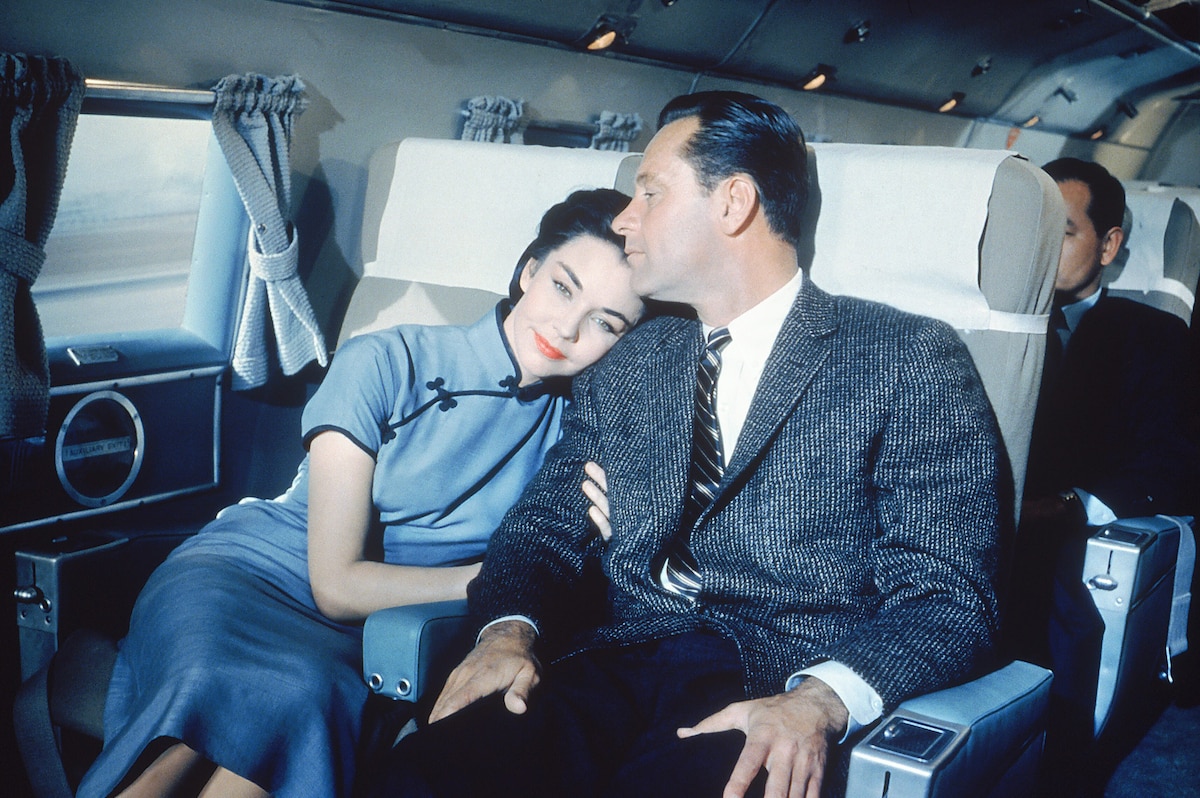
Based on an autobiographical novel, Love is a
Many-Spendored Thing (1955) is the story of a love
affair between Eurasian doctor Han Suyin (Jennifer
Jones), who works in a British-run hospital in Hong
Kong, and married American journalist Mark Elliott
(William Holden). The romance is played out against
the background of mid-century Hong Kong, with its
colonial and cultural conflicts, as well as the
looming threat of the Korean War. The novel, by the
Belgian-Chinese writer-physician Han Suyin,
fictionalized her real-life affair with a British
journalist and dealt with social and political
developments in China in the late 1940s.
The novel, A Many-Splendoured Thing, had been
published in 1952, but the Production Code
Administration, the industry's censor, rejected the
book, with its themes of adultery and miscegenation,
as unsuitable for a film. Three years later, 20th
Century Fox bought the rights, and submitted a first
draft script that was rejected by the PCA. After much
discussion, the censors agreed to allow the film to be
produced as long as there was no suggestion that the
couple's relationship was sexual.
Love is a Many-Spendored Thing was the first
film in a three-picture deal with Fox for Jennifer
Jones. The offer had come at a time when she badly
needed it. She had won an Oscar for her first starring
role in The Song of Bernadette (1943) and had
become one of the top stars of the mid-1940s. But her
stardom had waned after her marriage to her mentor,
producer David O. Selznick, who micro-managed her
career and whose interference was dreaded by producers
and directors. Jones's own high-strung temperament
also made working with her difficult, in spite of her
enormous talent. Her most recent film, Indiscretion
of an American Wife (1954), made in Italy by
director Vittorio De Sica and co-produced by De Sica
and Selznick, had not been successful. The combination
of Italian neo-realism and American gloss didn't work,
in spite of heartfelt performances by Jones and
Montgomery Clift, and Selznick made matters worse by
drastically cutting the American release version to
just over an hour. Jones's Broadway debut in a stage
adaptation of Henry James's novel, Portrait of a
Lady (1954), had also flopped. Love is a
Many-Spendored Thing was Jones's return to the
screen after those failures. Selznick was busy trying
to develop other projects, so he did not get involved
in the production of Love is a Many-Spendored
Thing, but he did send his usual lengthy memos
with his usual barrage of suggestions about Jones's
hair, makeup, and wardrobe to producer Buddy Adler and
director Henry King.
Jones was on edge without Selznick on hand to be her
advocate. She was unhappy that William Holden, by then
the bigger star, had top billing. At every imagined
slight, she shouted, "I'm going to tell David about
this." Holden tried to smooth over their differences,
giving her a bouquet of roses. She threw them in his
face.
In spite of the offscreen tensions, the onscreen
chemistry was excellent, and Love is a
Many-Spendored Thing was a big success, even
though the film received decidedly mixed reviews.
"Fine and sensitive," Variety raved, adding, "
[it] is indeed a many splendored thing...as simple and
moving a love story as has come along in many a moon."
But Bosley Crowther of the New York Times
called it "elaborately sentimental," and slammed John
Patrick's screenplay. "His story is commonplace and
stilted, his dialogue is foolishly verbose, and his
characters are stiff and bloodless people with no
seeming urge for anything but love." Crowther and
other critics credited Sammy Fain and Paul Francis
Webster's romantic title song, which was a pop hit
even before the film's premiere, for much of Love
is a Many-Spendored Thing's success. The song and
Alfred Newman's score and Charles LeMaire's costumes
won Academy Awards. The film was nominated for five
other Oscars®, including Best Picture (it lost to
Marty), and Jones as best actress (she lost to
Anna Magnani for The Rose Tattoo).
Director: Henry King
Producer: Buddy Adler
Screenplay: John Patrick
Cinematography: Leon Shamroy
Editor: William Reynolds
Costume Design: Charles LeMaire
Art Direction: Lyle R. Wheeler, George W. Davis
Music: Alfred Newman; title song by Sammy Fain and
Paul Francis Webster
Principal Cast: William Holden (Mark Elliott),
Jennifer Jones (Han Suyin), Torin Thatcher (Mr.
Palmer-Jones), Isobel Elsom (Adeline Palmer-Jones),
Murray Matheson (Dr. John Keith), Virginia Gregg (Ann
Richards), Richard Loo (Robert Hung), Soo Yong (Nora
Hung), Philip Ahn (Third Uncle), Jorja Curtright
(Suzanne), Donna Martell (Suchen).
C-102m. Letterboxed.
by Margarita Landazuri
Love is a Many Splendored Thing - Love Is a Many-Splendored Thing
by Margarita Landazuri | December 08, 2008
SIGN UP FOR OUR NEWSLETTERS

CONNECT WITH TCM