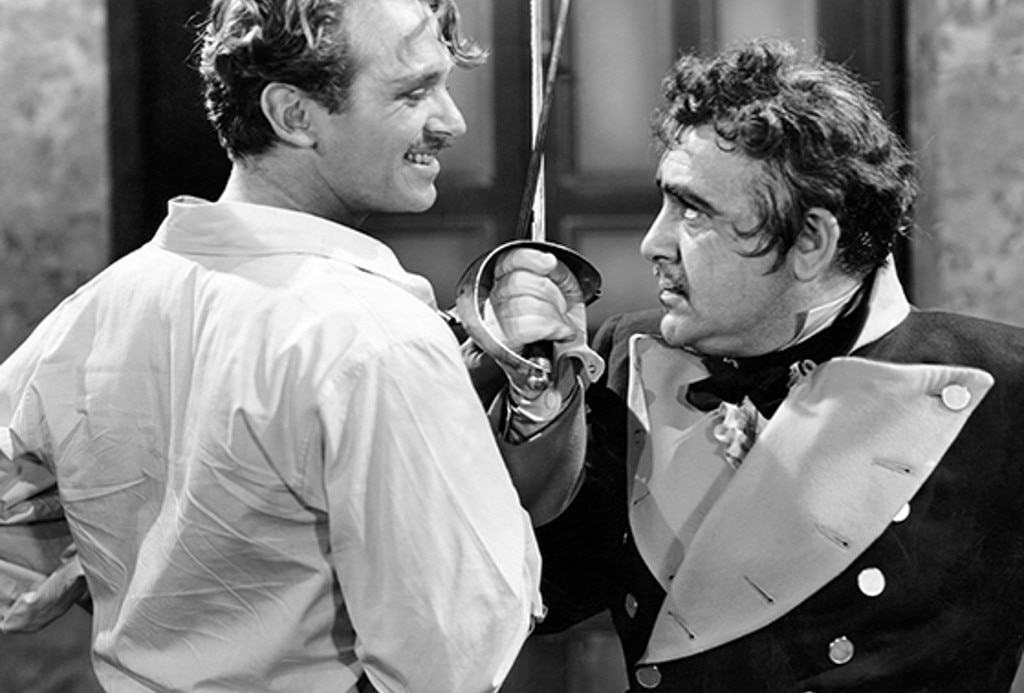
Put the blame on Cain but two brothers pitted against one another or teaming up to take on a common enemy has long been a storytelling standard. Romulus and Remus, The Prince and the Pauper, Biff and Happy Loman, The Krays and The Brothers Grimm all have books and/or films of their own that speak to the eternal question of man's divided nature. Alexander Dumas' 1844 novel Les frères Corses is considered one of the French writer's lesser works (especially when compared to the long-lived Le Comte de Monte-Cristo and Les trois Mousquetaires) but has been adapted for the big screen no less than ten times (as early as 1898 and as recently as 1997, with the most interesting interpretation being Cheech and Chong's The Corsican Brothers in 1984). The best-remembered of these swashbucklers is Gregory Ratoff's 1941 version, starring Douglas Fairbanks, Jr., made for producer Edward Small at United Artists.
The Brooklyn-born Small had been a talent agent during the silent era, later producing films through his Reliance Pictures, which had a distribution deal with UA. Small had his first crack at Dumas père with The Count of Monte Cristo (1934), starring Robert Donat. True to his name, the frugal producer kept his productions modest and got name actors to lower their asking price in exchange for roles they would not have been offered elsewhere. After a brief stint behind the scenes at RKO, Small formed Edward Small Pictures and produced James Whale's The Man in the Iron Mask (1939) and Rowland V. Lee's The Son of Monte Cristo (1940), both starring Louis Hayward. When 20th Century Fox scored a success with their lavish adaptation of The Three Musketeers (1939), Small turned to the lesser-known The Corsican Brothers but upped the ante by tapping Douglas Fairbanks, Jr., the son of cinema's greatest swashbuckler.
At the time he signed on to star in The Corsican Brothers, Douglas Fairbanks, Jr. hadn't worked in a year. Handsomer than his world-famous father (whose second wife was silent screen star Mary Pickford), "Young Doug" never quite escaped that familial shadow. Given a Paramount contract when he was only 14 years old, Fairbanks fils (christened Douglas Elton Ulman Fairbanks at birth and raised by his mother after his parents' divorce) made a number of undistinguished silent films but paid his thespian dues as a stage actor. His early, four-year marriage to rising star Joan Crawford seemed to focus Fairbanks' energies and he was well-placed in a few big films after the advent of sound, including The Dawn Patrol (1930), Outward Bound (1930) and Little Caesar (1931). He played the villain to Ronald Colman's The Prisoner of Zenda (1937) and was one of the two-fisted heroes of Gunga Din (1939), made the year of his father's death.
At the time that cameras rolled on The Corsican Brothers in the summer of 1941, the war in Europe was escalating and Fairbanks' attentions were unevenly divided between his negligible career and his interests in politics, diplomacy and humanitarian causes. (Fairbanks' efforts on behalf of Russian refugees won him the admiration and respect of his Corsican Brothers director, Gregory Ratoff.) President Franklin Delano Roosevelt named the then-31 year-old actor a special envoy to South America and during shooting he was called to active duty by the United States Navy. Allowed to complete the picture, Fairbanks enjoyed the discipline of training with dueling coaches Ralph Faulkner (for sabers) and Fred Cavens (for foils and epées) and establishing distinct mannerisms for each of the identical Corsican Brothers (whose presence in the same frame was achieved via double exposure and rear projection). In between set-ups, Fairbanks' leading lady Ruth Warrick (an RKO player on loan-out) helped him study his officer's training manual. When the two parted company at the completion of principal photography, Fairbanks told Warrick that working with her was the most fun he'd had "since punting on the Thames with Gertie Lawrence" - and this despite the fact that he completed work on the film with a raging fever of 103 degrees.
The Corsican Brothers opened on December 18, 1941, just eleven days after the Japanese sneak attack upon the United States Naval Base at Pearl Harbor. Due to America's entry into World War II, the official premiere at the Loew's Palace in Washington, D.C., was understated and conducted without benefit of klieg lights. Reviews were decidedly mixed, with The New York Times sniping that the production "has the comfortable old-fashioned look of a 1910 sofa, most of its springs are broken," but the box office returns were encouraging. As a junior officer aboard the Boston-based USS Mississippi, a navy supply ship, Douglas Fairbanks, Jr., had no time to reflect on The Corsican Brothers... until a regularly scheduled movie night on the afterdeck consisted of a special screening of just that picture. Sitting uncomfortably among the assembled "bluejackets," the star of the show suffered the Bronx cheers and ribald remarks that greeted both his fight scenes with villain Akim Tamiroff (and Tamiroff's more agile double) and love scenes with Ruth Warwick. "The wolf whistles, catcalls, and shouted recommendations as to what I should do next," Fairbanks recalled in his combat memoir A Hell of a War, "held me in rigid dumbness with, I was told, a stupid, self-conscious grin on my face."
The military career of Douglas Fairbanks, Jr., would prove to be decidedly more heroic. Promoted from lieutenant to lieutenant commander to commander, Fairbanks worked tirelessly with military intelligence, served as a valuable go-between for the American and British high commands and even invented a variety of decoy parachutist (or "paragon") that would draw enemy fire away from the activities of actual paratroopers and self-destruct on landing, leaving behind no trace of the bait-and-switch. For his service above and beyond the call of duty, Fairbanks was awarded the Silver Star, the British Distinguished Service Cross, the Legion of Honor and Croix de Guerre from France and the War Cross for Military Valor from Italy. In 1946, he was made Knight Commander of the Order of the British Empire. Because his efforts for Naval Intelligence were so top secret in their day, the full extent of Fairbanks' military career may never fully be appreciated. (In an odd coincidence that illustrates the hush-hush aspect of this work, Fairbanks would later retain as a butler a man whom he discovered only by chance had been a ranking Special Operations officer during the war but who remained steadfast in his resolve never to speak of it.) On his return to Hollywood in 1947, Fairbanks enjoyed a sizeable success with Sinbad the Sailor at RKO but it was in television that he would have the most impact, as the host of the British anthology series Douglas Fairbanks, Jr., Presents. He died of a heart attack on May 7, 2000, at the age of 90, and is interred in the Hollywood Forever Cemetery in Los Angeles, alongside his father.
by Richard Harland Smith
Sources:
Salad Days by Douglas Fairbanks, Jr.
A Hell of a War by Douglas Fairbanks, Jr.
The Confessions of Phoebe Tyler by Ruth Warrick with Don Preston
The Deceivers: Allied Military Deception in the Second World War by Thaddeus Holt
The Politics and Strategy of Clandestine War: Special Operations Executive, 1940-1946 by Neville Wylie
The Film Encyclopedia by Ephraim Katz
The Corsican Brothers (1941)
by Richard Harland Smith | December 04, 2008
SIGN UP FOR OUR NEWSLETTERS

CONNECT WITH TCM