Dinner at Eight began as a Broadway play written by George S. Kaufman and Edna Ferber. The play opened at the Music Box Theater on October 22, 1932 and was a smash hit.
The rights to the play were sold first to Joseph Schenck, the president of United Artists. Schenck, however, eventually lost interest in the project and the rights went back up for grabs. MGM, which had just enjoyed a huge success with Grand Hotel (1932), quickly stepped in. Dinner at Eight, MGM decided, would be their next big project with David O. Selznick producing.
David O. Selznick had just left RKO and moved to MGM, the most prestigious studio in Hollywood. Dinner at Eight would be his first assignment for MGM. Irving Thalberg, MGM's top producer, had butted heads with the notoriously difficult Louis B. Mayer, leaving their relationship somewhat shaky. On top of that, Thalberg had recently been experiencing health problems, including a heart attack in 1932, which made MGM head Mayer nervous about Thalberg's ability to take on future projects for the studio. While Thalberg was recuperating in Europe, Mayer worked hard to persuade Selznick, who also happened to be his son-in-law (he was married to Mayer's daughter Irene), to come work at MGM where he could set up his own new production unit. Mayer announced to the MGM employees that Selznick would be coming in to share-not take over--producing duties with Irving Thalberg. Meanwhile, everyone worried about how Thalberg would respond to the news once he returned from Europe. To everyone's relief, Thalberg seemed to genuinely welcome Selznick into the MGM family. Screenwriter Frances Marion remarks in her 1972 autobiography Off With Their Heads! that Thalberg had always liked and respected Selznick. The only conflict that existed, she says, was strictly between Thalberg and Mayer.
When Selznick was assigned Dinner at Eight as his inaugural production at MGM, he was determined to prove he could make just as big a hit with it as Irving Thalberg had made with the Oscar®-winning Grand Hotel. He knew that the right director would make all the difference. George Cukor had been a colleague back at RKO with whom Selznick had worked successfully on several pictures. Cukor, he thought, would be perfect to direct Dinner at Eight. Through a shrewd deal, Selznick arranged for RKO to lend Cukor to MGM for the film. In exchange, MGM arranged to loan actor Lionel Barrymore to RKO to star in one picture (One Man's Journey [1933]). All eyes would be watching Selznick to see what he could do at MGM-a lot was riding on the success or failure of Dinner at Eight.
Cukor and Selznick wanted MGM's top screenwriters to tackle the assignment of adapting the play to the big screen, so they enlisted the talents of legendary scribe Frances Marion and Herman Mankiewicz. "It was not an easy job because we had to juggle an enormous cast," says Frances Marion in her autobiography, "but Herman (Mankiewicz) had a razor-sharp mind and we worked together in harmony, aided by George Cukor, who was to direct the picture." The two writers pounded out the screenplay in a mere four weeks. A third writer, Donald Ogden Stewart, was later brought in to write some additional dialogue.
Like the star-studded Grand Hotel, MGM wanted only their top actors for the roles in Dinner at Eight. Some of the Dinner at Eight cast including John Barrymore, Wallace Beery, Lionel Barrymore and Jean Hersholt came directly from the cast of Grand Hotel. For the role of Carlotta Vance, a wealthy and flamboyant former actress and great beauty, no one at MGM immediately thought of Marie Dressler. Despite being one of MGM's most popular stars, Dressler was far from a great beauty and was known mostly for playing low comedy. The role of Carlotta was at the opposite end of her usual screen persona. Nevertheless, Dressler was eager to stretch as an actress and wanted the part. "When I learned that Marie Dressler was to play Carlotta Vance," said George Cukor in a later interview, "I said to myself: she is not quite my idea for the part, not the way it was played on the stage by Constance Collier...But, very shrewdly, Louis B. Mayer contended that Dressler was the biggest thing in pictures, although she looked like a cook and had never played that type of part."
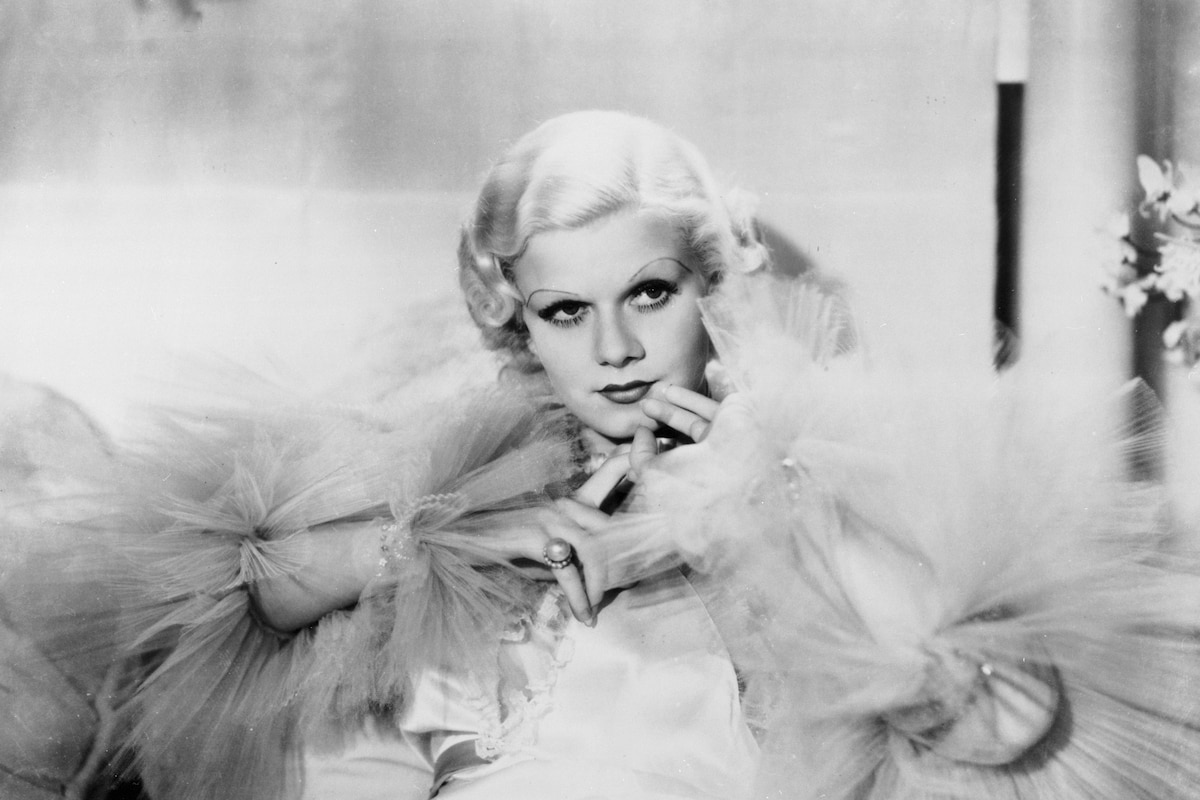
For the role of Wallace Beery's flashy vulgar wife, Kitty, George Cukor wanted bombshell newcomer Jean Harlow. Louis B. Mayer, however, did not believe that Harlow had the acting chops. Cukor, who famously had a way of bringing out the best in actresses' performances, believed she could do it. "I'd seen (Jean Harlow) in The Public Enemy (1931) and Hell's Angels (1930), where she was so bad and self-conscious it was comic," recalled Cukor in a 1970 interview. "Then I saw Red Dust (1932)-and there she was, suddenly marvelous in comedy. A tough girl and yet very feminine, like Mae West. They both wisecrack, but they have something vulnerable, and it makes them attractive." Sold on her potential in Red Dust, Cukor fought to cast Harlow in the career-making part and won.
With a first rate cast in place, Cukor also decided to use several of the same below the line talents on Dinner at Eight that had worked on Grand Hotel including costume designer Adrian, cinematographer William Daniels, and set designer Cedric Gibbons. Cukor, Selznick and all of MGM were determined to make the film a success.
by Andrea Passafiume
The Big Idea - Dinner at Eight
by Andrea Passafiume | November 20, 2008
SIGN UP FOR OUR NEWSLETTERS

CONNECT WITH TCM