Peter O'Toole returned to one of his most acclaimed roles, England's King
Henry II, in 1968 for The Lion in Winter, a film that still stands
as one of his greatest triumphs. When he won an Oscar® nomination for
his performance, he became the only actor to be nominated twice for playing
the same character in two completely different films (Al Pacino has two
nominations for playing Michael Corleone in the Godfather films, but
the second was for a sequel by the same writers and director). Four years
earlier, O'Toole had been similarly honored for his interpretation of Henry
II in Becket (1964), an adaptation of Jean Anouilh's play.
As famous as The Lion in Winter has become from its film version and
frequent revivals of the play, it was originally a Broadway flop. James
Goldman's fanciful treatment of the lives and intrigues of the Plantagenets
and the plotting to choose a successor to Henry II opened in March 1966
with Robert Preston as the king and Rosemary Harris (most recently seen as
Aunt May in Spider-Man, 2002) as his estranged wife, Eleanor of Aquitaine.
Although Harris' performance made her a star and brought her a Tony Award,
the production received mixed reviews and closed in less than three months
at a substantial loss. It was hardly the first flop in Broadway history.
But unlike other stage failures, it had a life after that initial
production.
With the recent success of A Man for All Seasons (1966), an epic film about
historical England adapted from a much more successful play, producers were
looking for similar material that could offer a combination of prestige and
box-office performance. The Lion in Winter seemed made for the
movies. Not only did the arrival of Henry and his family members
for a Christmas court at Chinon offer opportunities for pageantry on a
grand scale, but the film featured several juicy roles and the kind of
literate, witty, quite catty dialogue rarely seen since All About
Eve (1950) almost 20 years earlier. So Martin Poll, a pioneer in bringing
film production to New York City, picked up the rights and secured
financing from Joseph E. Levine's Avco-Embassy Pictures, an independent
distributor best known for importing foreign classics and low-budget exploitation films
(like Hercules (1957) starring Steve Reeves) to the U.S.
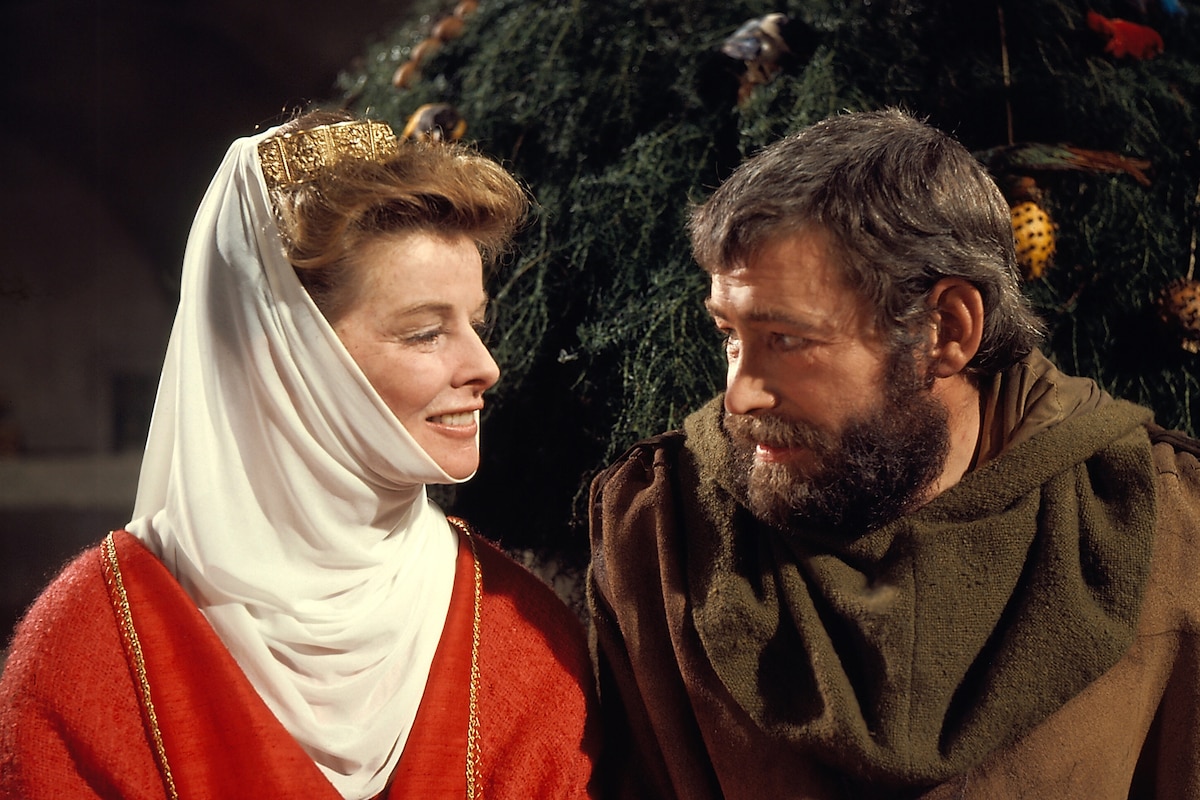
O'Toole and Katharine Hepburn were naturals for the leads: O'Toole for his
previous success playing the young Henry II in Becket; Hepburn
because she was descended from Eleanor, tracing her lineage back to
children from the monarch's marriages to both Henry and the king of France.
In addition, Hepburn had played a role in boosting O'Toole's career when
she urged producer Sam Spiegel to cast him in Lawrence of Arabia (1962).
But for all her respect for him as an actor, she was not about to put up
with his by-then legendary drunken shenanigans. According to Barbara Leaming's biography of Katharine Hepburn (Crown Publishers, Inc.), when the film company arrived in
Ireland for three weeks of rehearsals for the film, the actress laid down the law:
"You're known to be late! I intend for you to be on time. I hear you stay
out at night. You'd better be rested in the morning if you're going to
work with me!"
Hepburn and O'Toole set the pace for the film's younger players, one of the
strongest collections of film beginners to appear together. Making their
film debuts were Nigel Terry, who would go on to play King Arthur in John
Boorman's Excalibur (1981), and future James Bond Timothy Dalton. Richard,
Henry and Eleanor's warrior son who turns out to be a closeted homosexual,
was the first major film role for Anthony Hopkins, who would go on to win
stardom and an Oscar® as the infamous Hannibal Lecter.
Surprisingly, The Lion in Winter opened to mixed reviews. While
many critics applauded its re-creation of the middle ages, the witty
dialogue and the star's impressive performances, some others thought the
picture had reduced major historical events to the level of soap opera.
When it won the New York Film Critics Award for Best Picture, four critics
quit the group in protest. The picture's success at the box office soon
wiped out the memory of any dissension. It would go on to win seven
Oscar® nominations, including Best Picture, Best Director (Anthony
Harvey), Best Actor and Best Actress. On Oscar® night, it captured the
awards for its score, screenplay and, in a surprise tie with Barbra
Streisand in Funny Girl, Hepburn's performance. Today The Lion in
Winter enjoys a continued popularity in revival screenings, television airings
and video rentals. The stage version has been performed successfully
around the globe, most recently in a Broadway revival starring Laurence
Fishburne and Stockard Channing. Plans were recently announced for a new
television version, set to air in 2003, starring Patrick Stewart and Glenn
Close.
Producer: Martin Poll
Director: Anthony Harvey
Screenplay: James Goldman, based on his Play
Cinematography: Douglas Slocombe
Art Direction: Peter Murton, Peter James
Music: John Barry
Principal Cast: Peter O'Toole (Henry II), Katharine Hepburn (Eleanor of
Aquitaine), Jane Merrow (Princess Alais), John Castle (Prince Geoffrey),
Timothy Dalton (King Philip), Anthony Hopkins (Prince Richard the
Lion-hearted), Nigel Terry (Prince John), Nigel Stock (William Marshall).
C-135m. Letterboxed. Closed captioning.
by Frank Miller
The Lion in Winter
by Frank Miller | February 27, 2003
SIGN UP FOR OUR NEWSLETTERS

CONNECT WITH TCM