What could be a more authentically American subject for a movie than Coal Miner's Daughter (1980), the movie biography that chronicles the life and times of Loretta Lynn, one of country music's most beloved singers? Ironically enough, the film was directed by a Brit - Michael Apted - yet it offers an insider's point of view that feels honest and true to the country music scene and Lynn's career.
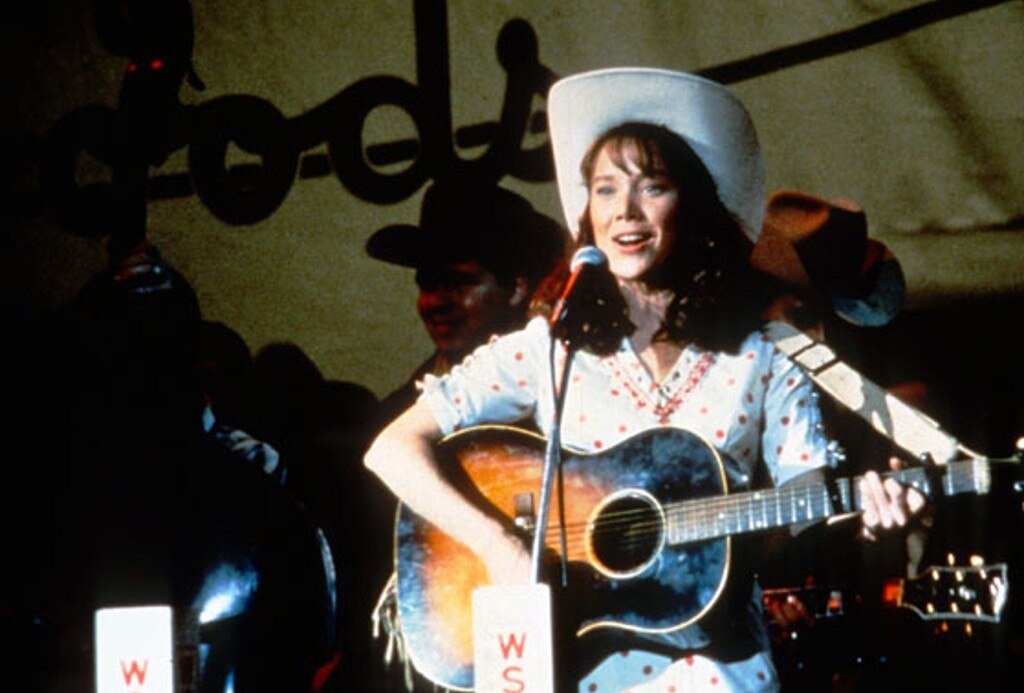
Sissy Spacek received an Academy Award for her performance as the legendary Nashville superstar, who rises from the poverty of rural Kentucky to become the reigning queen of country music. The film begins with Lynn's adolescent years when she was living with five siblings in a small shack in rural Kentucky while her father struggled to support them through his work in the coal mines. When Lynn is just fourteen, she meets her future husband, Doolittle Lynn (played by Tommy Lee Jones), who is substantially older and more experienced than Loretta, having left their community, Butcher Hollow, to serve in the army.
The two fall in love and soon marry, leaving their humble beginnings in search of less life-threatening work. Recognizing his wife's musical talent, "Doo" gives Loretta her first guitar and encourages her to write and perform her own songs. Soon the couple begins pedaling Loretta's tunes to any radio station that will play her music, often performing live in the studio. Eventually Lynn scores a hit record which effectively launches her career and brings her into contact with country star Patsy Cline, who becomes a close friend and mentor to the naive young singer.
While Coal Miner's Daughter is saddled with some of the expected cliches of the musical biopic, it also refuses to sugarcoat the more painful aspects of Lynn's private life and how fame and fortune can wreak havoc on ordinary relationships. Though not entirely factual - the film does take liberties by glossing over Lynn's drug abuse and mental breakdowns - the movie is based on the autobiography of Loretta Lynn. And the singer herself was involved in the shooting, often conferring with cast members and offering her perspective on her life in between scenes.
The one element that consistently holds the film together is the music of Loretta Lynn, which, surprisingly enough, is performed by Sissy Spacek. Among the songs performed in the film are "You Ain't Woman Enough to Take My Man," "You're Looking at Country," "I'm a Honky Tonk Girl," and the title tune. Unlike other female musical bios where the lead actress lip-syncs to the original recordings (Ann Blyth in The Helen Morgan Story, 1957), Spacek skillfully interprets all of Lynn's songs in the movie, proving that she could have had an alternate career in music. For that matter, so could Beverly D'Angelo as Lynn's friend, Patsy Cline, who also does her own singing in the film and does a memorable rendition of "Sweet Dreams." Still, Spacek is most humbly grateful to Lynn, who attended the Oscar ceremony in 1980. After thanking her as "the woman who gave me all that hair," Spacek told the press: "Just to be nominated makes me feel like a real actress. I used to watch the Oscars growing up, so all this is like a dream come true, like living out a fantasy."
Producer: Bernard Schwartz
Director: Michael Apted
Screenplay: Tom Rickman (based on the autobiography by Loretta Lynn with George Vescey)
Cinematography: Ralf D. Bode
Music: Owen Bradley
Cast: Sissy Spacek (Loretta Lynn), Tommy Lee Jones (Doolittle "Mooney" Lynn), Levon Helm (Ted Webb), Phyllis Boyens (Clara Webb), Beverly D'Angelo (Patsy Cline), William Sanderson (Lee Dollarhide), Robert Elkins (Bobby Day), Bob Hannah (Charlie Dick).
C-125m. Letterboxed. Closed Captioning.
by Mary Anne Melear
Coal Miner's Daughter
by Mary Anne Melear | February 26, 2003
SIGN UP FOR OUR NEWSLETTERS

CONNECT WITH TCM