I've wrestled with reality for 35 years, doctor, and I'm happy to state I
finally won out over it."
Elwood P. Dowd in Harvey
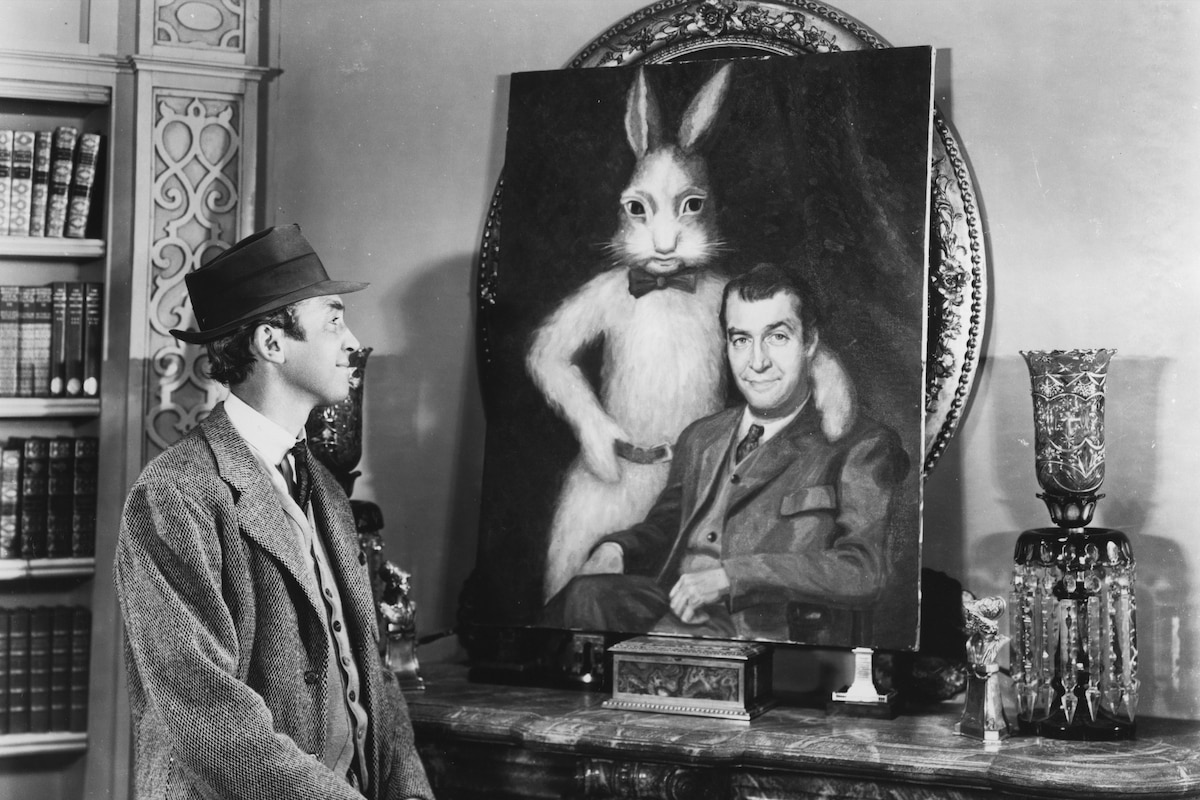
One of the more offbeat and whimsical comedies produced for the screen, Harvey (1950) was a personal triumph for James Stewart who won over audiences and most of the nation's critics with his portrait of a lovable eccentric whose best friend is an invisible 6', 3-1/2"
rabbit.
Harvey was the surprise hit of the 1944 Broadway season, running
five years, winning the Pulitzer Prize and returning comic actor Frank Fay
to the front rank of stage stars. He wasn't the first choice to star in
the play, nor was a six-foot rabbit the title character in Mary Chase's
first draft. She had written the piece for Tallulah Bankhead, and
originally had her best friend be an invisible four-foot-tall canary. But
with Fay in the lead after years of obscurity following a failed film
career and disastrous marriage to Barbara Stanwyck the show was a
phenomenon. Everybody in the business wanted to see his performance except
his ex-wife, who quipped that she'd seen enough of the hard-drinking Fay's
six-foot rabbits.
Universal Pictures snapped up the film rights for a record $1 million but
wasn't about to risk the property on an actor with little public
recognition outside of New York. Instead, they cast James Stewart, who had
played the part on Broadway during the summers of 1947 and 1948. He hadn't
been the first choice, either. The show's producers had all but signed
Bing Crosby when the singing star decided his fans wouldn't accept the
priest of Going My Way (1944) as the hard-drinking Dowd. Although Stewart's
reviews were mixed, his two summer theatre engagements sold out. When Universal announced
plans for a film version, he campaigned for the role and even signed to do
the Western Winchester ‘73 (1950) to clinch the deal with the studio.
Universal wisely kept original stage cast members Josephine Hull as Dowd's
equally daffy but socially upright sister, Victoria Horne as his lovelorn
niece and Jesse White as a lunatic asylum attendant sucked into Dowd's
madness. Although White had had small roles in three earlier films,
Harvey would mark the start of a long Hollywood career that would
culminate with his role as the first Maytag repairman in a series of
popular and lucrative commercials.
Director Henry Koster, who had helped make Deanna Durbin a star in the
'30s, maintained a jovial mood on the set. During lunch breaks the cast
always kept an empty chair for Harvey, and they even gave the character a
slot in the final credits, where they announced that he had played himself.
Audiences loved the film, and Stewart won an Oscar® nomination for his
performance. So did Hull, who waltzed off with the award for Best
Supporting Actress on Oscar® night. Stewart got another bonus when
Winchester ‘73 (a film he only agreed to do in order to win the lead in
Harvey) became an even bigger hit and encouraged him to play tougher, more complex
characters in '50s action films.
Despite his success as Dowd, however, Stewart tended to agree with the
critics who thought he came in a distinct second to Fay. He would later
state that he had made Dowd "too nice." He got a chance to remedy that
problem with an acclaimed return to the stage in the role, with Helen Hayes
as his sister. After a profitable Broadway run in 1970, he reprised the
role for a 1972 television production, with Hayes co-starring and Jesse
White reprising his original role. Then in 1975 he took the play to London
for still more rave reviews. For this return to the stage, he requested one
change in the script. Since Stewart's 6', 3" height was harder to disguise
on stage than on screen, it made little sense that Harvey would tower over
him at just 6', 3-1/2", so for the stage revivals, the rabbit's height was elevated
to 6', 7-1/2".
Producer: John Beck
Director: Henry Koster
Screenplay: Mary Chase, Oscar Brodney
Based on the Play by Chase
Cinematography: William Daniels
Art Direction: Nathan Juran, Bernard Herzbrun
Music: Frank Skinner
Principal Cast: James Stewart (Elwood P. Dowd), Josephine Hull (Veta Louise
Simmons), Peggy Dow (Miss Kelly), Charles Drake (Dr. Sanderson), Cecil
Kellaway (Dr. Chumley), Victoria Horne (Myrtle Mae), Jesse White (Wilson).
BW-105m. Closed captioning.
by Frank Miller
Harvey
by Frank Miller | February 26, 2003
SIGN UP FOR OUR NEWSLETTERS

CONNECT WITH TCM