1969 was a watershed year for movies in the United States; it was the first full year under the new MPAA ratings system, which allowed a much greater freedom for filmmakers to explore previously forbidden themes and topics. The result was a slate of daring and challenging films including Midnight Cowboy, They Shoot Horses, Don't They?, Bob & Carol & Ted & Alice, and Easy Rider. How did the moviegoing public react to this new frontier in groundbreaking cinema? They voted with their pocketbooks and made the 2nd highest-grossing film of the year the Walt Disney Production The Love Bug (1968), a movie about a man and his racing Volkswagen Beetle, nicknamed "Herbie."
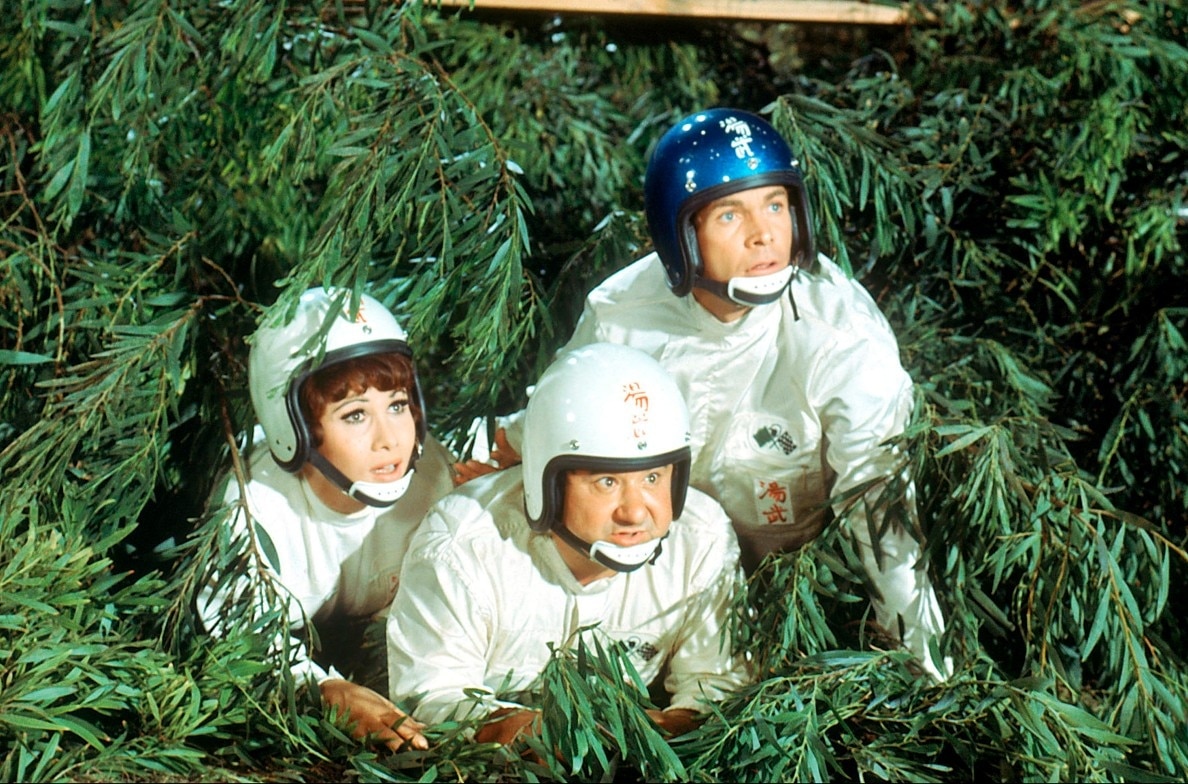
The success of The Love Bug (it grossed over $50 Million at the box office, beat only by Butch Cassidy and the Sundance Kid) probably surprised the Disney organization as much as anyone. After all, the movie followed roughly the same formula as a number of previous live-action comedies they had turned out in the 1960s built on a fantasy/sports premise, such as The Absent-Minded Professor (1961; basketball) and Son of Flubber (1963; football). The sport in this case is auto racing, and our hero is Jim Douglas (Dean Jones), a driver living in San Francisco who is down-on-his-luck because he can't keep a sponsor on the racing circuit. His fortunes change when he happens upon an upscale auto showroom and a pretty sales assistant named Carole (Michele Lee). The two strike up a friendship under the glaring eye of the obnoxious dealership owner, Thorndyke (David Tomlinson). A used Volkswagen beetle rolls into the showroom and immediately takes a liking to Douglas; unknown to the driver, it follows him home. Douglas lives in an apartment with Tennessee Steinmetz (Buddy Hackett), an eccentric Eastern-influenced artist specializing in large sculpted-metal objects often made from old car parts. Douglas is forced to buy the errant beetle when Thorndyke threatens to prosecute him for stealing it. He soon learns that he and "Herbie" (as Tennessee nicknames the bug) are a pretty unbeatable racing combination, and with Tennessee as chief mechanic and Carole as head cheerleader, they take on the cheater Thorndyke in a series of auto races.
The Love Bug is set in San Francisco and makes good use of the locale in several scenes, such as one in which Herbie follows a cable car uphill, and during a bizarrely touching sequence in which the bug threatens to "jump" off the Golden Gate Bridge. Since the film was made in the late 1960s, Disney could hardly avoid the presence of the city's counterculture, although the one scene with hippies is something of a throwaway. (It is worth noting that the hippie with the most dialogue is played by an unrecognizable Dean Jones!) Interestingly, it isn't a hippie but Buddy Hackett's earthy Tennessee character that displays a New Age take on the possible reason for Herbie's seemingly sentient state:
Us human beings - we had a chance to make something outa this world. We blew it. OK, another kind of a civilization is gonna take a turn. I'm sittin' up on top of this mountain, right? I'm surrounded by these gurus and swamis and monks, right? I'm lookin' at my stomach, I'm knockin' back a little rice wine. Got some contemplation goin' - I see things like they are. We take machines and we stuff 'em with information until they're smarter than we are! Take a car. Most guys spread more love and time and money on their car in a week than they do on their wife and kids in a year. Pretty soon, you know what? The machine starts to think it *is* somebody.
Disney Productions became known for the elaborate special effects in their live-action films during this period. Although the studio possessed the superior "sodium vapor process" (a yellowscreen that created more accurate matte lines than the more common bluescreen), the optical work in The Love Bug is curiously substandard and obvious. Fortunately, the movie rolls ahead at breakneck speed with excellent stunt driving and some startling physical effects. A particularly impressive example of the latter occurs late in the film as Herbie develops a split personality - and a split chassis - to block the way of an opposing racecar.
Any Disney live-action picture from the 1960s or 70s could be counted on to feature a number of familiar comedic faces in supporting roles. The Love Bug included Joe Flynn as Havershaw, the sniveling assistant to evil Thorndyke. Flynn previously had a brief role in Son of Flubber in 1963, and would appear in nine more Disney productions in the next decade. The police detective that initially investigates the disappearance of Herbie in The Love Bug is played by gravelly-voiced comic Joe E. Ross, popular for years in vaudeville and in such television series as Car 54, Where Are You? (1961-63). In the drive-in scene, California's oldest and crankiest carhop is played by Iris Adrian, an actress with dozens of credits dating back to the early sound era; along the way she appeared with Laurel & Hardy in Our Relations (1936), the Marx Bros. in Go West (1940), and Bob Hope and Bing Crosby in Road to Zanzibar (1941).
Critics were seldom kind to the Disney live-action features, so it is not surprising to encounter harsh reviews for The Love Bug. Time magazine wrote "It can be a many-splendored thing. Optimists insist that it's sweeping the country. According to the Beatles, it's 'all you need.' [The Love Bug] however, give[s] love such a mauling that it emerges bruised and battered, in an all but unrecognizable state...Connoisseurs of camp may enjoy watching Tomlinson ranting at the Volkswagen, but The Love Bug is surely the first film in which the actors are so meticulously insipid that a car can handily steal the show." In The New York Times, Vincent Canby called the film "...a long, sentimental Volkswagen commercial about a small car - the film...has the form of fantasy-comedy, lots of not-very-special effects and no real humor."
The Love Bug was certainly critic-proof at the box office; following a limited run during Christmas of 1968 the film was given a wide release in March of 1969 and proved to be a huge hit. In the years since, Disney has brought Herbie back several times including the three sequels Herbie Rides Again (1974), Herbie Goes to Monte Carlo (1977), and Herbie Goes Bananas (1980); a short-lived TV series in 1982; a remake for TV in 1997 (starring Bruce Campbell); and a relaunch, Herbie Fully Loaded (2005), starring Lindsay Lohan.
Producer: Bill Walsh
Director: Robert Stevenson
Screenplay: Bill Walsh, Don DaGradi; Gordon Buford (story "Car-Boy-Girl")
Cinematography: Edward Colman
Art Direction: Carroll Clark; John B. Mansbridge
Music: George Bruns
Film Editing: Cotton Warburton
Cast: Dean Jones (Jim), Michele Lee (Carole), David Tomlinson (Thorndyke), Buddy Hackett (Tennessee Steinmetz), Joe Flynn (Havershaw), Benson Fong (Mr. Wu), Andy Granatelli (Association President), Joe E. Ross (detective), Iris Adrian (carhop), Ned Glass (toll booth attendant), Robert Foulk (Bice), Gil Lamb (policeman at park)
C-107m.
by John M. Miller
The Love Bug
by John M. Miller | October 07, 2008
SIGN UP FOR OUR NEWSLETTERS

CONNECT WITH TCM