Jack Nicholson wrote the original screenplay which would eventually evolve into Psych-Out. It was first called Love is a Four Letter Word, then was changed to Love and Money and went through many revisions before being given to Betty Ulius for a final rewrite as The Love Children.
American-International Pictures mogul Sam Arkoff didn't like the title The Love Children because he felt audiences would assume the movie was about illegitimate children so it was switched to Psych-Out.
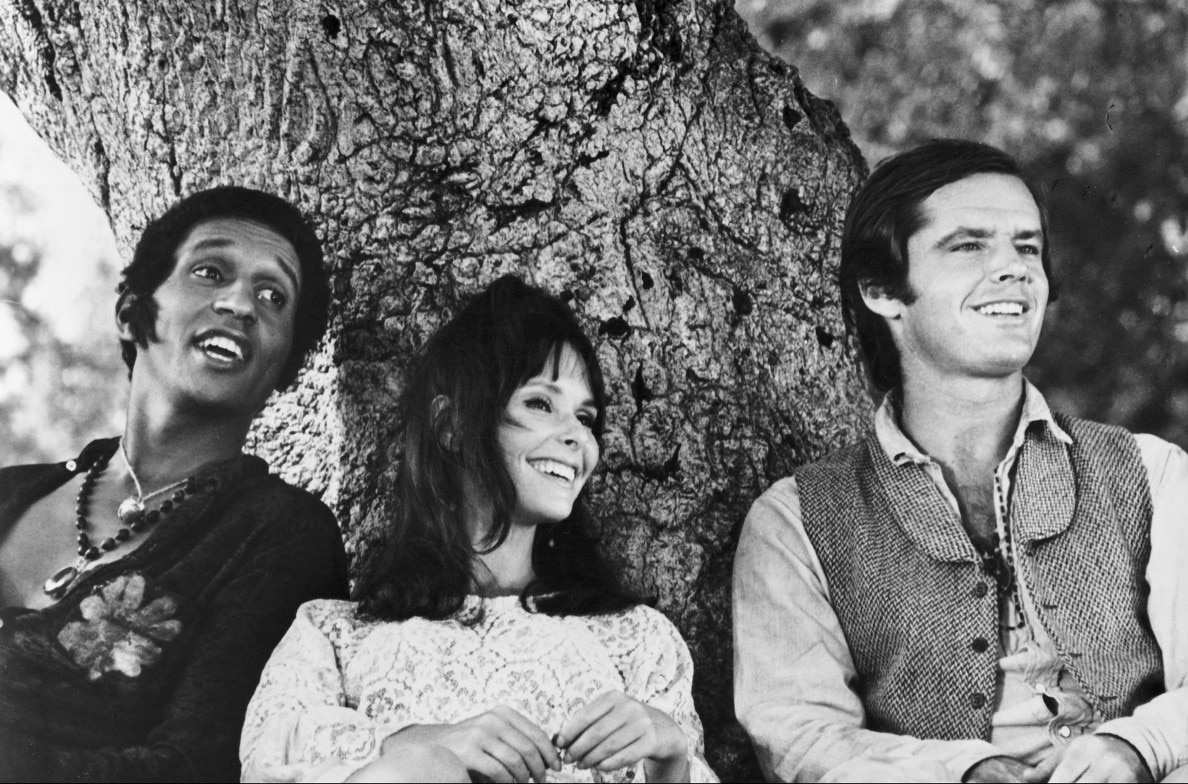
Prior to I>Psych-Out, Nicholson had had little success in winning auditions for roles he badly wanted such as the lead in The Graduate, which went to an actor (Dustin Hoffman) who had less acting experience than him. Richard Rush, however, was one of the few directors willing to take a chance on him and agreed to cast him in Psych-Out as Stoney, a part Nicholson had clearly modeled on himself. Rush had previously directed Jack in Hells Angels on Wheels (1967).
Rush would later remark, "Jack was a very clever writer, a very articulate writer...His script had an interesting verbalization of ideas. But it was too way out, too experimental, for the commercial mainstream, much too adventurous, different, cerebral." Nicholson would end up receiving no screen credit for his script for Psych-Out but his performance in the film was noticed by many in Hollywood and led to better offers.
Nicholson had done such a good job of fleshing out the character of Stoney in the screenplay that his part and dialogue were barely altered in all of the many script revisions. Co-star Adam Roarke said, "Jack had packaged the film for himself...Thirty years ago, he knew how to package. Jack was way ahead of us at understanding the ways in which Hollywood was a business."
Some autobiographical details from Nicholson's own life were used for the Psych-Out script, such as his own experiences with therapy and LSD as well as his wife-at-the-time Sandra Knight, who had a particularly bad LSD reaction.
American Bandstand host Dick Clark became involved in Psych-Out as a producer in the early planning stages. It was his first foray into feature film making.
Clark took an active interest in the day to day aspects of filmmaking, personally selecting the pop acts that appear in
Psych-Out and orchestrating the product placement of Dr. Pepper cans.
Psych-Out was filmed in and around the Haight-Ashbury district in San Francisco in twenty-two days in October of 1967.
The cast and crew members of Psych-Out noticed that the beatific vibe of San Francisco's Summer of Love had already faded by the Fall. Commercialization of the hippie scene was already under way and many local residents resented the presence of the film crew, suspecting the worst of them.
At one point, some film crew members were threatened with knives by local panhandlers. In response, director Rush hired Sonny Barger and some of his Hells Angels to patrol the shoot and act as their bodyguards during the filming of Psych-Out. Rush had worked with Barger previously on Hells Angels on Wheels.
Because the once topical script began to seem dated in the current climate of San Francisco's changing counterculture, Rush ordered some on-the-spot rewriting, which reflected the more negative aspects of the scene, particularly the destructive effect of hard drugs and hallucinogens on young people.
Nicholson and Susan Strasberg were both uncomfortable with their lovemaking scene in Psych-Out. According to Strasberg, "When we did our love scene, I was wearing a minidress and Jack wore his jeans and boots...I asked him if he could take his boots off. Peter Fonda had played his [role] in the nude in The Trip. Neither one of us wanted to show our thighs, but I had to."
Strasberg was also uncomfortable during that scene because she and Jack were being watched intently by Nicholson's jealous girlfriend Mimi Machu, who went by the screen name of I.J. Jefferson and had a supporting role in Psych-Out (as Pandora). Machu had also appeared with Jack in Hells Angels on Wheels and would also make appearances in Head, the Monkees' feature film satire which Nicholson wrote, and Jack's directorial debut, Drive, He Said (1971).
In Jack's Life: A Biography of Jack Nicholson by Patrick McGilligan, Strasberg also recalled "I kind of admired the way Jack was able to bring everything down to the bottom line...He didn't complicate things in the way that some actors do. When we were filming [the sex scene], for example, I discussed Reichian therapy with him. I had been in Reichian therapy, and so had Jack, I believe. Reich was a brilliant man with complex theories, far ahead of their time, about the bio-energy of the body. And I remember Jack distilling it all down to 'You f*ck better.'
Co-star Bruce Dern credits most of his acting ability to learning his craft on his own in B-movies. "In Psych-Out," he wrote in his autobiography, "Dick Rush was a serious filmmaker, but he had no conception of how to deal with an actor. He just didn't know what to say to you; he'd just say, "Do it again," or "Try it again," and any kind of enthusiasm or energy he would mistake for talent, and he would love that. He was the most sensitive of the early directors that I worked for, although he wasn't the best. Corman was far superior to him. So what you did was to learn to do it yourself. You learn how to survive and be real and be good and be interesting and exciting and to promote your career and continue on."
Psych-Out was not one of Dean Stockwell's favorite films. In an interview for Psychotronic Magazine, he said "I did not enjoy that very much. On the positive side, I think that was the first time I met Jack Nicholson, but that's the only time I ever worked with him."
by Jeff Stafford
SOURCES:
afi.com
The Films of Jack Nicholson by Douglas Brode
Jack's Life: A Biography of Jack Nicholson by Patrick McGilligan
Five Easy Decades: How Jack Nicholson Became the Biggest Movie Star in Modern Times by Dennis McDougal
Things I've Said, But Probably Shouldn't Have by Bruce Dern (Wiley)
Dean Stockwell Interview by Craig Edwards, Psychotronic Magazine
FilmFacts
Hollywood Rock: A Guide to Rock 'N' Roll Movies by Marshall Crenshaw (HarperPerennial)
IMDB
Insider Info (Psych-Out) - BEHIND THE SCENES
by Jeff Stafford | November 04, 2008
SIGN UP FOR OUR NEWSLETTERS

CONNECT WITH TCM