The Hippie movement of the mid-sixties, which first flourished in San Francisco's Haight-Ashbury neighborhood, has rarely been captured accurately in Hollywood feature films but there have been a few exceptions and one of the most notable is Psych-Out (1968). Filmed on location in San Francisco by cinematography Laszlo Kovacs, under the director of Richard Rush (The Stunt Man, 1980), the American-International release captures a moment in time as well as any documentary on the same subject. On a visual level, you couldn't ask for a better snapshot of the period from the clothes to the hair styles to the social behavior and counterculture attitude. Even the now dated hipster jargon, some of which will make you cringe, seems true to the period. If only the musical acts featured had been less a top forty fabrication than the real thing (Only The Seeds have any credibility among the groups on display), Psych-Out might have had a more significant impact upon its release.
Produced by American Bandstand host Dick Clark (it was his feature film debut as a producer), Psych-Out was made to capitalize on the success of Roger Corman's previous counterculture film, The Trip (1967) and even recast two of the main actors, Susan Strasberg and Bruce Dern. Jack Nicholson was also involved with both productions. He wrote the screenplay for The Trip and also pitched his scenario for Psych-Out to director Rush who decided it was too experimental for a commercial movie. Instead, Nicholson's initial concept was reworked into a new script with contributions by Betty Tusher, E. Hunter Willett, and Betty Ulius. As part of the agreement, Nicholson was cast in the role of Stoney, a part he wrote for himself.
Susan Strasberg, who had previously played the wife of LSD experimentee Peter Fonda in The Trip, stars as Jenny, a 17-year-old deaf runaway who comes to San Francisco in search of her brother Steve (Dern). Known around town as "The Seeker," Steve is a mysterious, enigmatic sculptor who remains elusive while Jenny is pursued by the authorities. She is soon befriended by members of the psychedelic band, Mumblin' Jim, led by guitar star Stoney (Nicholson), and offered refuge in their crowded Victorian crash pad. Jenny is quickly immersed in the San Francisco hippie scene and is eventually reunited with her brother in a dramatic finale which involves a fire and a drug freakout.
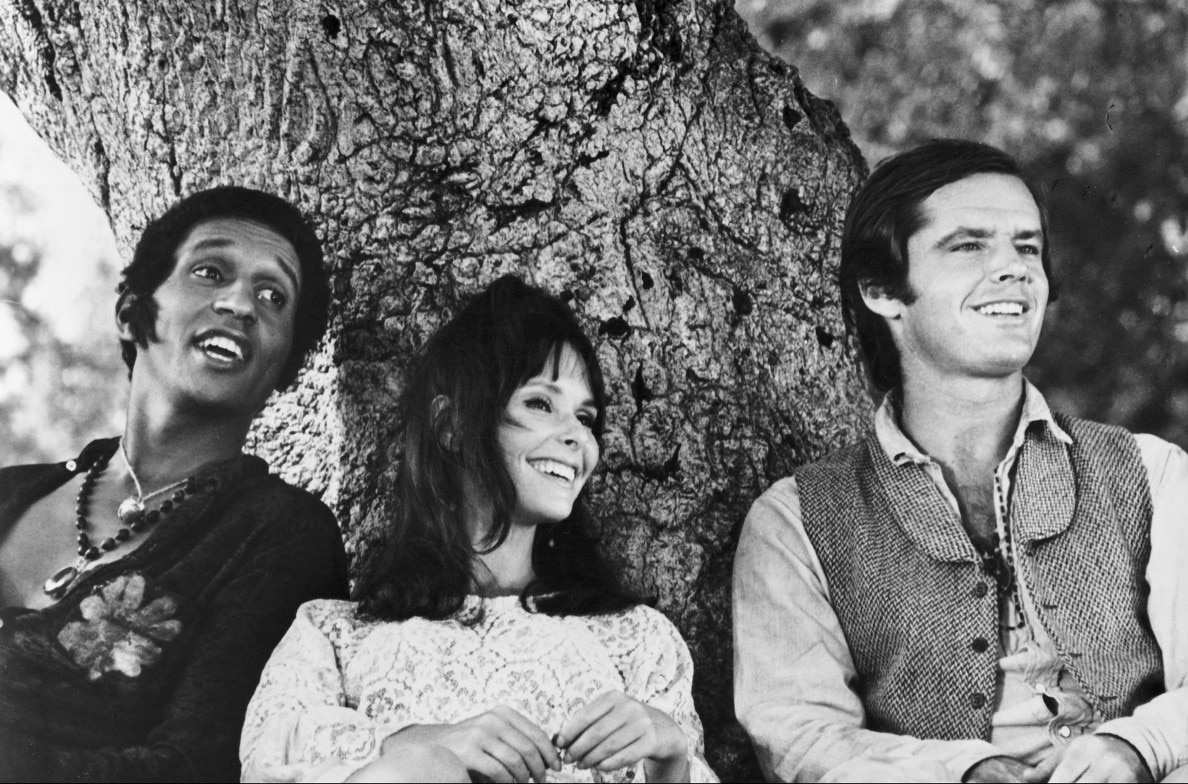
Audiences seeing Psych-Out for the first time will be fascinated, amused or even embarrassed by the presence of so many up-and-coming actors and directors in such low-budget drive-in fare. Besides Nicholson (in a ponytail and not even bothering to fake his own guitar playing), Dern (in a wild man wig), and Strasberg,Dean Stockwell makes a memorable impression as Dave, the long-haired, headband-wearing guru of the group who plays devil's advocate to Nicholson's rock 'n' roll hero. Adam Rourke, who had already appeared in Hells Angels on Wheels (1967) with Nicholson, would go on to specialize in other biker flicks and exploitation films such as Frogs (1972) and Dirty Mary Crazy Larry (1974). Max Julien, one of the most talented African-American actors of his generation, scored a cult hit with The Mack in 1973 and added producer and screenwriter to his credits with Cleopatra Jones (1973) and Thomasine & Bushrod (1974). Future directors Henry Jaglom (A Safe Place [1971], Sitting Ducks [1980]) and Garry Marshall (Young Doctors in Love [1982], Pretty Woman [1990]) also show up in supporting roles with Jaglom stealing the show as an artist with Elvis Presley-like sideburns who flips out on a hallucinogen and threatens people with power tools.
As previously noted, the music score for Psych-Out is a major disappointment with The Strawberry Alarm Clock, the one-hit wonder who recorded "Incense and Peppermints," being given the showcase treatment in their number "Rainy Day Mushroom Pillow." The other featured songs include "Ashbury Wednesday" by Boenzee Cryque, "Beads of Innocence" by The Storybook and "Two Fingers Pointing To You" by Sky Saxon of The Seeds.
Even though no one at American-International Pictures expected Psych-Out to find favor with any critics, it actually received favorable coverage from many mainstream critics such as Renata Adler of The New York Times who commented that the movie "has considerable elan" and noted, "What is most interesting, though, is that the demands of plot seem to make it necessary to superimpose the structure of a Western onto hippie life." Variety was impressed the performances of the main actors, but also with the direction and cinematography: "Rush's direction is quite exceptional. Considering what coin he had to play with, it is worthy of 20 times the apparent budget. Overlaps, transitions, chases and hallucinations are inventive, telling and lucid. Were he a foreigner - Canadian, British or French, per the vogue - he might be greeted by 'auter! auter! cries. Leslie Kovacs' fluid and responsive Pathecolor photography is first-rate."
Producers: Dick Clark, Norman T. Herman
Director: Richard Rush
Screenplay: Betty Tusher, Betty Ulius; E. Hunter Willett (screenplay, story); Betty Tusher (story uncredited)
Cinematography: Laszlo Kovacs
Art Direction: Leon Ericksen
Music: Ronald Stein
Film Editing: Renn Reynolds
Cast: Susan Strasberg (Jenny Davis), Dean Stockwell (Dave), Jack Nicholson (Stoney), Bruce Dern (Steve Davis), Adam Roarke (Ben), Max Julien (Elwood), Henry Jaglom (Warren), Linda G. Scott (Lynn), I.J. Jefferson (Pandora), Tommy Flanders (Wesley), Ken Scott (preacher), Gary Marshall (plainclothesman), Geoffrey Stevens (Greg).
C-101m.
by Jeff Stafford
The Gist (Psych-Out) - Psych-Out
by Jeff Stafford | November 04, 2008
SIGN UP FOR OUR NEWSLETTERS

CONNECT WITH TCM