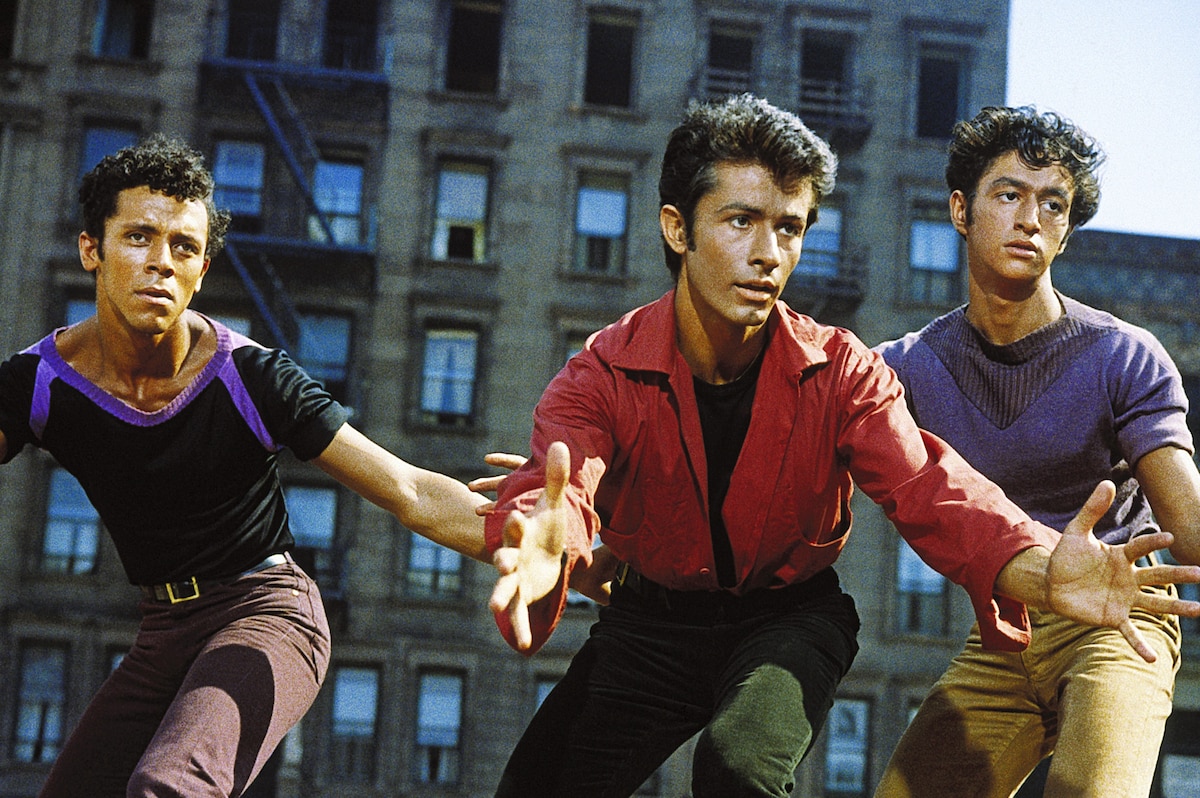
The first order of business in bringing West Side Story to the screen was casting. This was left largely to Robert Wise, who had been chosen as co-director primarily for his work with film actors (stage choreographer-director Jerome Robbins would handle the musical sequences). The Broadway leads, Larry Kert and Carol Lawrence, were deemed too old by 1961, a curious decision considering the "teenagers" in the film were eventually played by people ranging from their early 20s to 30s. For the role of Tony, everyone from Marlon Brando to Elvis Presley was mentioned. Brando, who made his musical debut in Guys and Dolls (1955), was reported by The New York Times as being "very anxious" to do the picture, "however, he wants to play the young lead and is worried at 34 whether this will be plausible on screen." The question turned out to be moot. The producers decided early on not to seek major stars since the project was considered to have enough advance appeal to attract large audiences on its own. Dozens of actors were tested before the male lead was given to Richard Beymer, who had made his mark in George Stevens' film version of The Diary of Anne Frank (1959). Several of the original dancers from the stage musical of West Side Story were brought to play members of the Jets and the Sharks, although the show's Anita, Chita Rivera, was bypassed in favor of Rita Moreno, a Puerto Rican actress known to movie audiences from The King and I (1956). George Chakiris, who played Riff in the London production, was cast as Bernardo. The role of Riff was assigned to gymnastic champ/dancer dancer Russ Tamblyn, even though Arthur Laurents thought the all-American actor "didn't belong" in the picture.
Natalie Wood was Ernest Lehman's choice for Maria, but when it was decided to go with unknowns, she was eliminated, and the long testing process began. Ina Balin was an early favorite, but her deep voice contrasted too much with the soprano requirements of the songs. Barbara Luna was the tentative choice after all the tests, but suddenly Lehman's suggestion was reconsidered. Former child star Wood was just coming off the success of her first adult role in Splendor in the Grass (1961) when she was offered the script for West Side Story and one for Parrish (1961), a melodrama being produced by her studio, Warner Brothers. She thought the latter script was "crap," but knew if she refused it, Jack Warner would make it impossible for her to go to United Artists for West Side Story. So she faked a case of tonsillitis and checked into the hospital to have them removed, effectively ending her obligation to star in Parrish. Her plan almost backfired when she contracted an infection that developed into pneumonia. She was in critical condition for three days, but recovered in time to report to work on West Side Story in April 1961.
The first on-set flare-up occurred because Wood did not like her male co-star. She tried to get Beymer fired from the picture because she didn't think he was strong enough as a singer and a dancer; an odd objection, considering her own shortcomings in the same areas. But Robbins worked Wood 16 hours a day and on weekends to try for the perfection he demanded from his performers. Wood was also having trouble with her Puerto Rican accent and turned to Moreno for help. Exhausted and demoralized from being pushed by a director many have characterized as cruel and sadistic, she even asked to be taken off the picture. The problems were solved by devising simple steps and camera movements to disguise her lack of dance training. Soprano Marni Nixon was brought in to dub her vocals. Other uncredited voiceover talent was also used -Jimmy Bryant to dub Beymer and Betty Wand to enhance Moreno's vocals on one song.
The biggest problems encountered during production, however, came from Robbins. From the beginning, he wanted everything to be done exactly as it was on stage. Mostly he objected to Lehman's repositioning of the songs and placing them in new settings. In scripting the multiple-character song "Quintet," Lehman had tacked cards on his bulletin board with directions, such as "Sharks move toward rumble area," "Maria on the fire escape." Returning from lunch one day, Lehman and producer/scorer Saul Chaplin found that Robbins had scribbled his own comments on the cards: "Jerry vomits," "Jerry leaves town." But the sequence was shot as Lehman wrote it.
No one has ever denied Robbins' brilliance or his great contribution to the film. The dance numbers he devised for the New York location shots were even more powerful and exciting than those on stage, and everyone who watched him work was amazed at his endless stream of great ideas. But he could also be an abrasive and thoughtless collaborator if he didn't get along with his co-workers. And his drive to perfection was often taken out on the dancers that he worked to the point of exhaustion. "They didn't dance out of joy, they danced out of fear," Chaplin wrote later.
Other production headaches occurred during the location shoots in Manhattan, particularly in the area that was then being cleared to build Lincoln Center. Several times rocks were thrown at cast and crew members from the roofs of the abandoned buildings in the neighborhood. Police were on hand, but were of little use in stopping the problem. Finally, the production manager hired a real street gang to help keep order. Meanwhile, Robbins' contract stipulated he would shoot all the musical numbers and the scenes that led into them - which turned out to be almost every scene. That meant Robert Wise would have little to do (and even less, considering Robbins stepped over the line into directing actors in dramatic sequences). A compromise was eventually reached whereby Wise would do the non-musical scenes, but with Robbins' consultation.
One of Wise's major strengths was his experience as an editor. As he watched Robbins shooting scenes from several angles, his editor's eye saw several shots being set up and filmed that Wise knew could never be matched with the other angles. He kept quiet for a while, but as the film began to fall behind schedule and Robbins╒ experiments started eating into the budget, he stepped in with suggestions. But nothing Wise or the producers or production managers said could dissuade Robbins from doing it his own way. At last, United Artists determined the film was already $300,000 over budget with less than a third of it in the can. The decision was made to fire Robbins, over the objections of his only defender - Wise. All the choreography in the film is still the work of Jerome Robbins but the only musical numbers he actually shot were the "Prologue," "America," "Cool," and "Something╒s Coming" (and many consider these the picture's high points). The rest were shot by Wise with Robbins' assistants overseeing his choreography.
Behind the Camera - Feb. 16 - Behind the Scenes on WEST SIDE STORY
by Rob Nixon | January 24, 2003
SIGN UP FOR OUR NEWSLETTERS

CONNECT WITH TCM