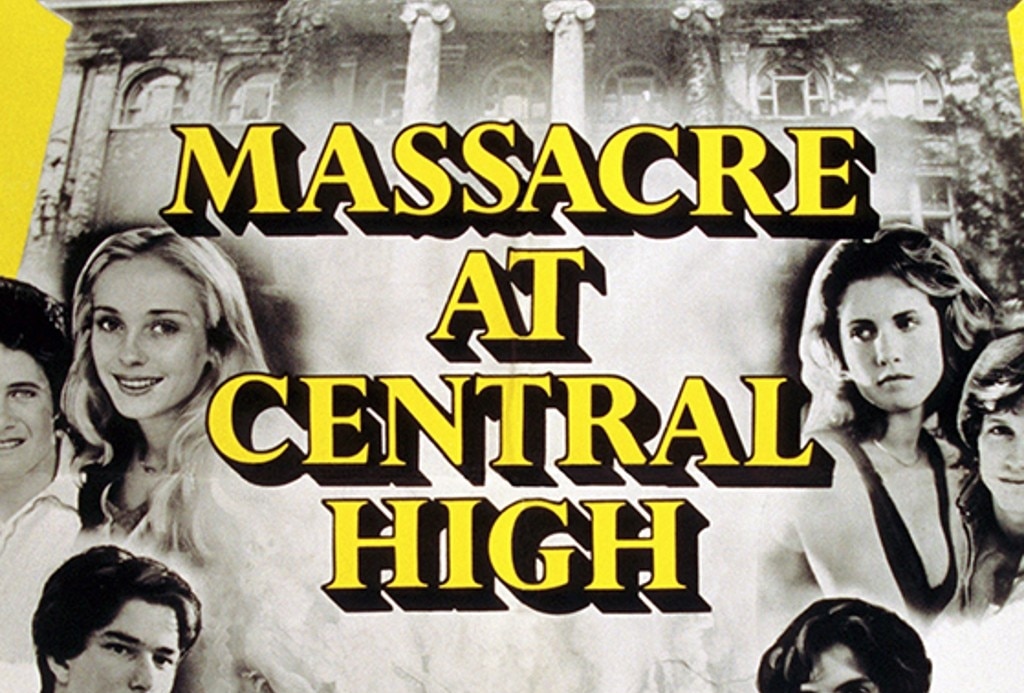
Despite its title, Massacre at Central High (1976) is a politically-charged horror/action examination of modern-day high school life and not a slasher film; in fact, it predates that popular craze by at least two years. Some neo-hack-and-slash films had already been released (most notably 1974's Black Christmas), but this oddball drive-in offering features a surprisingly ambitious and disturbing sensibility which bears little in common with the teens-in-peril hits following in its wake.
Drawing upon such prior films as diverse as Blackboard Jungle (1955) and even 1974's Twisted Brain, our story begins at a typical SoCal high school where new transfer student and track athlete David (Derrel Maury) finds himself entangled with a quartet of bullies: Mark (Andrew Stevens), Bruce (Ray Underwood), Craig (Steve Bond), and Paul (Damon Douglas). The only member to show compassion, his old friend Mark, is also dating pretty Theresa (Kimberly Beck), on whom David has a secret crush. An escalating series of misdeeds by the high school tyrants, including a van joyride gone terribly wrong, begin to push David over the edge as they try to goad him into going along with their amoral after-school activities. Finally a sexual assault on two female students forces David to take a stand and defend those who can't stand up for themselves, with Theresa witnessing his increasingly belligerent behavior.
The stakes escalate when David's track-running dreams are shattered by Bruce who pays him a visit in his garage and releases a car onto one of David's legs, a fate the youth decides to avenge not by going to the police, but by taking out the bullies on his own terms. Unfortunately the now liberated students don't seem as liberated as David would like and become as tyrannical as their oppressors, while Theresa and Mark find themselves in a race against time to save the school from total destruction.
As the synopsis above should already indicate, Dutch-born writer and director Rene Daalder has more on his mind here than offering a parade of T&A and mindless killings. The basic storyline owes most of its structural design to George Orwell's Animal Farm, of all things, and the interjection of fascistic music themes and an avoidance of traditional hero-versus-villain storytelling immediately sets it apart from its ilk.
The common critical and fan comparisons to the revenge fantasy of the same year's Carrie still seem appropriate, particularly since both films seem to exist in some twilight adolescent world where parents are negligible and adults in general fail to set any sort of example with the youths instead speaking dialogue far more advanced than their years might indicate. Several of the actors later claimed to have improvised many of their lines on the spot to spackle over their wooden dialogue, but it's impossible to judge the veracity of this by watching the finished product.
Also like Carrie, Massacre at Central High served as a springboard for a handful of its young actors who went on to subsequent Hollywood projects, albeit on a much smaller scale than De Palma's film. (Inexplicably the actor with the largest and most demanding role, Maury, has remained the most obscure, retiring from the screen in 1985 before making an unexpected resurgence in 2007.) More significantly, the film (perhaps the first in America to depict mass violence in a high school setting) influenced a surprising number of subsequent teen-oriented releases ranging from Allan Arkush's Rock 'N' Roll High School (1979) to Mark Lester's Class of 1984 (1982); however, the most blatant example, Michael Lehmann's Heathers (1988), cleverly riffs on numerous themes and sequences in this film and even quotes it directly during Christian Slater's memorable bomb-blasting finale on the high school steps.
The subsequent Columbine shootings and copycat high school incidents afterwards have now changed the public perception of this film and its successors, which once seemed like lurid, allegorical fantasies but have now taken on the disturbing sheen of cold, newsworthy reality-- less entertainment now than disturbingly prescient visions of adolescent educational terror. Though it first seemed out of step with its successors like Halloween (1978) and Friday the 13th (1980), the thoughtful and ultimately humane undercurrents of Massacre at Central High now make it a worthy discovery for those willing to step outside the usual constraints of traditional horror filmmaking.
Producer: Harold Sobel
Director: Renee Daalder
Screenplay: Renee Daalder
Cinematography: Bert Van Munster
Art Direction: Russell Tune
Music: Tommy Leonetti
Film Editing: Harry Keramidas
Cast: Derrel Maury (David), Andrew Stevens (Mark), Robert Carradine (Spoony), Kimberly Beck (Theresa), Ray Underwood (Bruce), Steve Bond (Craig), Steve Sikes (Rodney), Lani O'Grady (Jane), Damon Douglas (Paul), Dennis Kort (Arthur), Rainbeaux Smith (Mary), Jeffrey Winner (Oscar), Thomas Logan (Harvey).
C-87m.
by Nathaniel Thompson
The Gist (Massacre at Central High) - THE GIST
by Nathaniel Thompson | August 20, 2008
SIGN UP FOR OUR NEWSLETTERS

CONNECT WITH TCM