The Terror of Tiny Town producer Jed Buell (1897-1961) began his show business career as an exhibitor, managing the Orpheum Theater in Denver, Colorado in the early 1900s. While still in his 20s, he moved to Hollywood and joined the famed Keystone Studios as a publicist. Keystone chief Mack Sennett eventually promoted Buell to publicity director for the studio.
Buell left Sennett in 1929 to produce films on his own. He formed Spectrum Pictures, and concentrated on B-Westerns. Poverty Row companies such as Spectrum were production-only entities, and usually relied on other companies for distribution. In addition, they had no guaranteed exhibition outlet. The major studios (MGM, Warner Bros, RKO, etc.) had theater chains, which ensured an exhibition venue for their product; minor Hollywood studios relied on other distribution models, booking theaters by region on a "states rights" basis at significantly reduced rental rates.
A year before he tested the Western conventions by populating a film with Little People, Jed Buell and Spectrum Pictures challenged the genre with Harlem on the Prairie (1937). For this film, Buell took a standard Western singing cowboy script, but cast it with an all-African-American cast, hiring Big Band singer Herb Jeffries to play the crooning cowboy hero. (Jeffries was known as the "Bronze Buckaroo" and for a brief period had simultaneous careers as both a movie actor and a singer in Duke Ellington's band).
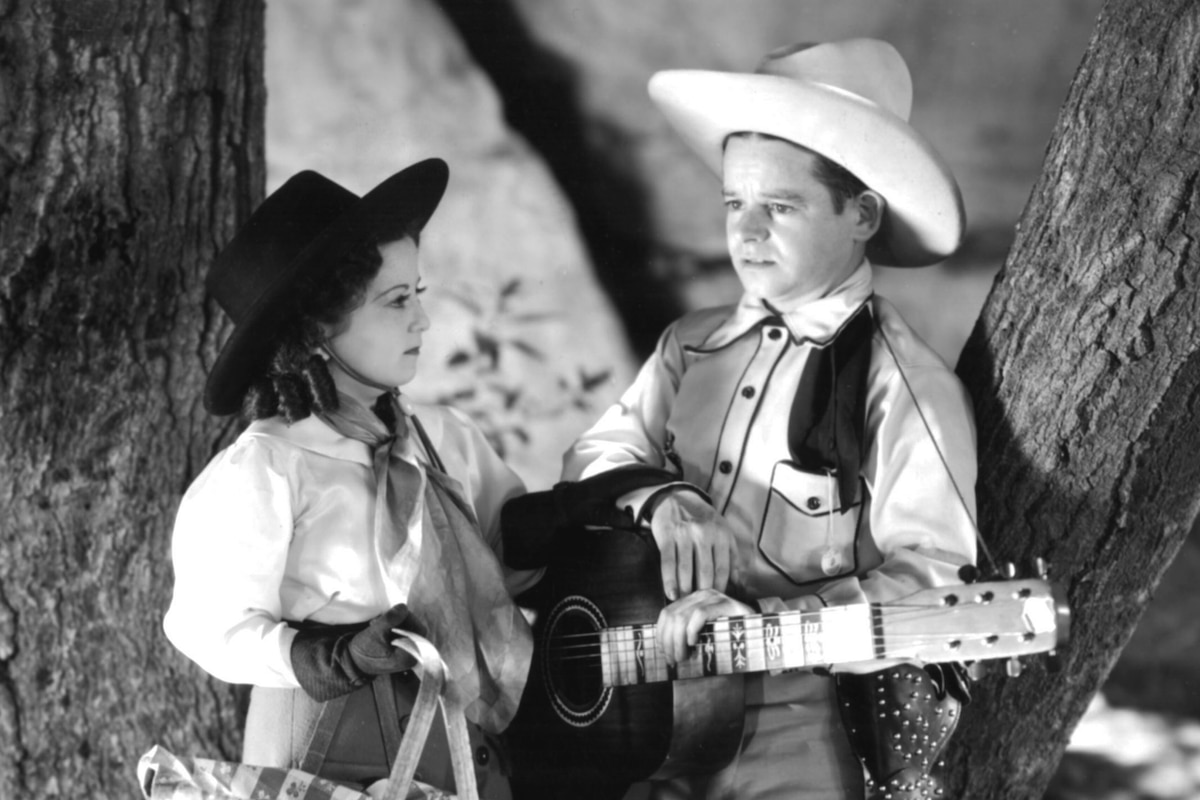
The credits for The Terror of Tiny Town prominently list "Jed Buell's Midgets." This implies a long-formed troupe, but actually this film is the only place to find this credit. Buell recruited Little People from many quarters, but the bulk of the cast was actually brought in from members of a European troupe known as "Singer's Midgets." Many in the cast were soon hard at work at MGM as Munchkins in Victor Fleming's The Wizard of Oz (1939).
In its August 1, 1938 review of the movie, TIME Magazine indulged in an unusual amount of behind-the-scenes reporting on the making of The Terror of Tiny Town. Here is part of their write-up: "'If this economy drive keeps on, we'll end up using midgets for actors.' To hefty, thrifty movie producer Jed Buell this crack of a subordinate was intended as a reproof. Instead it gave him an idea. Soon he was collecting all the midgets he could reach through agencies, advertisements, radio broadcasts ('big salaries for little people'). They drifted in by twos and threes. From Hawaii came a troupe of 14. At length he had 60 of them, averaging three-feet-eight in height, about 70 lbs., ranging in age from 19 to 65. Meanwhile, his writers turned out a script for a 'rollickin', rootin', tootin', shootin' drama of the Great Outdoors.' On the Lazy A ranch at Santa Susana, Calif., producer Buell started filming the first all-midget photoplay ever made. He had troubles. The flaccid little people tumbled off ponies, had trouble handling man-sized six guns, had attacks of temperament and sunburn. Finally, at a cost of almost $100,000 and many a headache, the film was finished." That last figure the budget is no doubt inflated by several thousand dollars. The shooting locations as noted in The Hollywood Reporter included Newhall and Placerita Canyon in Southern California for the exteriors and International Studios for the interiors.
SOURCES:
"Tradition, Parody, and Adaptation: Jed Buell's Unconventional West" by Cynthia J. Miller, in Hollywood's West: The American Frontier in Film, Television, and History edited by Peter C. Rollins and John E. O'Connor. University Press of Kentucky, 2005.
The 50 Worst Films of All Time by Harry Medved with Randy Dreyfuss. Warner Books, 1978.
b-westerns.com
by John M. Miller
Insider Info (The Terror of Tiny Town) - BEHIND THE SCENES
by John M. Miller | August 20, 2008
SIGN UP FOR OUR NEWSLETTERS

CONNECT WITH TCM