Not many films in the history of motion pictures can claim the exclusive subgenre territory that The Terror of Tiny Town (1938) owns. Since 1938, for better or worse, it remains the only All-Midget Western Musical ever produced. Created as a novelty variation during a string of independently produced B-Westerns, its potential appeal was recognized by Columbia Pictures, who picked it up for wider distribution. The fact that The Terror of Tiny Town remains the only attempt to make an All-Midget Western Musical is an indication that perhaps producer Jed Buell's gamble did not pay off as he had hoped, in spite of the interest from a major studio like Columbia.
Most (but not all) prints of The Terror of Tiny Town open with a pre-credits sequence in which a normal-sized man emerges from behind a curtain to address the audience. By way of introducing this "novelty picture," he explains that it has "everything that a Western should have" but that it is not to be taken too seriously. At this point Little Person Billy Curtis, in character as Buck Lawson, corrects the announcer and points out that, in fact, the picture is serious and that he is The Hero. "Little Billy" Rhodes then emerges, in character as Bat Haines, to be greeted by hisses from the off-screen audience! Looking straight into the camera, the Villain points a gun in our direction, saying, "Who laughed?" The announcer tries to keep the two mortal enemies apart and makes a recommendation to start the movie.
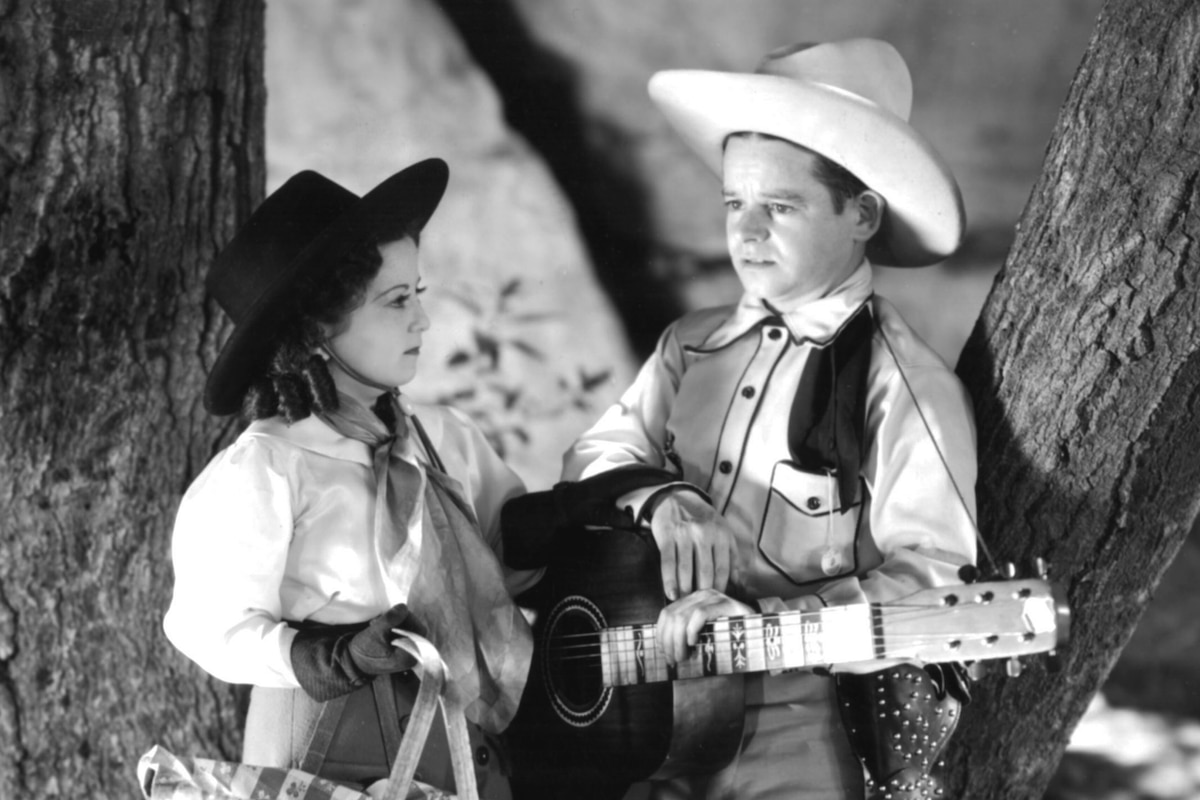
With the unusual nature of the film properly set up, we open on a cheery yet bizarre scene: there is a musical number called "Laugh Your Troubles Away" being performed at the outdoor Tiny Town blacksmith shop. (Clearly filmed on a preexisting Western set, the town itself isn't tiny only the residents are). Joining in on the singing is Buck Lawson (Billy Curtis), dressed in a clean all-white cowboy outfit and hat. Pop Lawson (John Bambury) comes up and tells Buck to check out the ranch for rustlers, because there are calves disappearing. Thus begins what turns out to be a standard B-Western plot: It turns out the rustling is being carried out by black hat-wearing villain Bat Haines ('Little Billy' Rhodes) and his gang. Haines plants a branding iron for Buck to find which implicates Tex Preston (Bill Platt), an old foe of Pop Lawson. As Tex and Pop growl at each other in town at the barbershop, Buck appeals to the town Sheriff (Joseph Herbst) for help. Haines knows that the Sheriff is a former convict, so he has him in his back pocket. Tex awaits the arrival of his niece Nancy (Yvonne Moray) who is due to arrive by stagecoach. The coach is set upon by Haines and his gang, but is rescued by Buck. Nancy and Buck start to fall for each other; since a relationship between the two would bring the Preston and Lawson families together, the evil Haines decides to do something drastic to drive them apart.
Most commentaries, those from 1938 as well as modern ones, go out of their way to comment that The Terror of Tiny Town "plays it straight" by simply placing a cast of Little People into a standard B-Western. However, there are actually several instances where the filmmakers attempt to inject some humor. When we first see the Western town, for example, a couple of ladies are walking along the main storefronts and one can be overheard gossiping, "as I was saying, I never thought that Mrs. Clancy could be so small..." The first time that a cowpoke hitches up his horse and then walks under the hitching post, the moviemakers accent the gag with a loud musical sting. Later, when Tex Preston heads for the barbershop, the camera lingers as he struggles to climb the first step up from the street. (The fact that Preston is played by what must be the oldest, frailest, and most wrinkled midget ever to appear on film sabotages the joke). Finally, the bass singer in the barbershop quartet is played, of course, by the smallest, youngest-looking cast member to heighten the irony.
Cynthia J. Miller writes in Hollywood's West: The American Frontier in Film, Television, and History, "Jed Buell's musical Westerns used parody, gimmickry, and casts of unlikely characters to turn 'the way things ought to be' on its ear. Buell's work might have been unremarkable were it not for the cultural commentary inherent in these small artifacts of moving picture industry history. While elements of all were in keeping with the Western myths and traditions of the day, the success or failure of the unique aspects of Buell's musical Western legacy whether viewed as parody or desperation, exploitation or mutation, the result of genius or greed speaks to the social and cinematic culture of the 1930s."
The Terror of Tiny Town was initially exhibited through various independent exchanges on a states rights basis, which was the standard practice for minor productions like those from Spectrum Pictures. Shortly after its initial release, the film was picked up by major studio Columbia Pictures. Columbia perhaps sensed a market beyond the typical B-Western audience that it could exploit, although Les Adams writes (on b-westerns.com) that "Columbia probably picked it up to fill an unexpected hole in their production schedule, i.e., number of films promised to be delivered to their exchanges for the 1937-38 production season." Columbia printed new posters, lobby cards and pressbook material for the film and redistributed prints through their own theater exchanges. (Adams notes that this was not an uncommon practice a year earlier Columbia had picked up the more routine Heroes of the Alamo [1937], which had been independently produced by Sunset Productions and had already been distributed to several regions of the country).
The Terror of Tiny Town fell into obscurity for decades but returned to prominence in the early 1970s, when it began appearing on the college and midnight movie circuit as a "camp" oddity, along with such other 1930s films as Reefer Madness (aka Tell Your Children 1936) and The Cocaine Fiends (aka The Pace that Kills 1935). The Terror of Tiny Town was also featured in Harry and Michael Medved's condescending books The 50 Worst Films of All Time (1978) and The Golden Turkey Awards (1980).
Producer: Jed Buell
Director: Sam Newfield
Screenplay: Fred Myton; Clarence Marks (additional dialogue)
Cinematography: Mack Stengler
Film Editing: Martin G. Cohn, Richard G. Wray
Music: Lew Porter
Art Direction: Fred Preble
Cast: Billy Curtis (Buck Lawson/The Hero), Yvonne Moray (Nancy Preston/The Girl), 'Little Billy' Rhodes (Bat Haines/The Villain), Bill Platt (Jim 'Tex' Preston/The Rich Uncle), John Bambury (Pop Lawson/The Ranch Owner), Joseph Herbst (The Sheriff), Charles Becker (Otto/The Cook), Nita Krebs (Nita, the dance hall girl/The Vampire), George Ministeri (Armstrong/The Blacksmith), Karl Casitzky (Sammy/The Barber), Johnnie Fern (Diamond Dolly), W.H. O'Docharty (The Old Soak)
BW-62m.
by John M. Miller
The Gist (The Terror of Tiny Town) - THE GIST
by John M. Miller | August 20, 2008
SIGN UP FOR OUR NEWSLETTERS

CONNECT WITH TCM