Sonny Boy originated in the mind of writer Graeme Whifler, a music video director residing at the time in San Francisco. He lived across the street from a biker house whose residents inspired the motley crew of criminals in the film, and they also told him a true story about a kidnapped child raised by a car thief in Indiana who tortured the youth and trained him to be a killer.
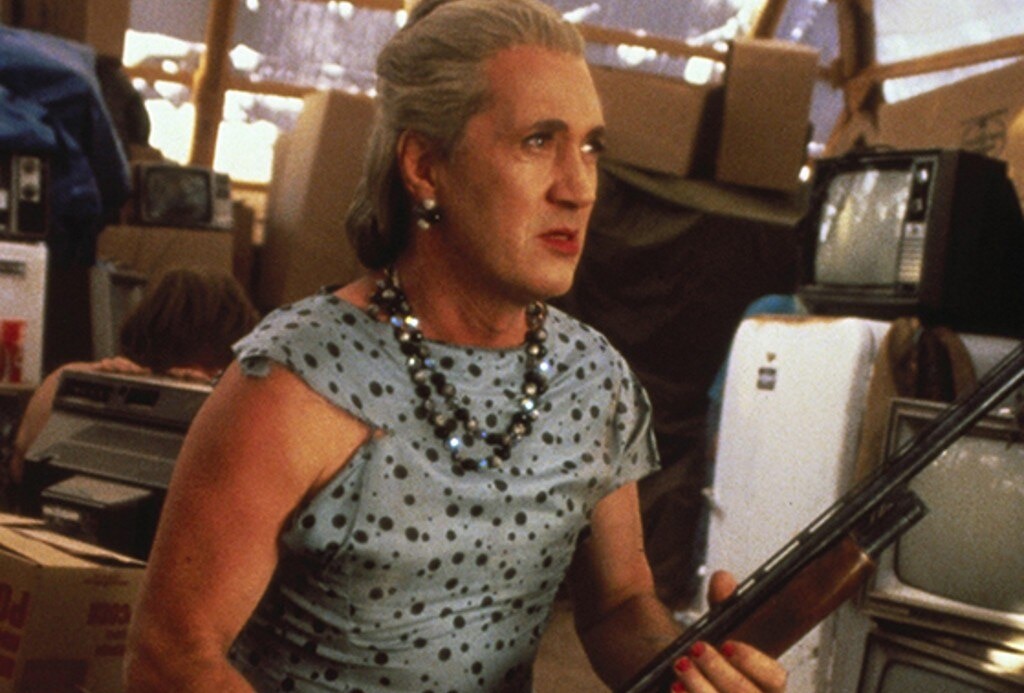
Though the character of Pearl was always intended by its creator as a cross-dressing man, the script makes no mention of his gender confusion. In his original script, Whifler even had the character sporting prosthetic black mammaries, which were slightly adapted for the finished film and almost completely censored out of most prints.
The screenplay of Sonny Boy was picked up by Ovidio G. Assonitis, an Italian producer and occasional director best known for his shameless cash-ins on U.S. box office hits like Beyond the Door (1974) (an Exorcist [1973] imitation), The Visitor (1979) (a delirious mish-mash of films like The Fury [1978] and Close Encounters of the Third Kind [1979]), and Tentacles (1977) (Jaws [1975] with a octopus). At the time Assonitis was busy cranking out numerous films for Trans World Entertainment, who were simultaneously mounting a sequel to his successful H.P. Lovecraft adaptation, The Curse (1987). However, when Whifler approached the producer about directing Sonny Boy himself, the producer balked. "You've got to let me direct this movie," Whifler argued. "If I don't, it's like Blake Edwards directing Blue Velvet [1986]." Assonitis responded, "If Blake Edwards had directed that, it would have made some money."
Instead Assonitis decided to use a director with even less experience, Robert Martin Carroll. The director viewed the project as "a complex film with lots to explore. I knew it was troubling while I made it. I kept asking them what audience they were going for. When they told me not to worry, I didn't. I just went for it. I always like to make complex characters that keep the audience guessing as to what they will do." The script underwent some cosmetic changes including the appearance of Sonny Boy himself, who was a disfigured monster on the written page but in the film became a wide-eyed, normal-looking young man. "I felt it was more of a tragedy if he was beautiful, but being isolated," Carroll explains. "He felt he was ugly because he wanted to look like his parents and they (to us) are hideous."
Sonny Boy was shot entirely in Columbus and Deming, New Mexico. For the climactic conflagration sequence which leads to Sonny's "rebirth," last-minute difficulties arose with the main house location, which was set to be demolished by fire but was saved at the last minute with considerable ensuing script difficulties -- when the owner changed his mind. "They couldn't burn down the house," Dourif explains. "The pyramid is what they burned down and it just didn't make any sense. They needed to burn down the house, because if they burned it you could see him surviving. But no-one could see him surviving that fire. It was just absolutely ridiculous."
Dourif also remembers the affable Carradine as one of the highlights of the shooting experience, terming him "hysterically funny. That was one of the funniest things I've ever seen him do. He was too much and he really did it just right. The thing was, he had false teeth and when he would take them out it was just really funny. And, you know, he's a wonderful musician and he's just fun to be around." Carradine himself referred to the film as a cross between Bonnie and Clyde (1967), Bringing Up Baby (1938) and The Rocky Horror Picture Show (1975) and used his wigs and costumes to convey the passage of time - a Joan Crawford wig for the sixties to a granny bun in the eighties. As Carradine himself notes, "I made the ugliest woman imaginable, except for the old broad, to whom I lent a certain venerable, statuesque beauty."
Paul Smith chose the pivotal role of Slue after seeing the list of actors signed to the project despite having no fondness for the script, simply terming it "really weird." Smith and Carradine were offered the roles of either Slue or Pearl, with Smith obviously opting for the former. According to Dourif, Smith and Carroll did not get along, resulting in significant tension on the set.
Just as Assonitis had cut off the screenwriter from the filming process, the same happened to Carroll after shooting when he was removed from the editing room and his final cut was trimmed down before its limited release. "[After] About a year and a half, I finally got into a screening," recalls Whifler. "I kept whispering 'I'm going to kill this f**king director.' But it was actually the producer's fault; about five or six years later, out of the blue, I got a letter from the director, and he basically said, 'Graeme, I'm really sorry, it wasn't my fault; they told me if I ever tried to call you, I'd be fired.'" A similar process had already occurred in 1981 when Assonitis sidelined director James Cameron on his first film, Piranha II: The Spawning, and completed the film without the director's input in the editing room.
The initial critical response to Sonny Boy was extremely harsh, and audiences proved no more receptive, with theater owners pulling it off screens after only a few days. "Sonny Boy essentially stopped my career," Carroll laments. "While a few people loved it such as Dennis Dermody of Paper Magazine in NY who voted it the Best Film of the Decade in a Village Voice critics poll, many were just disgusted. My agent actually let me go because a famous producer she worked with said she hated it so much that she wouldn't work with her again if she represented me. Wow, that hurt."
Home video editions of Sonny Boy have been very few and far between over the years, and even a fleeting laserdisc release failed to recapture the film's original 2.35:1 scope presentation. A slightly longer version appeared on VHS in the United Kingdom with a handful of additional and extended scenes, most notably Sonny's bloody, teeth-chomping escape from the angry townspeople. However, additional scenes shot by Carroll involving the character of Rose have yet to surface in any release prints.
by Nathaniel Thompson
Sources:
Psychotronic Magazine, Brad Dourif Interview with Dennis Daniel
The Unknown Movies (http://www.badmovieplanet.com/unknownmovies)
Fangoria, "Graeme Whifler's Warped World" by Michael Gingold
Endless Highway, David Carradine (Journey Editions)
"Paul Smith: The Reddest Herring," video interview for Pieces (Grindhouse DVD)
Internet Movie Database
Insider Info (Sonny Boy) - BEHIND THE SCENES
by Nathaniel Thompson | August 20, 2008
SIGN UP FOR OUR NEWSLETTERS

CONNECT WITH TCM