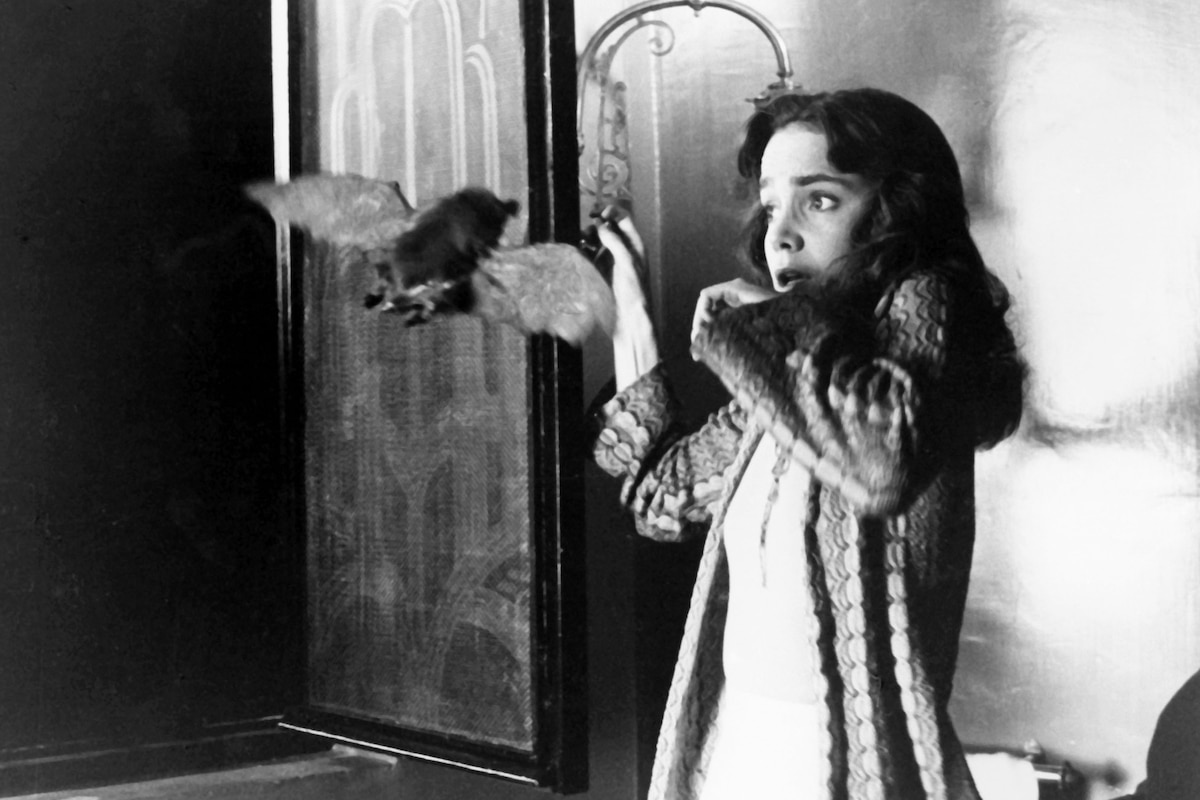
"Dario Argento's grossly overstated mise-en-scene adds some perverse interest to this routine (if unusually gory) horror film from 1976. Argento works so hard for his effects - throwing around shock cuts, colored lights, and peculiar camera angles - that it would be impolite not to be a little frightened."
- Dave Kehr, Chicago Reader
"Mr. Argento's methods make potentially stomach-turning material more interesting than it ought to be."
- Janet Maslin, The New York Times
"Although the narrative is contrived and artificial, Argento's exceptionally skillful use of colour, jagged cutting and good sense of decor, as well as the recourse to a shower of maggots, traps of steel mesh to exsanguinate their victims, razors, and so on, combine to create a hallucinatory atmosphere of terror...Valli's performance is appropriately hieratic and the entire picture culminates in one of the most chillingly efficient sequences of the terror subgenre's brief history."
- The Encyclopedia of Horror Movies, edited by Phil Hardy
"With his sharp eye for the bizarre and for vulgar over-decoration, it's always fascinating to watch; the thrills and spills are so classy and fast that the movie becomes in effect what horror movies seemed like when you were too young to get in to see them. Don't think, just panic."
- Scott Meek, TimeOut Film Guide
"..it's still like taking a bad-acid trip through "Alice in Wonderland," only instead of Alice we've got Jessica Harper drugged with "wine" that has the consistency of blood, and instead of Wonderland we've got the German dance academy run by some groady-looking old ladies who go somewhere every night at 9:30 and leave the innocent little girls in their dorm rooms to try to figure out why giant maggots are dropping out of the ceiling and messing up their hair-dos. This movie is so weird it's impossible to describe, which is why true horror fans rank it with Night of the Living Dead (1968) and The Texas Chainsaw Massacre (1974) as one of the scariest flicks in splatter history. It satisfies the first rule of a drive-in classic: anybody can die at any moment. And the second rule: the innocent must suffer. And the third: the zombies must rise. And it adds a fourth: the music on the soundtrack has to be so nerve-wracking that, even when nothing's happening, it's scary."
- Joe Bob Briggs
"It's a flawed film, to be sure, but it's also one of contemporary horror cinema's most influential and unforgettable works."
- Tim Lucas, Video Watchdog
"Perhaps Dario Argento's most satisfying work both in the conventional terms of the horror genre and in terms of his own extraordinary vision... Suspiria's attraction is its visual splendor and perversely inventive violence."
- Rick Worland, 100 European Horror Films
"Long admired in cult circles, Suspiria stands as one of the most visually striking horror films ever made, and the high watermark of a first-rate splatter stylist."
- Scott Tobias, The Onion AV Club
"This tale of witchcraft at a German dance academy is one of the most beautiful, dream-like horror films ever conceived, and quite simply the crowning achievement of a stylistic master."
- Robert Firsching, Images Journal
"This film about travel is a trip, and one can scarcely write about Suspiria without apologizing, since what makes the film so extraordinary is beyond the grasp of language, not to mention scholarly language... If you have ever talked yourself into a verbal corner trying to put a film, thousands of pictures, into words, you will sympathize with this writer's resort to the old cliché: You've just got to see it!"
- Linda Schulte-Sasse, Kinoeye
"As distinctive in its painterly colors as Val Lewton's horror films were in their expressive swaths of black and white, Suspiria serves up a gorehound's feast of explicit mayhem. But never has gratuitous bloodletting seemed so ornately beautiful."
- Scott Tobias, The Onion A.V. Club
"Argento's visuals actively evoke a fairy-tale fantastique, engaging and toying with the Technicolor glory of Disney's cartoon version of Snow White, a film the director had been obsessed with since youth. Additional elements were filtered into the project from Suspiria de Profundis (Sighs from the Depths), a collection of essays written by Thomas De Quincey (Confessions of an Opium Eater), and Fritz Lang's little-seen The Secret Beyond the Door (1982), a Freudian interpretation of the Bluebeard story from which the Argento film borrows considerably more than the fabulous Joan Bennett."
- Ed Gonzalez, Slant
"Nonstop shocks...A colorful, stylish horror movie with a witch, bats, and totally unexpected elements..."
- Michael Weldon, The Psychotronic Encyclopedia of Film
"...director Argento proved that you don't need a complex plot to scare the bejesus out of people. Atmospheric direction, clever camera work and a creepy score will do the trick (though lashings of violence help too)...Suspenseful, violent fare."
- The Rough Guide to Cult Movies
Compiled by David Kalat
Yea or Nay (Suspiria) - CRITIC REVIEWS OF "SUSPIRIA"
by David Kalat | August 20, 2008
SIGN UP FOR OUR NEWSLETTERS

CONNECT WITH TCM