Suspiria opens with one of horror cinema's most acclaimed introductory sequences, a frontal assault on the senses meant to establish an atmosphere of pervasive menace. It also contains an unintentional joke, for those familiar with German geography. Suzy Bannion arrives at Freiburg Airport and tries to flag a cab for the ride to the Academy, but is rebuffed-a portentous omen. But, there is no airport in Freiburg, a small town near Germany's border with France and Switzerland. In fact, the crew filmed that scene at Munich Airport, some 175 miles from Freiburg. No wonder she can't get a taxi to take her!
The driver of the cab she does ultimately manage to hail is played by Fulvio Mingozzi, one of Dario Argento's regular stock company, who also plays a cab driver in the sequel, Inferno (1980). As Suzy departs the airport, she briefly passes Daria Nicolodi, the film's screenwriter, in a cameo appearance. Nicolodi had written the role of Suzy for herself but had to bow out to make room for a more well known actress who could generate larger international sales.
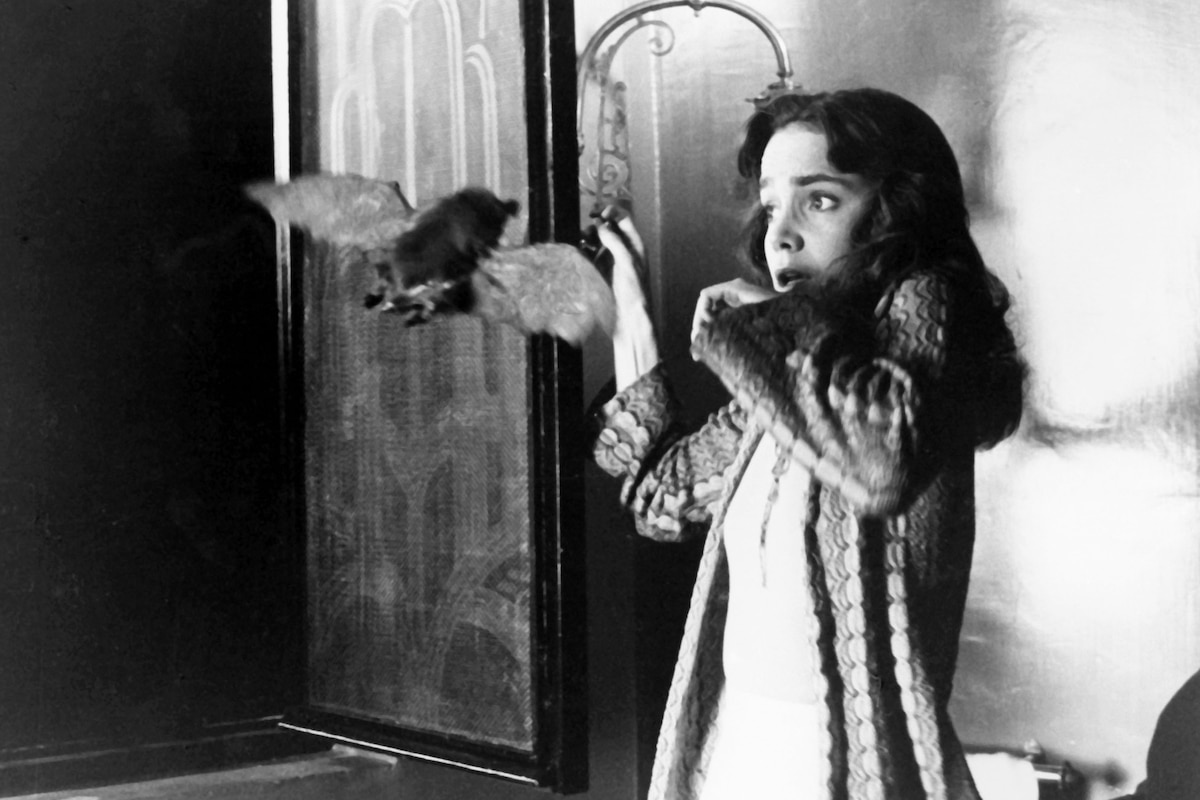
The role instead went to Jessica Harper, who turned down a part in Woody Allen's Annie Hall (1977) in order to battle maggots and bats for Dario Argento. She was delighted to have the chance to play opposite Hollywood Grande Dame Joan Bennett, who would end her long and illustrious screen career with Suspiria . Bennett's dark master, the villainous Elena Marcos, scarcely appears in the film at all, and no credit is given to the woman whose face is seen during Marcos' fleeting appearance in the finale. According to Harper, that old woman was in fact an aged prostitute, whose age Harper estimated at ninety! Meanwhile, the mute Romanian servant Pavlo was cast with a guy Argento found in a nearby Italian post office, whose look the director found imminently compelling.
During its initial run in the United States, Suspiria was distributed by International Classics, a subsidiary of 20th Century Fox. They clipped roughly five minutes of footage from the picture to reduce its gorier aspects, and the uncut version was not seen in America until the late 1980s. The film was successful around the world, even in Asia, where Italian films had not typically found much of an audience. Based on its box office performance, the Japanese distributors quickly imported Argento's previous thriller Deep Red (1975) and sold it as Suspiria Part 2 (one wonders what they did with the real Suspiria Part 2 aka Inferno (1980), when it showed up a few years later).
Suspiria's continued effect on Japanese horror can be seen in Takashi Shimizu's 2004 ghost story The Grudge, which contains a direct reference to the film Shimizu says was one of the most influential he ever saw.
by David Kalat
SOURCES:
Interview with Dario Argento and Daria Nicolodi, Fangoria Issue 35, 1984.
"Dario Argento: An Eye For Horror" documentary by Charles Preece and Janne Schack
Dennis Daniel and Michael Will, "Profondo Rosso: Interview with Dario Argento," Psychotronic Magazine, Issue 18, 1994.
Travis Crawford, Liner notes to DVD release from Blue Underground.
Scott Michael Bosco, Interview with Jessica Harper, from the liner notes to DVD release from Blue Underground, conducted 2000.
"Suspiria 25th Anniversary" documentary, Blue Underground.
Tim Lucas, "Suspiria review," Video Watchdog Issue 46.
Linda Schulte-Sasse, "The 'Mother' of all Horror Movies," Kinoeye Volume 2, Issue 11.
In the Know (Suspiria) - TRIVIA
by David Kalat | August 20, 2008
SIGN UP FOR OUR NEWSLETTERS

CONNECT WITH TCM