Exploitation film director Ray Dennis Steckler (The Thrill Killers, 1964) served as one of the cinematographers on The World's Greatest Sinner and was rumored to have organized the riot sequence.
Steckler also claims that Carey threw a boa constrictor at him while he was in a closet re-loading film for the shoot.
In an interview with Alex de Laszlo for Uno Mas Magazine in 1966, Steckler recalled, "I was living in Tim's garage with two dogs, a boxer named Caesar and some poor old German shepherd...He did run out of money and I stayed with him for as long as I could. We'd shoot a little here and there, and then all of a sudden it became years. He was always good at buying a lot of lunches, he'd always pick up the tab...I think he was kinda hurt that I didn't finish the movie." Steckler further adds, "Tim Carey was having an adventure - whatever happened, he thought it was great. As far as the script goes, it never made sense at the beginning when I read it. He didn't care about that cause he just threw the pages away anyway."
It was reported that director Edgar G. Ulmer (Detour, 1945) was involved in the production of The World's Greatest Sinner at some point.
In an interview for Psychotronic Magazine, Carey revealed how he met and hired his film's musical composer. "When I was working with Debbie Reynolds for the second time (in The Second Time Around, a 1961 western comedy) at 20th Century Fox, a fellow came up to me and complimented me on my acting. He said he was a composer and the guy he came with, his next-door neighbor, played the guitar. I said, 'What's your name?' He said, 'Frank Zappa'. So I said, 'OK, I have something for you. We have no music for The World's Greatest Sinner. If you can supply the orchestra and a place to tape it, you have the job'. And that same time he was on the Steve Allen Show. That's where our friendship stopped. Steve asked him what films he did. He said, 'I did The World's Greatest Sinner, the world's worst film and all the actors were from skid row.' It wasn't true."
The single that Frank Zappa and his band worked on for the film was titled "The World's Greatest Sinner/How's Your Bird", and was recorded under the name Baby Ray and The Ferns. It was released in March, 1963. "Baby Ray" was performed by vocalist Ray Collins. "How's Your Bird" was a phrase that Steve Allen used to say on TV. In 1983, Rhino/Del Fi Records included both sides on Zappa's "Rare Meat" EP.
Zappa was in his early twenties when he wrote the score for The World's Greatest Sinner.
Barreto claims that Carey changed a lot during the filming of The World's Greatest Sinner, and that he was actually becoming the character he portrayed. Barreto remembers, "At first, I only had a few lines, but Tim was so nasty to the bit players that they started quitting the picture. As they disappeared, Tim kept giving me their lines, until I had a big supporting role. Tim became God Hilliard, and we really had God in person on the set. It was very difficult to be with Tim at times."
Most of the The World's Greatest Sinner was shot in El Monte and Long Beach, California from 1958 to 1962.
The World's Greatest Sinner was mostly self-financed from earnings made from Carey's previous films, as well as his frequent guest appearances on television. Carey also received an investment of $25,000 from M.A. Ripps, the producer of another Carey film, Bayou (a.k.a. Poor White Trash, 1957).
Gil Barreto (who plays the gardener in the film) claimed that Carey "kept on shooting until about 1965 and stopped, because he ran out of money and [Ripps] wouldn't give him any more."
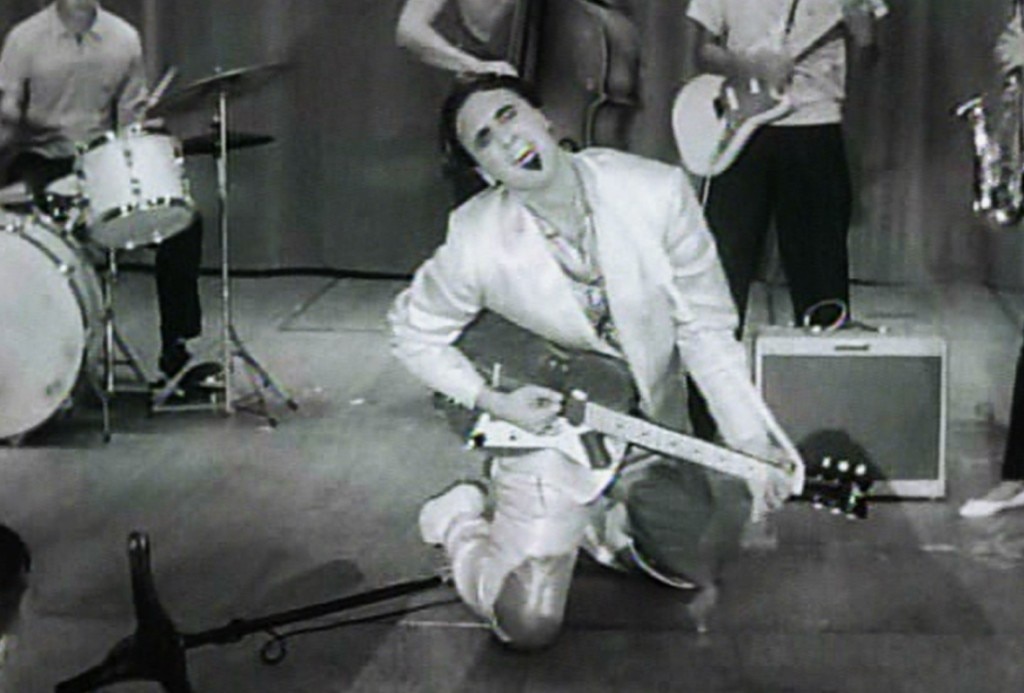
Carey rented the Vista Theater in Hollywood to screen The World's Greatest Sinner. Carey reportedly fired a gun above the heads of the audience before the screening started. He even wore his gold lame suit and went on talk shows in an effort to drum up publicity.
Although The World's Greatest Sinner was officially "released" in 1962, Carey continued re-editing and shooting new scenes for it for the rest of his life. According to an article on Carey by Sam McAbee for Cashiers du Cinemart, Carey said "I'm changing SINNER every second! I took my last cut of the show last year. That's after years and years! I'm not afraid to turn it around. Some people say, 'Oh, this is boring now. That I'm losing my touch 'cause I'm doing too much.' But a creative person can do it a thousand times, five thousand times, and still enjoy it because he's creating each time. You wine and dine something! You don't say, 'OK, it's gonna take me two weeks and that's it.' It's something that's going to be with you for the rest of your life."
On the set of Elvis Presley's last film, Change of Habit (1969), the King reportedly approached Carey (who also had a small part in the film) and asked him for a copy of The World's Greatest Sinner after "hearing good things about it". Carey only had four prints of the film and couldn't give him a copy.
Carey originally hoped to complete The World's Greatest Sinner in time for release on Election Day, 1961.
John Cassavetes once said that The World's Greatest Sinner had "the brilliance of Eisenstein". Carey used his quote to help promote his film but spelled Cassavetes's name wrong in the process.
Carey, on The World's Greatest Sinner: "I was tired of seeing movies that were supposedly controversial. So I wanted to do something that was really controversial."
by Millie de Chirico
Sources:
www.absolutefilms.net
Film Comment, Jan/Feb 2004
Psychotronic Video #6, 1990
FilmFax, issue #56 May/June 1996
Rolling Stone Magazine
www.imdb.com
www.allmovie.com
www.5minutestolive.com
www.ocweekly.com
www.cinematical.com
www.impossiblefunky.com
Insider Info (The World's Greatest Sinner) - BEHIND THE SCENES
August 14, 2008
SIGN UP FOR OUR NEWSLETTERS

CONNECT WITH TCM